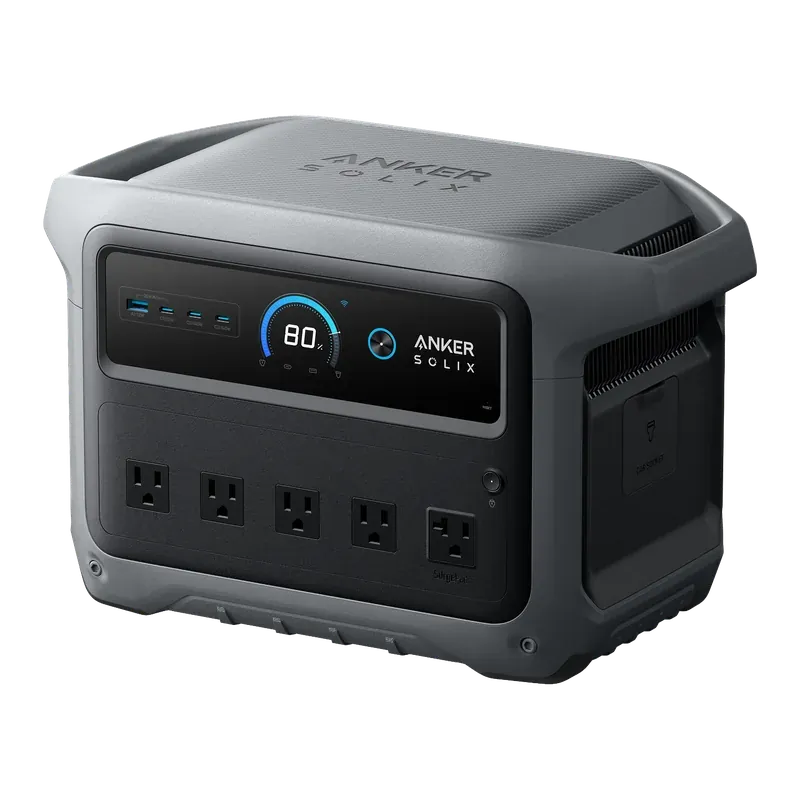
Anker SOLIX C1000 Gen 2
- Capacity
- 1,024 Wh
- Output
- 2,000 W output
- Weight
- 24.9 lb
- Battery
- LiFePO4
We may earn a commission if you buy through these links. It doesn’t change your price. How we make money

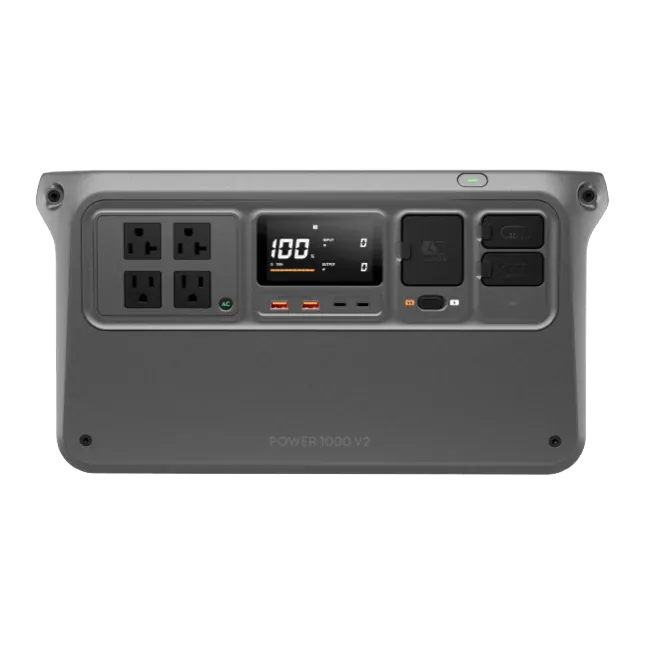
The DJI Power 1000 V2 is a 1,024 Wh LiFePO4 station with an unusually strong 2,600 W output, four AC outlets and two 140 W USB-C ports. It refills from the wall in 56 minutes, switches to battery in 10 ms as a UPS, and grows to 11,264 Wh with five expansion batteries. The trade-offs: there is no car socket, and solar needs a DJI add-on (1,800 W with the Super Fast Charger, 400 W with the MPPT module).
We may earn a commission if you buy through these links. It doesn’t change your price. How we make money
On a full charge it keeps a full-size fridge going for about 19 hours and a Starlink dish for about 9.5 hours. A desktop gaming PC gets about 2.5 hours. It cannot start a 1/2 HP well pump or a garage door opener, because both can need more than its 2,600 W limit at start-up.
One device at a time, from a full charge. Devices that cycle on and off (fridges, freezers, heaters, pumps) use their average draw.
Battery Wh × 0.85 ÷ the device’s average watts. “Can’t run it” means the device needs more than 2,600 W or a start-up surge above 2,600 W. Try your own mix in the calculator.
A full answer for each device on the DJI Power 1000 V2: hours, start-up surge and other units to consider.
Think of this as a home backup unit that you can still move. Its 2,600 W of continuous output is the most of any 1,024 Wh station on this site, so an 1,875 W hair dryer runs at full heat and an 1,800 W induction burner has room to spare. It can also grow further than any of them: up to 11,264 Wh with five expansion batteries, about nine days of fridge power.
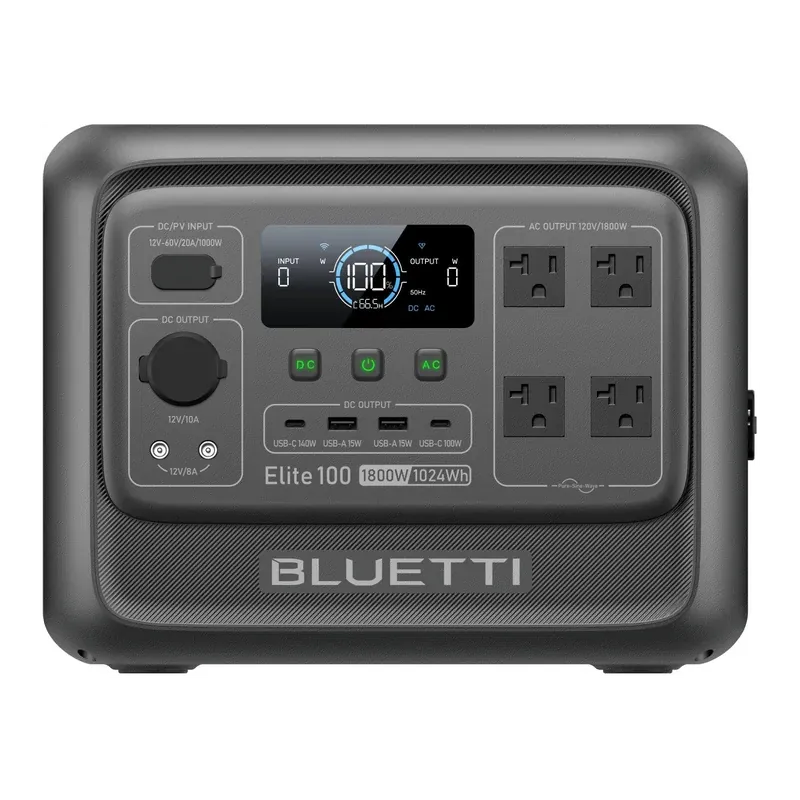
Surge is the trade-off. DJI lists no surge rating above the 2,600 W output, while the DELTA 3 and Elite 100 V2 handle 3,600 W. A fridge, a sump pump or an 8,000 BTU window AC starts fine. Hard-starting motors like a 1/2 HP well pump (about 3,000 W to start) do not. It is also the heaviest 1,024 Wh unit here, at 31.3 lb in a long 17.6 in case.
It is built for the house more than the campsite. There is no 12V car socket, and DC power needs DJI’s SDC accessories. Solar panels need a DJI add-on too: the Super Fast Charger takes up to 1,800 W, and the basic MPPT module 400 W. Budget for one if you plan to charge from the sun. On the plus side, it is rated at about 26 dB, quiet enough for a bedroom or home office.

1,024 Wh · 1,800 W output · 27.6 lb
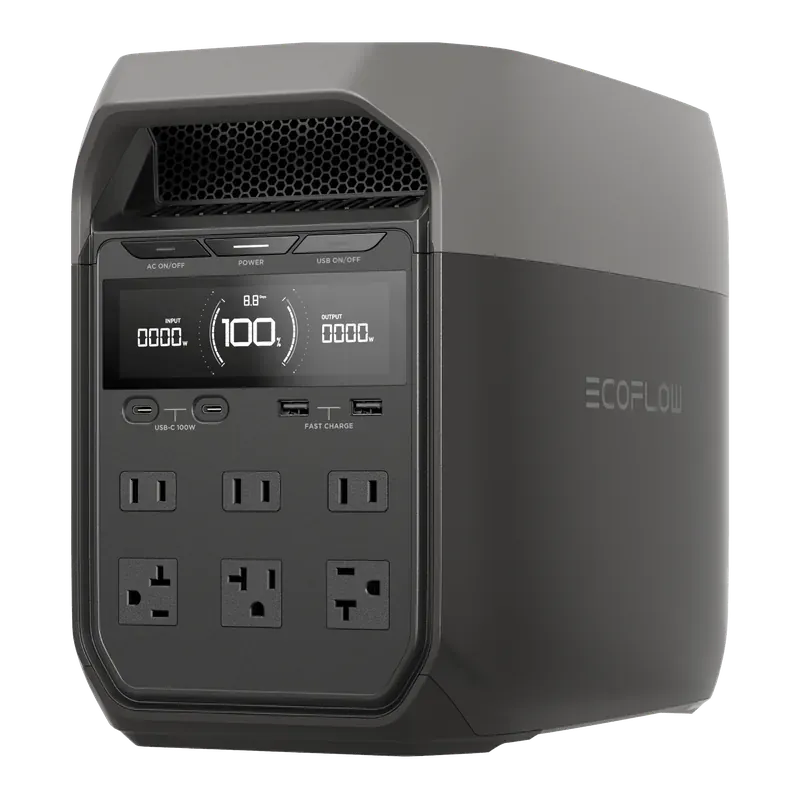
Pick the DELTA 3 Plus for camping or van life. It has two built-in solar inputs (1,000 W total), a car socket, three 12V outputs and a 3,600 W surge that starts a well pump or garage door opener. It weighs 27.6 lb but stops at 5,000 Wh of expansion.
2,048 Wh · 3,000 W output · 48.5 lb
Pick the DJI Power 2000 if you want twice the battery from day one. It holds 2,048 Wh, puts out 3,000 W with a 3,600 W surge, and expands to 22,528 Wh. At 48.5 lb, it is a unit you set in place and leave.
| Spec | DJI Power 1000 V2 |
|---|---|
| Capacity | 1,024 Wh |
| AC output (continuous) | 2,600 W |
| Surge | 2,600 W |
| Boost mode (heaters, kettles) | None |
| Battery type | LiFePO4 |
| Cycle life (rated) | 4,000 (to 80%) |
| Weight | 31.3 lb |
| Wall charge time | 56 min (Fast Recharge mode; 0–80% in 37 min) |
| Max solar input | 1,800 W (needs add-on) |
| AC outlets | 4 |
| USB-C ports (max) | 2 (140 W) |
| USB-A ports | 2 |
| 12V / car port | No |
| Expandable | Yes, up to 11,264 Wh |
| UPS switch-over | 10 ms |
| App control | Yes |
| Size | 17.6 x 8.9 x 9.1 in |
| Released | 2025 |
| Typical price | $340–$450 |
Needs add-on: solar charging on that unit needs a separate charger from the brand, sold separately. The figure shown is the best case with that add-on, so we don’t highlight a winner in that row.
Specs come from the maker’s own pages, checked . Runtimes use our own watt-hour math. How we pick

We may earn a commission if you buy through these links. It doesn’t change your price. How we make money

We may earn a commission if you buy through these links. It doesn’t change your price. How we make money

We may earn a commission if you buy through these links. It doesn’t change your price. How we make money
On the BLUETTI AC180 (1,152 Wh), runtimes go from about 40 min for a microwave (1000 W) to about 39 hrs for a Wi-Fi router + cable modem, each running by itself.
Swipe sideways to see every device →
| Power station | CPAP with heated humidifier 34 W average | Wi-Fi router + cable modem 25 W average | Full-size refrigerator 150 W running, about 45 W average | 55-inch LED TV 90 W average | Microwave (1000 W) 1,500 W average |
|---|---|---|---|---|---|
| Goal Zero Yeti 1000 (6th Gen) 998 Wh | 25 hrs | 34 hrs | 19 hrs | 9.5 hrs | 35 min |
| DJI Power 1000 V2 1,024 Wh | 26 hrs | 35 hrs | 19 hrs | 9.5 hrs | 35 min |
| Jackery Explorer 1000 v2 1,070 Wh | 27 hrs | 36 hrs | 20 hrs | 10 hrs | 35 min |
| BLUETTI AC180 1,152 Wh | 29 hrs | 39 hrs | 22 hrs | 11 hrs | 40 min |
Estimates: battery Wh × 0.85 ÷ the device’s average draw. Real runtime depends on temperature, battery age and how hard the device works.