
Best power station for a CPAP in 2026
As an Amazon Associate, BlackoutWise earns from qualifying purchases. We may also earn a commission when you buy through brand store links. This never changes the price you pay or which products we recommend. How we make money
Our top pick for a CPAP is the BLUETTI Elite 100 V2. Its 1,024 Wh battery runs a CPAP with the humidifier and heated tube on for about 26 hours, roughly three nights, and it switches to battery in 10 ms when the power cuts out. It usually sells for under $500.
A CPAP is one of the easiest things to back up. A ResMed AirSense 10 uses about 34 W with the humidifier and heated tube on, and about 7 W with the humidifier off. There is no motor surge to worry about, so every station here can run it. What you are really choosing is how many nights you get, how fast the station refills, and whether it keeps your machine running without a blip when the lights go out.
We do not test units ourselves. These picks come from the official spec sheets and manuals, the watt-hour math on this site, and prices we check by hand. Runtimes assume about 15% is lost in the inverter, so treat them as estimates for your own machine and settings. See how we pick.
Quick picks
- 1. Best overall: BLUETTI Elite 100 V21,024 Wh · 1,800 W · $380–$500
- 2. Fastest recharge: Anker SOLIX C1000 Gen 21,024 Wh · 2,000 W · $400–$600
- 3. Lightest: EcoFlow RIVER 3 Plus286 Wh · 600 W · $180–$300
- 4. Best for long outages: Anker SOLIX C2000 Gen 22,048 Wh · 2,400 W · $700–$900
- 5. Best for solar recharging: EcoFlow DELTA 3 Plus1,024 Wh · 1,800 W · $550–$800
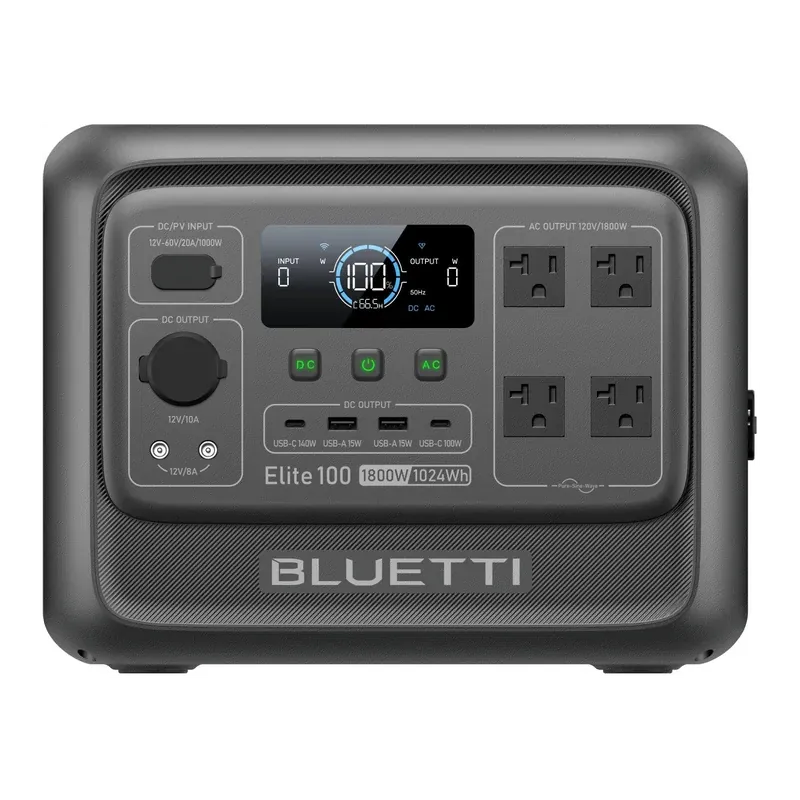
BLUETTI Elite 100 V2
$380–$500 · price checked
- Capacity
- 1,024 Wh
- Output
- 1,800 W (3,600 W surge)
- Battery
- LiFePO4, 4,000 cycles
- Weight
- 25 lb
- Wall charge
- 1 h 10 min
- Solar input
- 1,000 W
Why it won: With the humidifier and heated tube on, the 1,024 Wh battery lasts about 26 hours, or three 8-hour nights. With the humidifier off, the same charge stretches to about 124 hours, or about 15 nights. It has a 10 ms UPS switch-over, a 12V car-style socket for a DC CPAP cord, refills from the wall in about 70 minutes and usually costs under $500.
Skip it if: At 25 lb it is too heavy to pack for a trip where you carry your bags. It also cannot take extra batteries, so it will not grow with you if your outages get longer.
- 1,800 W output runs most kitchen appliances one at a time
- Full recharge from a wall outlet in about 70 minutes
- 25 lb, much lighter than the older AC180
- 4,000-cycle battery rated for about 10 years of use
- Cannot add extra batteries
- 1,024 Wh will run a fridge for roughly a day, not several days
- Reaching the full 1,000 W solar input takes several panels
We may earn a commission if you buy through these links. It doesn’t change your price. How we make money
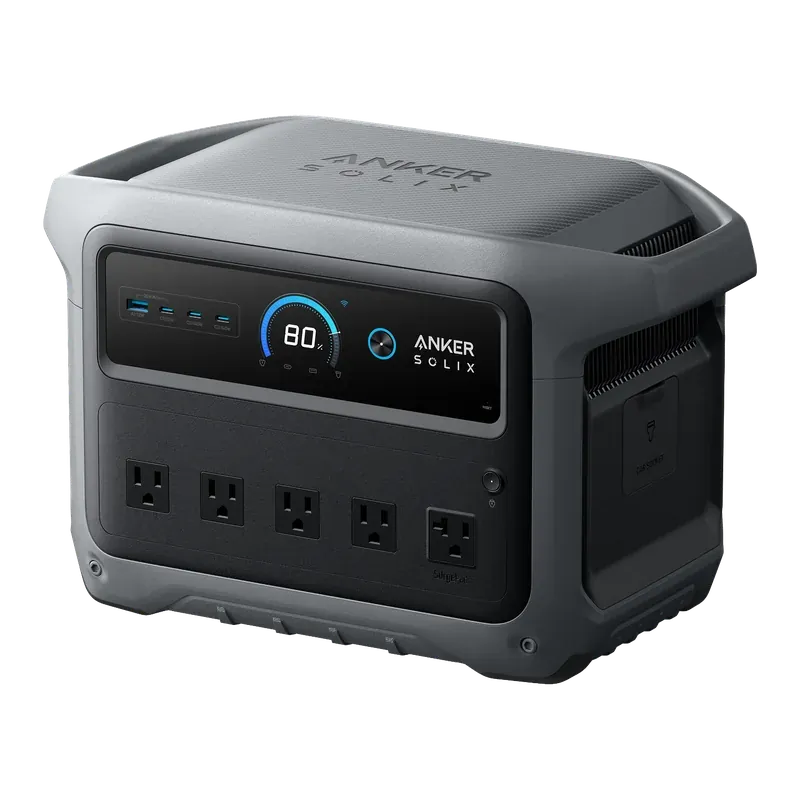
Anker SOLIX C1000 Gen 2
$400–$600 · price checked
- Capacity
- 1,024 Wh
- Output
- 2,000 W (3,000 W surge)
- Battery
- LiFePO4, 4,000 cycles
- Weight
- 24.9 lb
- Wall charge
- 49 min
- Solar input
- 600 W
Why it won: It has the same 1,024 Wh as our top pick and the same three heated nights, but it refills from a wall outlet in about 49 minutes with UltraFast charging turned on in the app. That matters when the power comes back for an hour between outages. It also has a 10 ms UPS, five AC outlets and a 24.9 lb body.
Skip it if: The 49-minute charge needs the app and a battery above 68°F, so it is slower in a cold garage. It often costs a bit more than the Elite 100 V2, and it cannot add extra batteries.
- 2,000 W output runs a fridge, microwave or space heater
- Refills from empty in under an hour from a wall outlet
- 10 ms UPS switch-over protects a CPAP or computer
- 4,000-cycle LiFePO4 battery in a compact 24.9 lb body
- Capacity cannot be expanded, unlike the older C1000
- Only one USB-A port
- The 49-minute charge needs the app and a battery above 68°F
We may earn a commission if you buy through these links. It doesn’t change your price. How we make money
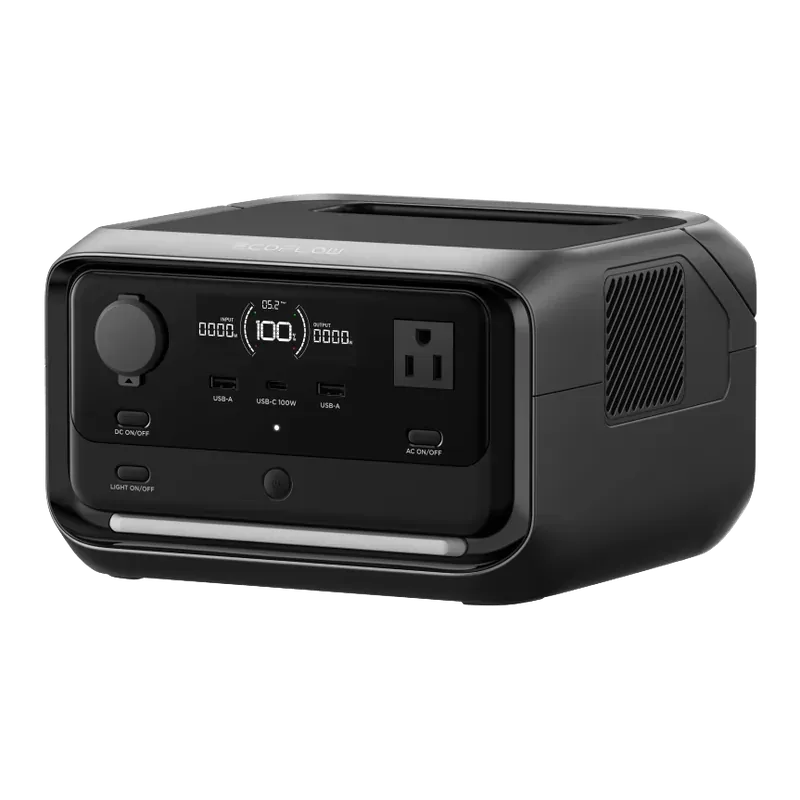
EcoFlow RIVER 3 Plus
$180–$300 · price checked
- Capacity
- 286 Wh
- Output
- 600 W (1,200 W surge)
- Battery
- LiFePO4, 3,000 cycles
- Weight
- 10.4 lb
- Wall charge
- 1 h
- Solar input
- 220 W
Why it won: At 10.4 lb, this is the one to pack for a camping trip or a cabin with shaky power. On its own, the 286 Wh battery runs a CPAP with the humidifier off for about 35 hours, a little over four nights, and it has a 10 ms UPS. Snap on an EB300 or EB600 extra battery and it grows to 858 Wh, enough for about 21 hours with the heated tube on, or about two and a half nights.
Skip it if: Skip it as your only home backup if you need the heated humidifier. One charge runs it for about 7 hours, just short of a full 8-hour night.
- Light enough to carry one-handed at 10.4 lb
- Refills from a wall outlet in about an hour
- 10 ms UPS switch-over keeps a router, modem or CPAP running through a flicker
- Snap on an EB300 or EB600 extra battery to reach 858 Wh
- 286 Wh only runs small loads for a few hours
- 600 W limit rules out most kitchen appliances and space heaters
- Only one USB-C port
We may earn a commission if you buy through these links. It doesn’t change your price. How we make money
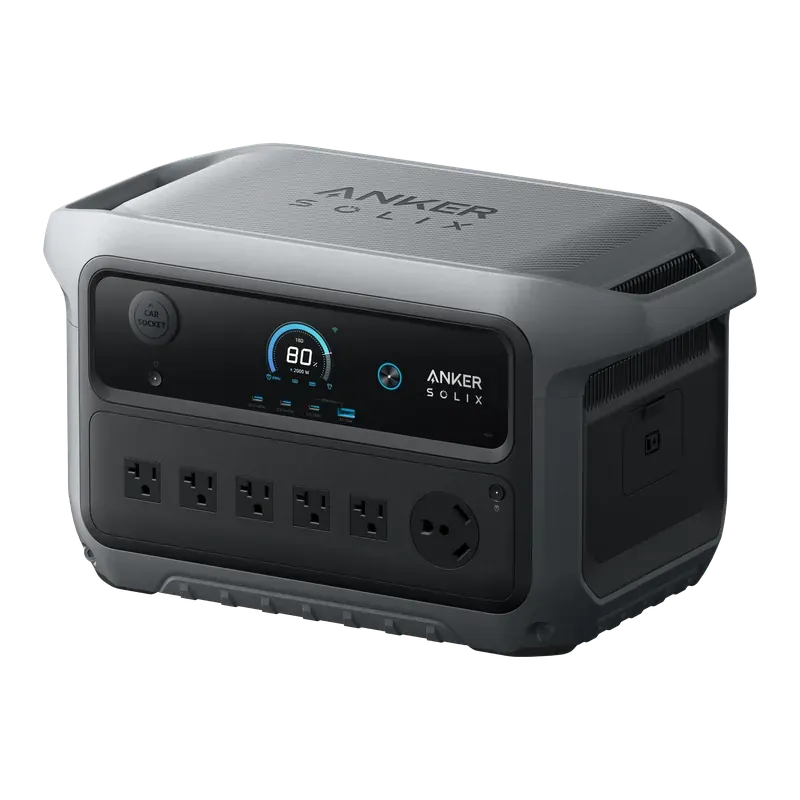
Anker SOLIX C2000 Gen 2
$700–$900 · price checked
- Capacity
- 2,048 Wh
- Output
- 2,400 W (4,000 W surge)
- Battery
- LiFePO4, 4,000 cycles
- Weight
- 41.7 lb
- Wall charge
- 1 h 28 min
- Solar input
- 800 W
Why it won: The 2,048 Wh battery runs a heated CPAP for about 51 hours, roughly six nights, and a CPAP with the humidifier off for about a month of nights. One BP2000 Gen 2 battery doubles it to 4,096 Wh, close to 13 heated nights. It has a 10 ms UPS and 2,400 W of output, enough to run a fridge on the side.
Skip it if: At 41.7 lb it is not something you move to the bedroom every night. If you only need to cover one or two nights, a 1,024 Wh unit costs hundreds less.
- 2,400 W output with 4,000 W peak handles most kitchen appliances
- Built-in TT-30 outlet plugs straight into an RV
- Expands to 4,096 Wh with one BP2000 Gen 2 battery
- 10 ms UPS switch-over protects a router or computer
- 41.7 lb, a two-hand carry
- Only one USB-A port
- List price is much higher than typical sale prices, so wait for a sale
We may earn a commission if you buy through these links. It doesn’t change your price. How we make money
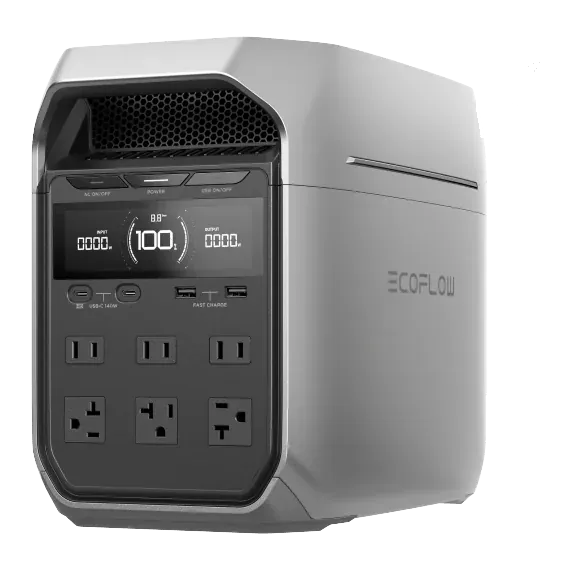
EcoFlow DELTA 3 Plus
$550–$800 · price checked
- Capacity
- 1,024 Wh
- Output
- 1,800 W (3,600 W surge)
- Battery
- LiFePO4, 4,000 cycles
- Weight
- 27.6 lb
- Wall charge
- 56 min
- Solar input
- 1,000 W
Why it won: Two solar inputs take up to 1,000 W total, so with enough panels and good sun you can refill the 1,024 Wh battery between nights during a long outage. It runs a heated CPAP for about three nights per charge, has a 10 ms UPS and 140 W USB-C ports for a laptop, and expands to 5,000 Wh with DELTA extra batteries.
Skip it if: If you will never use solar panels, the cheaper DELTA 3 has the same battery and output. At 27.6 lb it is also a two-hand carry.
- Two solar inputs take up to 1,000 W total (500 W each) for fast off-grid refills
- 140 W USB-C ports charge big laptops at full speed
- 10 ms UPS switch-over suits NAS drives, routers and medical devices
- Full recharge from a wall outlet in 56 minutes
- Same 1,024 Wh capacity as the cheaper DELTA 3
- 27.6 lb and roughly the size of a carry-on bag
- The extra cost over the DELTA 3 buys ports and solar, not capacity
We may earn a commission if you buy through these links. It doesn’t change your price. How we make money
How many nights each pick lasts
On the Anker SOLIX C2000 Gen 2 (2,048 Wh), runtimes go from about 6 nights for a CPAP with heated humidifier to about 31 nights for a CPAP (no humidifier), each running by itself.
| Power station | CPAP with heated humidifier 34 W average | CPAP (no humidifier) 7 W average |
|---|---|---|
| BLUETTI Elite 100 V2 1,024 Wh | 3 nights (26 hrs) | 15 nights (5 days) |
| Anker SOLIX C1000 Gen 2 1,024 Wh | 3 nights (26 hrs) | 15 nights (5 days) |
| EcoFlow RIVER 3 Plus 286 Wh | Under 1 night (7 hrs) | 4 nights (35 hrs) |
| Anker SOLIX C2000 Gen 2 2,048 Wh | 6 nights (2 days) | 31 nights (10 days) |
| EcoFlow DELTA 3 Plus 1,024 Wh | 3 nights (26 hrs) | 15 nights (5 days) |
Estimates: battery Wh × 0.85 ÷ the device’s average draw, with 8 hours of use a night. Real runtime depends on temperature, battery age and how hard the device works.
Other things you might plug in, in hours
On the Anker SOLIX C2000 Gen 2 (2,048 Wh), runtimes go from about 3 days for a Wi-Fi router + cable modem to about 8 days for an LED light bulb (9 W), each running by itself.
Swipe sideways to see every device →
| Power station | Wi-Fi router + cable modem 25 W average | Smartphone charging 20 W running, about 12 W average | LED light bulb (9 W) 9 W average |
|---|---|---|---|
| BLUETTI Elite 100 V2 1,024 Wh | 35 hrs | 3 days | 4 days |
| Anker SOLIX C1000 Gen 2 1,024 Wh | 35 hrs | 3 days | 4 days |
| EcoFlow RIVER 3 Plus 286 Wh | 9.5 hrs | 20 hrs | 27 hrs |
| Anker SOLIX C2000 Gen 2 2,048 Wh | 3 days | 6 days | 8 days |
| EcoFlow DELTA 3 Plus 1,024 Wh | 35 hrs | 3 days | 4 days |
Estimates: battery Wh × 0.85 ÷ the device’s average draw. Real runtime depends on temperature, battery age and how hard the device works.
Runtime on every station, one device at a time
Specs side by side
Swipe sideways to see every column →
| Spec | BLUETTI Elite 100 V2 | Anker SOLIX C1000 Gen 2 | EcoFlow RIVER 3 Plus | Anker SOLIX C2000 Gen 2 | EcoFlow DELTA 3 Plus |
|---|---|---|---|---|---|
| Capacity | 1,024 Wh | 1,024 Wh | 286 Wh | 2,048 Wh (better) | 1,024 Wh |
| AC output (continuous) | 1,800 W | 2,000 W | 600 W | 2,400 W (better) | 1,800 W |
| Surge | 3,600 W | 3,000 W | 1,200 W | 4,000 W (better) | 3,600 W |
| Boost mode (heaters, kettles) | 2,700 W | None | 1,200 W | None | 2,200 W |
| Battery type | LiFePO4 | LiFePO4 | LiFePO4 | LiFePO4 | LiFePO4 |
| Cycle life (rated) | 4,000 (to 80%) | 4,000 (to 80%) | 3,000 (to 80%) | 4,000 (to 80%) | 4,000 (to 80%) |
| Weight | 25 lb | 24.9 lb | 10.4 lb (better) | 41.7 lb | 27.6 lb |
| Wall charge time | 1 h 10 min (0–100% with TurboBoost; 80% in 45 min) | 49 min (with UltraFast mode turned on in the app) (better) | 1 h (0–100% from a wall outlet) | 1 h 28 min (0–100% from a wall outlet alone) | 56 min (0–100%; about 80% in 30–40 min) |
| Max solar input | 1,000 W | 600 W | 220 W | 800 W | 1,000 W |
| AC outlets | 4 | 5 | 3 | 5 | 6 (better) |
| USB-C ports (max) | 2 (140 W) | 3 (140 W) | 1 (100 W) | 3 (140 W) | 2 (140 W) |
| USB-A ports | 2 | 1 | 2 | 1 | 2 |
| 12V / car port | Yes (3 DC ports) | Yes (1 DC ports) | Yes (1 DC ports) | Yes (1 DC ports) | Yes (3 DC ports) |
| Expandable | No | No | Yes, up to 858 Wh | Yes, up to 4,096 Wh | Yes, up to 5,000 Wh |
| UPS switch-over | 10 ms | 10 ms | 10 ms | 10 ms | 10 ms |
| App control | Yes | Yes | Yes | Yes | Yes |
| Size | 12.6 x 8.5 x 9.8 in | 15.1 x 8.2 x 9.6 in | 9.2 x 9.1 x 5.8 in | 18.1 x 9.8 x 10.1 in | 15.7 x 8.0 x 11.2 in |
| Released | 2025 | 2025 | 2025 | 2025 | 2024 |
| Typical price | $380–$500 | $400–$600 | $180–$300 (better) | $700–$900 | $550–$800 |
Related comparisons
Torn between two of these? Each comparison gives a verdict, specs and runtimes side by side.
How much battery does a CPAP need per night?
Start with your settings. With the humidifier and heated tube on, an AirSense 10 uses about 34 W, so an 8-hour night is about 272 Wh. Add about 15% for inverter loss and you need roughly 320 Wh of battery per night. With the humidifier on but the heated tube off, it uses about 22 W. With the humidifier off, it is about 7 W.
Here is a worked example. Say you want to cover a two-night outage with the humidifier and heated tube on. That is two nights of 272 Wh, or 544 Wh at the machine, and about 640 Wh of battery once you allow for losses. A 286 Wh unit falls short. A 1,024 Wh unit covers it with room left for phones and a lamp, and a 2,048 Wh unit gets you through about six nights.
Your own machine may use more or less. Higher pressure settings and bilevel machines draw a little more, and a cold bedroom makes the humidifier work harder. If your supplier can give you a measured number for your model, use that. The 53 W typical and 104 W peak printed for the AirSense 10 are power supply ratings, not what it draws all night.
What features matter in a power station for a CPAP?
UPS switch-over comes first. Most CPAP users want the machine to keep running if the power cuts out while they sleep. Every pick here lists a 10 ms switch-over, so the station takes over almost at once when wall power drops. Leave the station plugged into the wall with the CPAP plugged into the station. Try it once while you are awake: pull the station's wall plug and make sure the CPAP keeps running.
Next is a 12V option. Many CPAP makers sell a 12V DC cord or converter for their machines. Plugged into the station's car-style socket, it skips the inverter, which wastes roughly 10% to 15% of the battery as heat. Get the cord your CPAP maker approves for your model, not a generic adapter. All five picks have a car-style socket.
Battery type and weight matter too. Every pick uses LiFePO4 cells rated for 3,000 to 4,000 cycles, which is many years of nightly use, and this chemistry handles heat better than older NMC packs. Weight matters if the station lives in a closet and comes out for each storm. A 25 lb unit is easy for most people to move. A 40 lb unit is not.
If your outages last days, look at solar input and expandability. The RIVER 3 Plus grows to 858 Wh, the DELTA 3 Plus to 5,000 Wh and the C2000 Gen 2 to 4,096 Wh. The DELTA 3 Plus and the Elite 100 V2 take the most solar of the five, up to 1,000 W each.
Mistakes to avoid
Buying for the power brick, not the machine. People see 104 W on the CPAP power supply and buy a huge station. With every heater on, the machine uses about a third of that.
Forgetting about the humidifier. The heated tube and humidifier use most of the energy. A 286 Wh station that lasts four nights with the humidifier off will not finish one night with the heated tube on.
Storing it empty. A station that sat at 20% in a closet will not help at 2 a.m. Keep it topped up, or better, keep it plugged in and use it as a UPS every night. Also skip power strips and long, thin extension cords. Plug the CPAP straight into the station.
Safety
A power station should never be the only backup for a CPAP or any equipment you rely on to breathe. If missing a night of therapy is dangerous for you, talk to your doctor and equipment supplier about a plan, and register with your utility's medical-needs program so they know you depend on power.
Keep the station on a hard, dry surface with space around it for airflow, not under bedding or against a heater. Refill the humidifier tank away from the station so water does not drip on it. Do not cover the vents, and do not charge it inside a closed cabinet.
Battery stations burn no fuel, so they are safe to use in a bedroom. A gas generator is not. Never run one inside, in a garage or near an open window.
How can you get more nights from one charge?
Turn off the heated tube first. On an AirSense 10 that drops use from about 34 W to about 22 W, which turns three nights on a 1,024 Wh station into about five.
If it is comfortable for you, turn the humidifier off during an outage. That cuts use to about 7 W, and a 1,024 Wh station then lasts about 15 nights. Ask your supplier first if you rely on humidity to avoid a dry nose or mouth.
Use your maker's 12V cord if there is one, charge phones from USB ports, and switch off the AC outlets when nothing needs them, since an idle inverter still uses some power. Recharge the station any time the power comes back, even for an hour, so each night starts as full as possible.
Common questions
- How long will a power station run a CPAP?
- It depends on the battery and your humidifier. With the humidifier and heated tube on, a CPAP uses about 34 W, so a 1,024 Wh station lasts about 26 hours, roughly three nights. With the humidifier off it uses about 7 W, and the same station lasts about 15 nights.
- Can a 300 Wh power station run a CPAP all night?
- Yes, with the humidifier off. At about 7 W, a 286 Wh unit runs a CPAP for about 35 hours, more than four nights. With the humidifier and heated tube on, it lasts about 7 hours, just short of an 8-hour night.
- Should I use the 12V DC port or an AC outlet for my CPAP?
- DC is more efficient because it skips the inverter, which loses roughly 10% to 15% of the battery as heat. You need your CPAP maker's DC cord or converter for your model. AC works with the cord you already have and is simpler to set up.
- What does UPS mean on a power station, and do I need it for a CPAP?
- UPS means the station passes wall power through to your devices and switches to its own battery when the wall power drops. All five picks here list a 10 ms switch-over. That is what lets you sleep through an outage instead of waking up to restart the machine, but test it once with your own CPAP while you are awake.
- How many nights will a 2,000 Wh power station run a CPAP?
- About six nights with the humidifier and heated tube on, based on about 34 W and an 8-hour night. With the humidifier off, it is about a month of nights. Add phones, a lamp or a router and those numbers drop.
- Is it safe to keep a power station in the bedroom?
- Yes. Battery stations burn no fuel and give off no fumes. Put it on a hard, dry surface with a few inches of space around the vents, away from the humidifier water tank. All five picks use LiFePO4 batteries, the more heat-tolerant type.