Can a power station run a CPAP with heated humidifier?
Updated
Short answer
Yes. With the heated humidifier and heated tube on, a CPAP uses about 34 W, so a 1,000 Wh power station lasts about three 8-hour nights. A 300 Wh unit falls just short of one night.
The label on a CPAP power supply is not what the machine draws. ResMed's AirSense 10 lists 53 W typical and 104 W peak, but in ResMed's own measurements the heaters, not the blower, use most of the power: about 22 W with the humidifier on and about 34 W with the heated tube added. The newer AirSense 11 lists 56 W typical. Running without a humidifier? Our CPAP without humidifier page has those numbers, and one charge lasts about five times longer.
There is no motor surge worth worrying about. The 104 W peak is far below the surge limit of every station in our table. What matters is battery size. An 8-hour night at 34 W uses about 272 Wh. After about 15% inverter loss, that means a battery of roughly 320 Wh for one full night. A 288 Wh unit lasts about 7 hours, just short of a night. A 500 Wh unit covers about one and a half nights, a 1,000 Wh unit about three nights (25 to 27 hours), and a 2,000 Wh unit about six.
Turning off the heated tube and humidifier makes a big difference. With the heated tube off, the same machine uses about 22 W, and with the humidifier off too, about 7 W. If your outages tend to run more than a night or two, plan a way to recharge, such as solar panels or a car charger. A power station should never be your only backup for a CPAP or any equipment you rely on to breathe. Talk to your equipment supplier about outage plans, and register with your utility's medical-needs program so they know you depend on power.
How long does each power station run a CPAP with heated humidifier?
At about 34 W on average, a CPAP with heated humidifier runs for about 7 hrs on the 286 Wh EcoFlow RIVER 3 Plus, about 3 nights (25 to 27 hrs) on a 1,000 Wh-class unit (998–1,070 Wh) and about 12 nights (102 hrs) on the 4,096 Wh EcoFlow DELTA Pro 3.
Nights (8 hours each) a CPAP with heated humidifier runs on each power station, from a full charge with nothing else plugged in (15% inverter loss). Sorted by battery size.
Swipe sideways for battery size, output and price →
Nights (8 hours each) a CPAP with heated humidifier runs on each power station, from a full charge with nothing else plugged in (15% inverter loss). Sorted by battery size.
Estimate: battery Wh × 0.85 ÷ 34 W average (34 W × 1 duty), with 8 hours of use a night. Your model may draw more or less; check its label. Prices are typical ranges we checked by hand on October 9, 2026, not live prices.
ResMed measured the AirSense 10 at 22 W with the humidifier on and 34 W with the heated tube added, and lists a 104 W peak. Plan on roughly 270 Wh for an 8-hour night, or turn the humidifier off to bring it down to about 60 Wh. A battery should never be the only backup for life-support equipment.
We do not test units ourselves. Picks come from the official spec sheets and manuals, the watt-hour math on this site, and prices we check by hand. How we pick
Stations that can bridge a short outage for a CPAP with heated humidifier
About one and a half nights with the heated tube on, or about seven with the humidifier off. No UPS mode is listed, so you plug the CPAP in when the power goes out.
• Turn off the heated tube first. On the AirSense 10 it raises use from about 22 to about 34 Wh per hour.
• If it is comfortable for you, turn the humidifier off too during an outage. That cuts use by about two-thirds. Ask your supplier if you are unsure.
• If your CPAP maker sells a 12V DC cord or converter for your model, plug it into the station's car port. That skips the inverter, which loses about 10 to 15% turning DC into AC.
• Turn on the station's UPS or pass-through mode at bedtime if it has one. Most units in our table list a 10 to 20 millisecond switch-over. Test it once by unplugging the station from the wall while the CPAP runs.
• Recharge the station during the day so you start each night full.
Add the rest of your devices
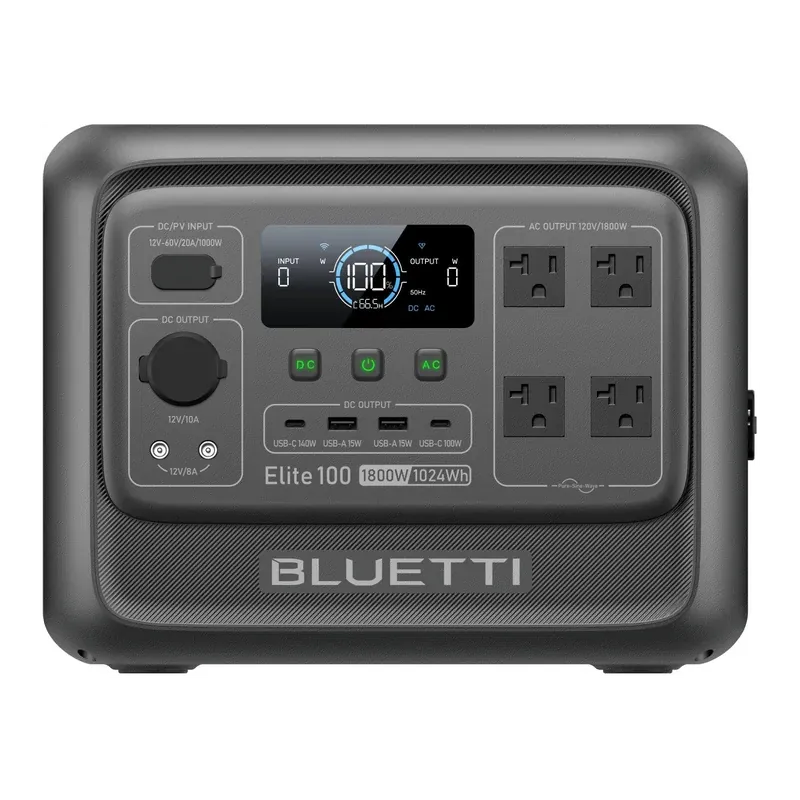
Yes, it can run this, about 26 hrs (about 3 nights at 8 hours a night) for a CPAP with heated humidifier on the BLUETTI Elite 100 V2.
How many nights will a 1,000 Wh power station run a CPAP with a humidifier?
About three 8-hour nights with the heated tube on, based on about 34 W. With the humidifier on but no heated tube (about 22 W), it is closer to five nights. With the humidifier off (about 7 W), it is about 15 nights.
Will a 300 Wh power station last all night with a heated humidifier?
Not quite. A 288 Wh unit runs a CPAP with a heated tube for about 7 hours. Turn off the heated tube and it lasts about 11 hours, which covers a full 8-hour night.
Should I plug my CPAP into AC or DC?
DC is more efficient if your CPAP maker offers a DC cord or converter for your model. AC works with the cord you already have, but the station's inverter loses about 10 to 15% of the battery as heat. Either way, check that the port can supply your machine's rated power.
Is a power station enough backup for a CPAP?
It is a useful backup, but it should not be your only one. Batteries run down and can fail. Ask your equipment supplier what they recommend for outages, keep the station charged, and register with your utility's medical-needs program.
Does a CPAP need a lot of surge power?
No. Even the 104 W peak on the AirSense 10 power supply is far below the 600 W surge of the smallest station in our table. Battery size, not surge, decides how long it runs.