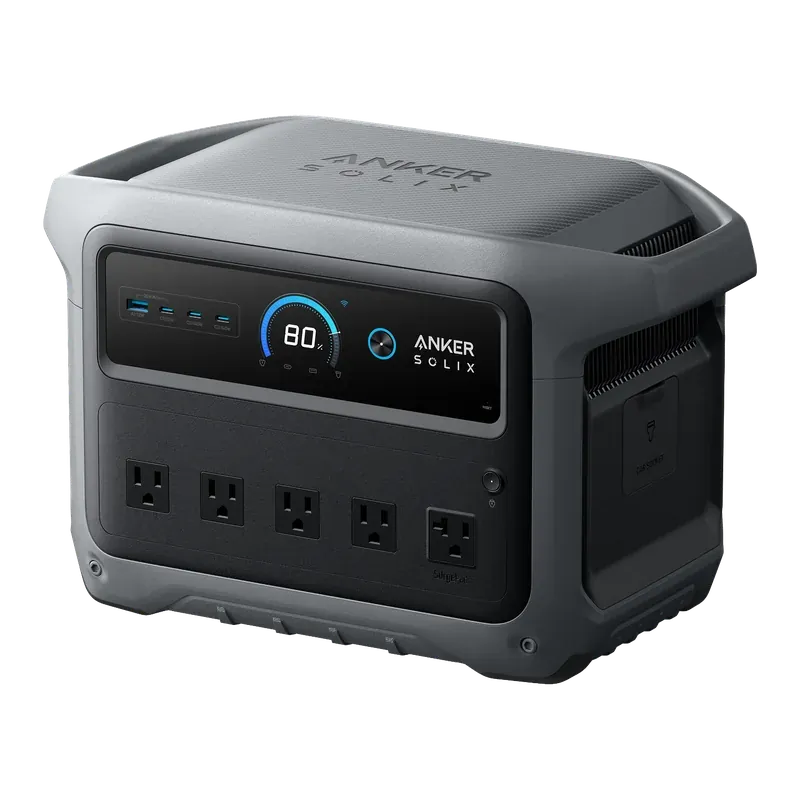
Anker SOLIX C1000 Gen 2
- Capacity
- 1,024 Wh
- Output
- 2,000 W output
- Weight
- 24.9 lb
- Battery
- LiFePO4
We may earn a commission if you buy through these links. It doesn’t change your price. How we make money

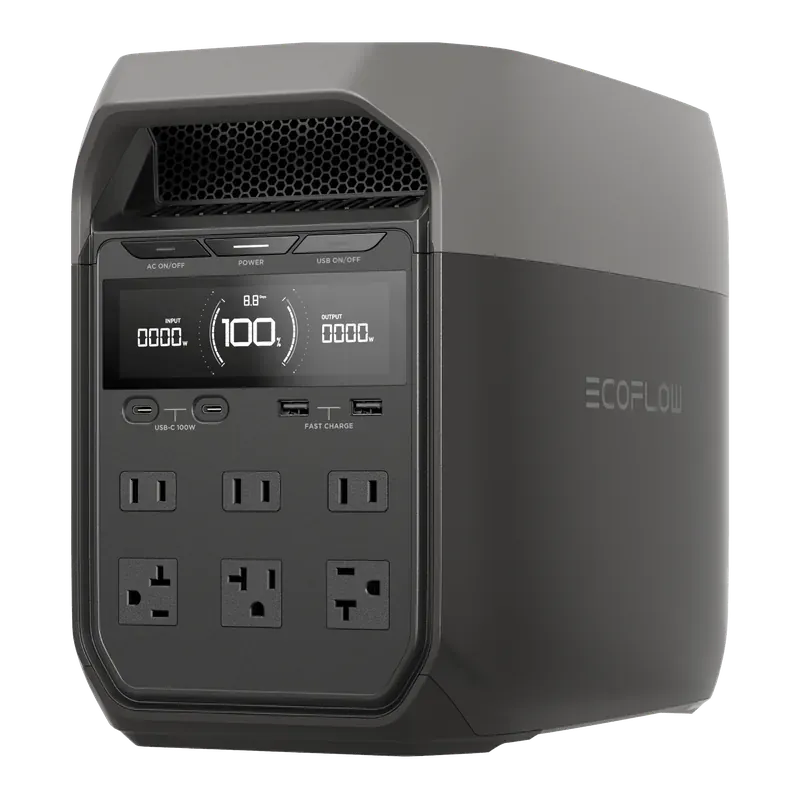
The EcoFlow DELTA 3 is a mainstream 1,024 Wh station for home backup and camping. It delivers 1,800 W (2,200 W with X-Boost for heaters and kettles), refills from empty in 56 minutes, and has six AC outlets plus USB-C, USB-A and 12V ports. It matches the DELTA 3 Plus in size and weight but has slower USB-C and a single 500 W solar input, which is why it usually costs less.
We may earn a commission if you buy through these links. It doesn’t change your price. How we make money
Plan on about 19 hours from a full-size fridge, or about 35 hours from a Wi-Fi router and cable modem. A 1,000 W microwave gets about 35 minutes of cooking. Add DELTA extra batteries up to 5,000 Wh and the same fridge runs about 94 hours, close to four days.
One device at a time, from a full charge. Devices that cycle on and off (fridges, freezers, heaters, pumps) use their average draw.
Battery Wh × 0.85 ÷ the device’s average watts. “Can’t run it” means the device needs more than 1,800 W or a start-up surge above 3,600 W. Try your own mix in the calculator.
A full answer for each device on the EcoFlow DELTA 3: hours, start-up surge and other units to consider.
This is the expandable 1,024 Wh pick for people who charge from the wall. It has six AC outlets (tied with the DELTA 3 Plus for the most in its size), a 3,600 W surge rating, a 56-minute wall recharge and room to grow to 5,000 Wh. That covers a fridge, a router, a CPAP and a few lamps at once, with a path to multi-day backup later.
Its sibling, the DELTA 3 Plus, shares the battery, the 1,800 W output, the surge, the 27.6 lb weight, the case and the expansion limit. The Plus adds a second solar input (1,000 W total against 500 W here), 140 W USB-C against 100 W, and a third 12V outlet. If you charge from the wall and your laptop charger is 100 W or less, the plain DELTA 3 runs the same devices for the same time and usually costs less.
The limits are solar and weight. At 500 W of solar, a full refill takes about two hours of ideal sun, and real days are slower. That is fine for weekend camping but slow for a long outage. At 27.6 lb it is a two-hand carry. X-Boost helps heating devices like kettles up to 2,200 W, but it is not extra output: a hair dryer at full heat (1,875 W) is still too much.

1,024 Wh · 1,800 W output · 27.6 lb
Pick the Plus only if you will use what it adds: 1,000 W of solar across two inputs, which refills it about twice as fast in good sun, or 140 W USB-C for a laptop that ships with a 140 W charger. Runtime, output, weight and expansion are the same.
1,024 Wh · 1,800 W output · 25 lb
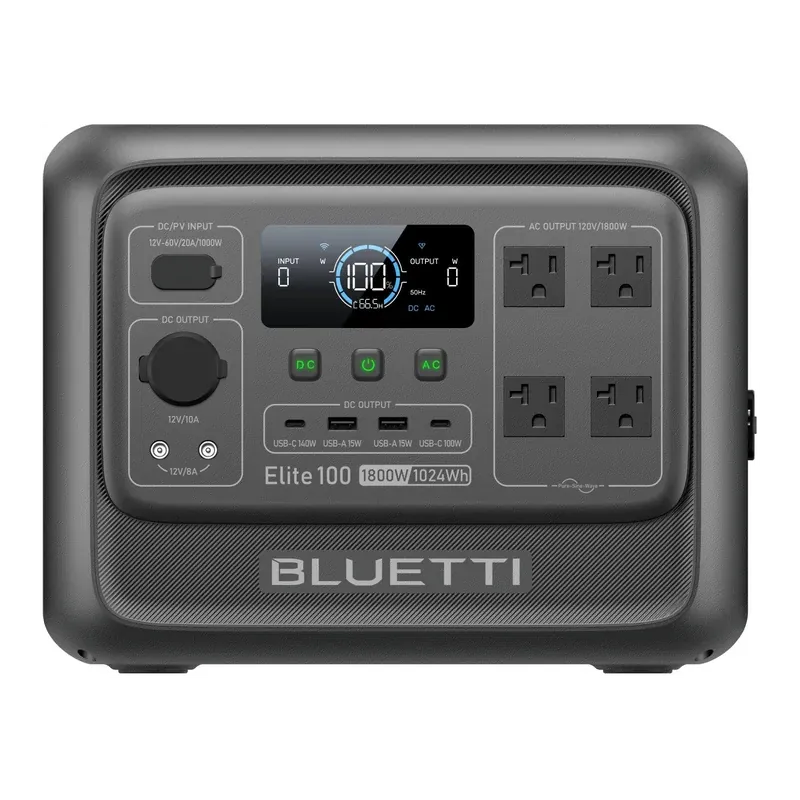
Pick the Elite 100 V2 if you will never add batteries. It has the same 1,024 Wh, 1,800 W and 3,600 W surge, takes 1,000 W of solar, weighs 25 lb and usually costs less. You get four AC outlets instead of six.
| Spec | EcoFlow DELTA 3 |
|---|---|
| Capacity | 1,024 Wh |
| AC output (continuous) | 1,800 W |
| Surge | 3,600 W |
| Boost mode (heaters, kettles) | 2,200 W |
| Battery type | LiFePO4 |
| Cycle life (rated) | 4,000 (to 80%) |
| Weight | 27.6 lb |
| Wall charge time | 56 min (0–100%; about 80% in 30 min) |
| Max solar input | 500 W |
| AC outlets | 6 |
| USB-C ports (max) | 2 (100 W) |
| USB-A ports | 2 |
| 12V / car port | Yes (2 DC ports) |
| Expandable | Yes, up to 5,000 Wh |
| UPS switch-over | 10 ms |
| App control | Yes |
| Size | 15.7 x 8.0 x 11.2 in |
| Released | 2024 |
| Typical price | $500–$700 |
Specs come from the maker’s own pages, checked . Runtimes use our own watt-hour math. How we pick

We may earn a commission if you buy through these links. It doesn’t change your price. How we make money

We may earn a commission if you buy through these links. It doesn’t change your price. How we make money

We may earn a commission if you buy through these links. It doesn’t change your price. How we make money
On the BLUETTI AC180 (1,152 Wh), runtimes go from about 40 min for a microwave (1000 W) to about 39 hrs for a Wi-Fi router + cable modem, each running by itself.
Swipe sideways to see every device →
| Power station | CPAP with heated humidifier 34 W average | Wi-Fi router + cable modem 25 W average | Full-size refrigerator 150 W running, about 45 W average | 55-inch LED TV 90 W average | Microwave (1000 W) 1,500 W average |
|---|---|---|---|---|---|
| Goal Zero Yeti 1000 (6th Gen) 998 Wh | 25 hrs | 34 hrs | 19 hrs | 9.5 hrs | 35 min |
| EcoFlow DELTA 3 1,024 Wh | 26 hrs | 35 hrs | 19 hrs | 9.5 hrs | 35 min |
| Jackery Explorer 1000 v2 1,070 Wh | 27 hrs | 36 hrs | 20 hrs | 10 hrs | 35 min |
| BLUETTI AC180 1,152 Wh | 29 hrs | 39 hrs | 22 hrs | 11 hrs | 40 min |
Estimates: battery Wh × 0.85 ÷ the device’s average draw. Real runtime depends on temperature, battery age and how hard the device works.