Skip to content

Popular searches
Not sure what to search? Try the runtime calculator
Will it run my…

Can a power station run a 55-inch LED TV?

Updated
Short answer

Yes. A 55-inch LED TV draws about 90 W, so a 500 Wh power station covers a 4-hour evening and a 1,000 Wh unit runs it for about 9 to 10 hours.

Calculate your runtime
Running
90 W
60–150 W range
Start-up
90 W
Runs
100%
of the time

TVs use less than most people expect. A 55-inch LED set draws about 90 W, based on ENERGY STAR figures for the sizes just below and above it. Brightness is the biggest factor, so a dimmer picture uses noticeably less.

There is no start-up surge worth noting, so every station in our table can run one. For a typical 4-hour evening at 90 W, you use about 360 Wh, or roughly 425 Wh of battery after inverter losses. A 288 Wh unit lasts about 2.5 to 3 hours, a 500 Wh unit about 4.5, a 1,000 Wh unit about 9 to 10, and a 2,000 Wh unit about 19 to 20.

Remember the rest of the setup. A streaming box, a soundbar and your router all add to the load. With a router and modem on the same station, the total is about 115 W, and a 1,000 Wh unit lasts about 7.5 to 8 hours. If internet or cable service is down in your area, download shows ahead of time so the TV still has something to play.

How long does each power station run a 55-inch LED TV?

At about 90 W on average, a 55-inch LED TV runs for about 2.5 hrs on the 286 Wh EcoFlow RIVER 3 Plus, about 9.5 hrs to 10 hrs on a 1,000 Wh-class unit (998–1,070 Wh) and about 39 hrs on the 4,096 Wh EcoFlow DELTA Pro 3.

Swipe sideways for battery size, output and price →

Hours a 55-inch LED TV runs on each power station, from a full charge with nothing else plugged in (15% inverter loss). Sorted by battery size.
Power stationRuntimeBatteryOutput / surgePrice range
EcoFlow RIVER 3 Plus2.5 hrs286 Wh600 / 1,200 W$180–$300
BLUETTI Elite 30 V22.5 hrs288 Wh600 / 1,500 W$180–$280
Jackery Explorer 300 v22.5 hrs288 Wh300 / 600 W$200–$280
Goal Zero Yeti 5004.5 hrs499 Wh500 / 1,000 W$340–$500
Goal Zero Yeti 1000 (6th Gen)9.5 hrs998 Wh2,000 / 3,600 Wlist price about $1,200
Anker SOLIX C1000 Gen 29.5 hrs1,024 Wh2,000 / 3,000 W$400–$600
BLUETTI Elite 100 V29.5 hrs1,024 Wh1,800 / 3,600 W$380–$500
DJI Power 1000 V29.5 hrs1,024 Wh2,600 / 2,600 W$340–$450
EcoFlow DELTA 39.5 hrs1,024 Wh1,800 / 3,600 W$500–$700
EcoFlow DELTA 3 Plus9.5 hrs1,024 Wh1,800 / 3,600 W$550–$800
Jackery Explorer 1000 v210 hrs1,070 Wh1,500 / 3,000 W$430–$560
BLUETTI AC18011 hrs1,152 Wh1,800 / 2,700 W$400–$500
Jackery Explorer 2000 v219 hrs2,042 Wh2,200 / 4,400 W$700–$1,000
Anker SOLIX C2000 Gen 219 hrs2,048 Wh2,400 / 4,000 W$700–$900
DJI Power 200019 hrs2,048 Wh3,000 / 3,600 W$700–$1,300
BLUETTI Elite 200 V220 hrs2,074 Wh2,600 / 3,900 W$700–$900
BLUETTI Apex 30026 hrs2,765 Wh3,840 / 7,680 W$1,200–$1,600
Jackery HomePower 300029 hrs3,072 Wh3,600 / 7,200 W$900–$1,500
Anker SOLIX F3800 Plus36 hrs3,840 Wh6,000 / 9,000 W$2,090–$2,700
EcoFlow DELTA Pro 339 hrs4,096 Wh4,000 / 8,000 W$2,400–$3,700

Estimate: battery Wh × 0.85 ÷ 90 W average (90 W × 1 duty). Your model may draw more or less; check its label. Prices are typical ranges we checked by hand on October 9, 2026, not live prices.

Where these numbers come from

ENERGY STAR lists Samsung's QN90D LED TV at 74 W in the 50-inch size and about 122 W at 65 inches, so a 55-inch set lands near 90 W. Turning the brightness down can cut that by about a third.

Sources

  1. ENERGY STAR certified TV listing (ID 3354304) · energystar.gov · PDF
  2. ENERGY STAR certified TV listing (ID 3354305) · energystar.gov · PDF
  3. ENERGY STAR certified TV listing (ID 3354303) · energystar.gov · PDF

We do not test units ourselves. Picks come from the official spec sheets and manuals, the watt-hour math on this site, and prices we check by hand. How we pick

Good fits for a 55-inch LED TV

#1
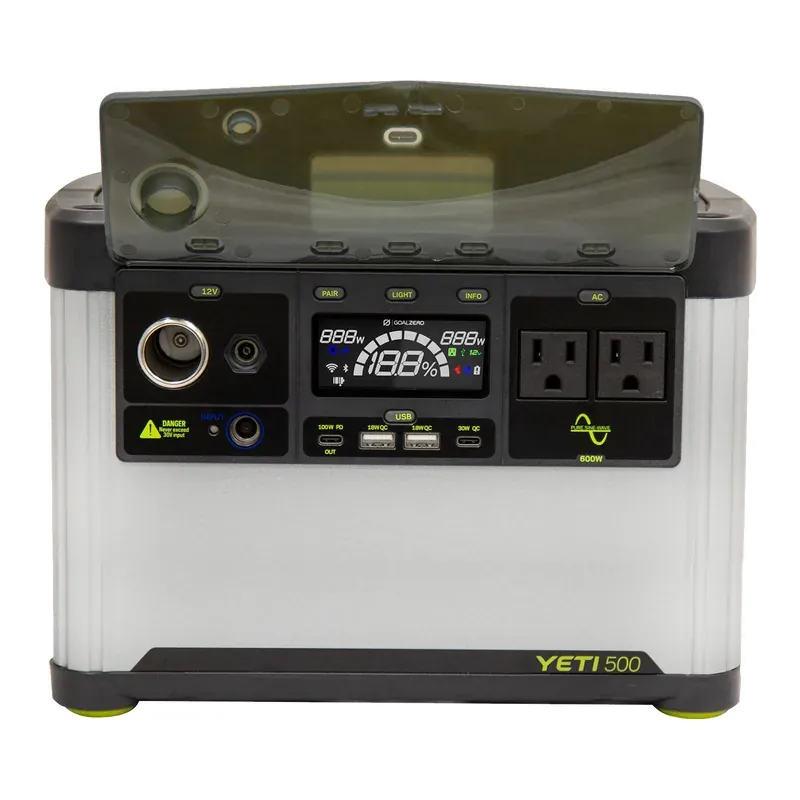
Goal Zero Yeti 500 portable power station, front view

Goal Zero Yeti 500

$340–$500 · price checked

Capacity
499 Wh
Output
500 W (1,000 W surge)
Battery
LiFePO4, 4,000 cycles
Weight
16.1 lb
Wall charge
1 h 30 min
Solar input
200 W

Why it won: Runs a 55-inch LED TV for about 4.5 hrs on one charge.

  • Light enough to carry one-handed at 16.1 lb
  • Long-life LiFePO4 battery rated for 4,000 cycles
  • Full wall recharge in about 90 minutes in High input mode
  • Water-resistant (IPX4) and works down to -4°F
  • 500 W of AC output, so no microwaves or space heaters
  • Solar input tops out at 200 W
  • Cannot add extra batteries, and has no rated UPS switch-over time
Full specs and runtimes for the Goal Zero Yeti 500
#2
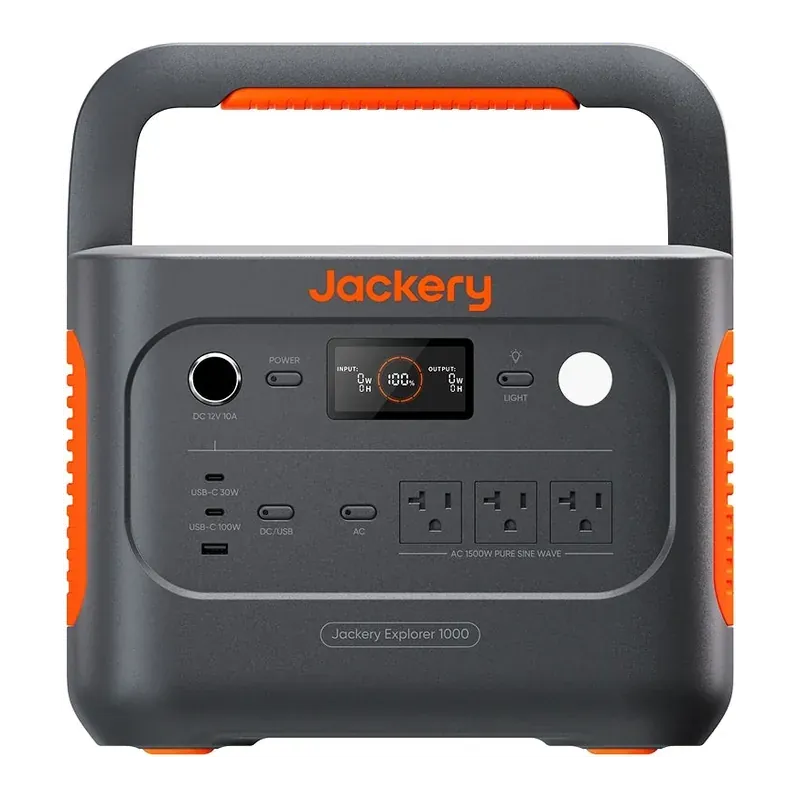
Jackery Explorer 1000 v2 portable power station, front view

Jackery Explorer 1000 v2

$430–$560 · price checked

Capacity
1,070 Wh
Output
1,500 W (3,000 W surge)
Battery
LiFePO4, 4,000 cycles (to 70%)
Weight
23.8 lb
Wall charge
1 h 35 min
Solar input
400 W

Why it won: Runs a 55-inch LED TV for about 10 hrs on one charge.

  • 1,500 W output runs a fridge, microwave or coffee maker one at a time
  • Light for its size at 23.8 lb, with a folding handle
  • Full recharge in about 95 minutes, or about 1 hour in emergency mode
  • App control plus a 20 ms UPS switch-over for routers and computers
  • Cannot add extra batteries
  • Only one USB-A port, and the second USB-C is 30 W
  • Jackery rates cycle life to 70% capacity, not 80%
Full specs and runtimes for the Jackery Explorer 1000 v2
#3
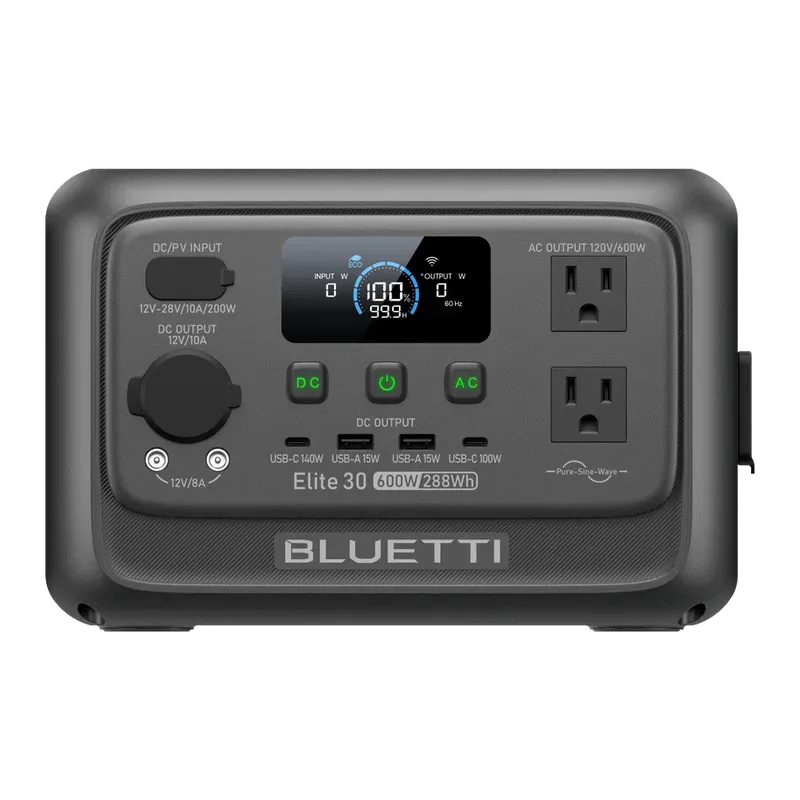
BLUETTI Elite 30 V2 portable power station, front view

BLUETTI Elite 30 V2

$180–$280 · price checked

Capacity
288 Wh
Output
600 W (1,500 W surge)
Battery
LiFePO4, 3,000 cycles
Weight
9.5 lb
Wall charge
1 h 10 min
Solar input
200 W

Why it won: Runs a 55-inch LED TV for about 2.5 hrs on one charge.

  • Only 9.5 lb, easy to carry one-handed
  • 140 W USB-C can charge a laptop at full speed
  • Refills from a wall outlet in about 70 minutes
  • 10 ms UPS switch-over protects a router or small electronics during an outage
  • 288 Wh is only enough for phones, laptops, lights and a small fan
  • 600 W output cannot run a microwave, coffee maker or space heater normally
  • Cannot add extra batteries
Full specs and runtimes for the BLUETTI Elite 30 V2

Make it last longer

  • • Turn the brightness down or use an energy-saving picture mode. It can cut use by about a third.
  • • Unplug the soundbar and use the TV's own speakers.
  • • Download shows ahead of time, so you do not need the router running too.
  • • Turn the TV fully off when you are done, and unplug anything else that sits in standby.

Add the rest of your devices

Yes, it can run this, about 4.5 hrs for a 55-inch LED TV on the Goal Zero Yeti 500.

Step 1

What do you want to run?

  • 55-inch LED TV
    Number of 55-inch LED TV: 1
Add more
Step 2

Pick a power station

500 W output · 1,000 W surge · full specs

For a 55-inch LED TV on the Goal Zero Yeti 500:

Yes, it can run this
Estimated runtime
4.5 hrs
Running load
90 W
Average draw
90 W
Biggest surge
90 W
  • • Everything fits within the 500 W output and 1,000 W surge rating.

Math: battery Wh × 0.85 ÷ average watts. Cold weather, battery age and screen-on time all shorten this.

Power stations that can run this

We may earn a commission if you buy through these links. It doesn't change your price. How we make money
Price ranges checked by hand on October 9, 2026. Prices change often.

About 4.5 hrs
1 device on Goal Zero Yeti 500
See result

Common questions

How long will a power station run a TV?
For a 55-inch LED TV at about 90 W: about 2.5 to 3 hours on a 288 Wh unit, about 4.5 hours on a 500 Wh unit, 9 to 10 hours on a 1,000 Wh unit, and 19 to 20 hours on a 2,000 Wh unit.
How many watts does a 55-inch TV use?
About 90 W for a typical LED model, based on ENERGY STAR figures for Samsung's QN90D line at 50 and 65 inches. The range is about 60 to 150 W depending on the model and brightness.
Can I run a TV and a router on a power station?
Yes. Together they draw about 115 W, so a 1,000 Wh unit lasts about 7.5 to 8 hours and a 288 Wh unit about 2 hours.

Related “will it run” questions