Can a power station run a portable oxygen concentrator?
Updated
Short answer
Yes, as a bridge through an outage. At about 40 W, a portable oxygen concentrator runs for about 21 to 23 hours on a 1,000 Wh power station, but a battery should never be your only backup for oxygen.
Portable oxygen concentrators use less power than their chargers suggest. The Inogen One G5 power supply is rated up to 120 W, but Inogen's published draw runs from about 15 W at setting 1 to about 48 W at setting 5. Our 40 W figure sits near the top of that range. The unit pulls more, up to that 120 W rating, while it is also recharging its own battery.
Surge is not an issue, and every station in our table can run one. Battery size is what matters, because oxygen is often needed around the clock. At 40 W, 24 hours uses about 960 Wh. After inverter losses, that is roughly 1,130 Wh of battery per day. A 288 Wh unit lasts about 6 hours, a 500 Wh unit about 11, a 1,000 Wh unit about 21 to 23 hours, and a 2,000 Wh unit about 43 hours. At 48 W, the top of Inogen's table, a 1,024 Wh unit lasts about 18 hours.
Think of a power station as a bridge through an outage of a day or so, not as your main oxygen backup. Use the setting your prescriber gave you. Do not turn it down to make the battery last. A power station should never be the only backup for oxygen or any life-support equipment. Talk to your equipment supplier about what they provide for outages, and register with your utility's medical-needs program so they know you depend on power. For outages longer than a day, plan a way to recharge the station, such as solar panels or a car.
How long does each power station run a portable oxygen concentrator?
At about 40 W on average, a portable oxygen concentrator runs for about 6 hrs on the 286 Wh EcoFlow RIVER 3 Plus, about 21 hrs to 23 hrs on a 1,000 Wh-class unit (998–1,070 Wh) and about 4 days on the 4,096 Wh EcoFlow DELTA Pro 3.
Hours a portable oxygen concentrator runs on each power station, from a full charge with nothing else plugged in (15% inverter loss). Sorted by battery size.
Swipe sideways for battery size, output and price →
Hours a portable oxygen concentrator runs on each power station, from a full charge with nothing else plugged in (15% inverter loss). Sorted by battery size.
Estimate: battery Wh × 0.85 ÷ 40 W average (40 W × 1 duty). Your model may draw more or less; check its label. Prices are typical ranges we checked by hand on October 9, 2026, not live prices.
Where these numbers come from
Use 40 W as a middle planning number for a portable concentrator like the Inogen One G5; higher flow settings draw more. Its power input is rated up to 120 W, and it can pull close to that while it also charges its own battery, so we treat 120 W as the peak. A battery should never be the only backup for life-support equipment.
We do not test units ourselves. Picks come from the official spec sheets and manuals, the watt-hour math on this site, and prices we check by hand. How we pick
Stations that can bridge a short outage for a portable oxygen concentrator
• Use the concentrator's DC cord if it came with one. The Inogen One G5 has a DC input, and plugging into the station's 12V car port skips the inverter, which loses about 10 to 15%. Check that the port's rating covers the cord's draw.
• Charge the concentrator's own batteries while the grid is up. Charging them from the station adds load, up to the 120 W rating of the Inogen G5 supply.
• Turn on UPS or pass-through mode if your station has it, so the concentrator stays powered when the grid drops. Most units in our table list a 10 to 20 millisecond switch-over.
• Keep the station topped up between outages and check its charge regularly.
• Keep both the station and the concentrator in a cool room with good airflow, away from curtains and bedding.
Add the rest of your devices
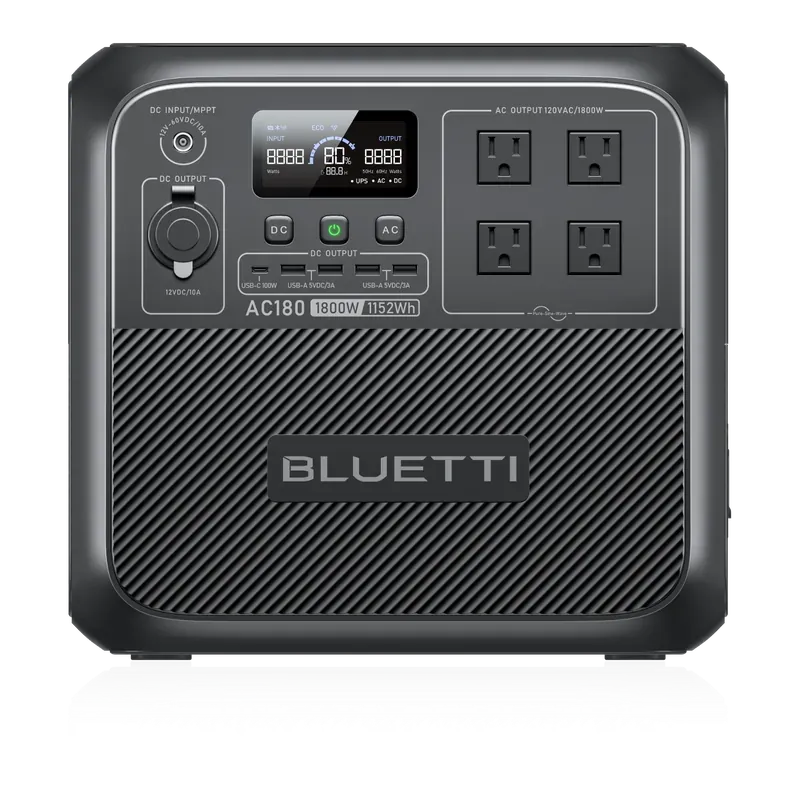
Yes, it can run this, about 24 hrs for a portable oxygen concentrator on the BLUETTI AC180.
How long will a power station run a portable oxygen concentrator?
At about 40 W, a 288 Wh unit lasts about 6 hours, a 500 Wh unit about 11 hours, a 1,000 Wh unit about 21 to 23 hours, and a 2,000 Wh unit about 43 hours. Higher settings and charging the concentrator's own battery shorten that.
Can I charge my portable oxygen concentrator from a power station?
Yes. Its AC power supply plugs into any station in our table, and some models, like the Inogen One G5, also have a DC input. Charging pulls more power than running, up to 120 W for the G5 supply, so expect shorter runtime while it charges.
Is a power station a safe backup for oxygen?
It can be one part of your plan, but never the only part. Batteries run down and can fail. Ask your equipment supplier what backup they recommend, and register with your utility's medical-needs program.
What size power station do I need for a full day of oxygen?
About 1,130 Wh of battery for 24 hours at 40 W. A 1,000 Wh unit comes close, and a 2,000 Wh unit gives nearly two days. If your prescribed setting draws more, size up.