
Best power station for camping in 2026
As an Amazon Associate, BlackoutWise earns from qualifying purchases. We may also earn a commission when you buy through brand store links. This never changes the price you pay or which products we recommend. How we make money
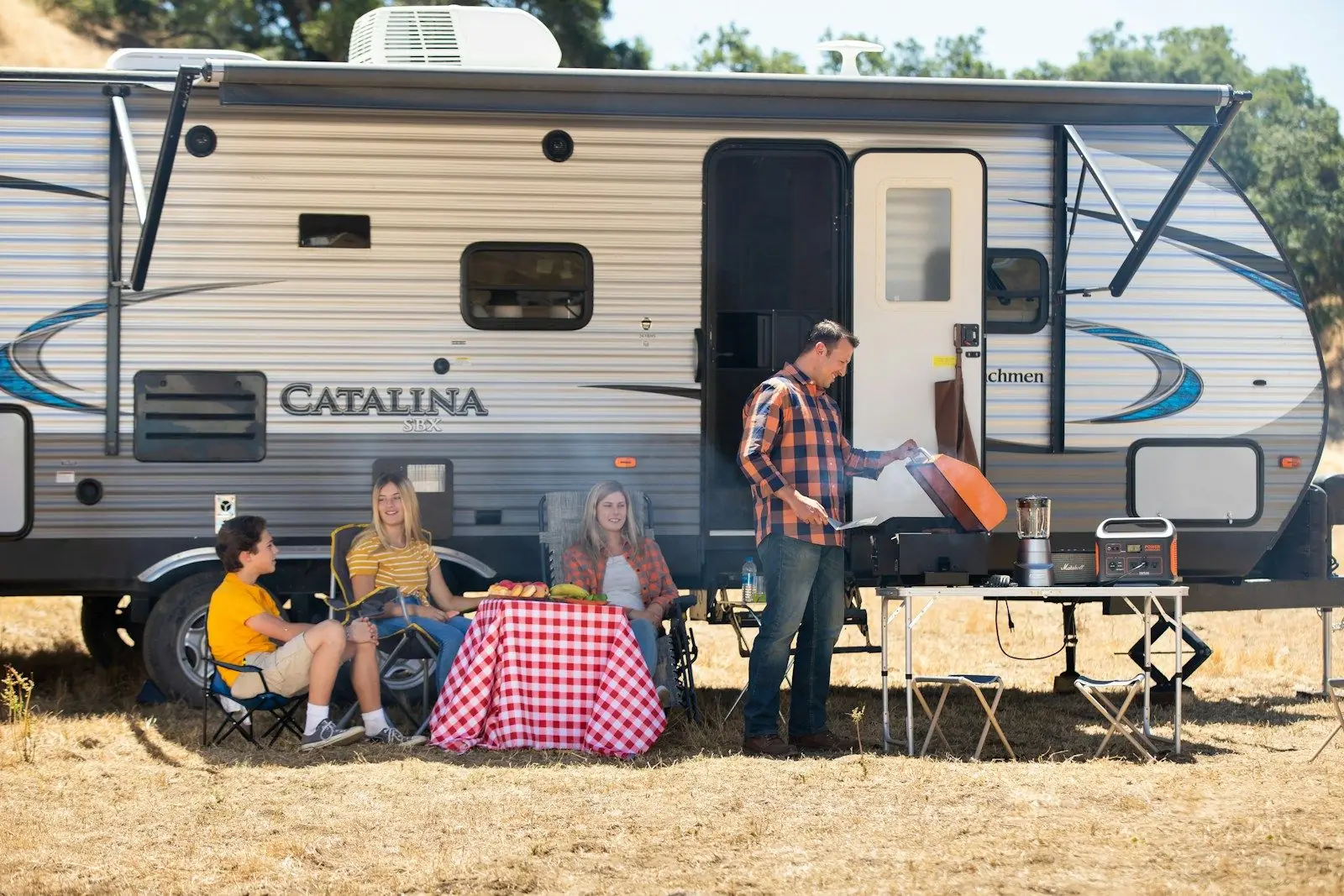
Our top pick for camping is the Jackery Explorer 1000 v2. Its 1,070 Wh battery runs a 12V compressor cooler, string lights and two phones for about two days, and at 23.8 lb with a folding handle it is light for its size.
Camping power is about small loads over long stretches: a 12V cooler, a string of LED lights, phones, a fan on a hot night or a CPAP. None of these need a big inverter, but they add up over a weekend. The right station depends on how far you carry it and whether you can recharge from solar.
We do not test units ourselves. These picks are based on the official spec sheets and manuals, the watt-hour math on this site, and prices we check by hand. Runtimes are estimates that allow about 15% for inverter loss. See how we pick.
Quick picks
- 1. Best overall: Jackery Explorer 1000 v21,070 Wh · 1,500 W · $430–$560
- 2. Best for solar: BLUETTI Elite 100 V21,024 Wh · 1,800 W · $380–$500
- 3. Best for cold and wet weather: Goal Zero Yeti 500499 Wh · 500 W · $340–$500
- 4. Best budget pick: EcoFlow RIVER 3 Plus286 Wh · 600 W · $180–$300
- 5. Lightest: Jackery Explorer 300 v2288 Wh · 300 W · $200–$280
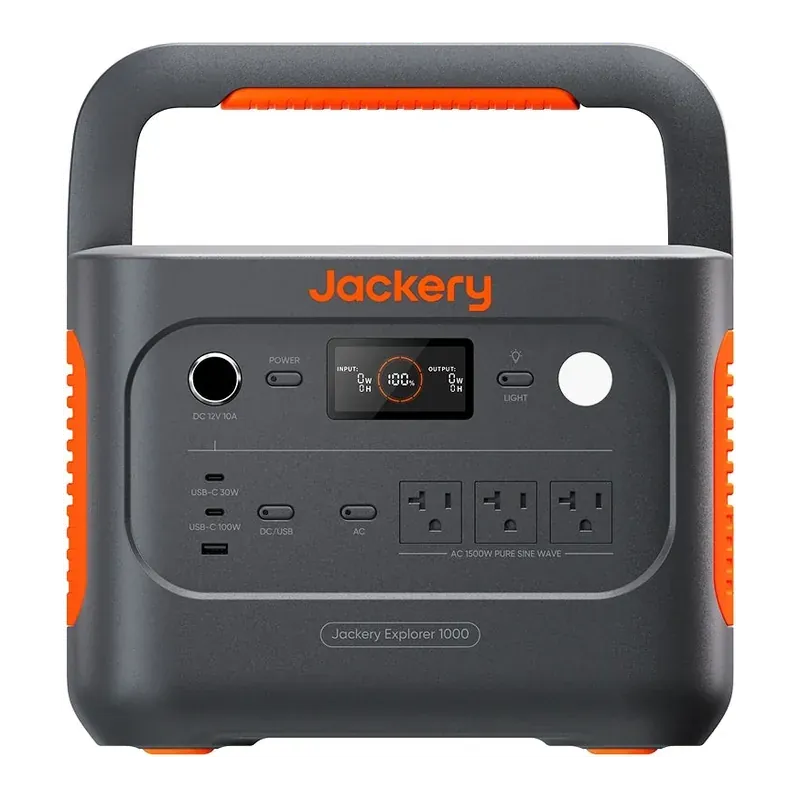
Jackery Explorer 1000 v2
$430–$560 · price checked
- Capacity
- 1,070 Wh
- Output
- 1,500 W (3,000 W surge)
- Battery
- LiFePO4, 4,000 cycles (to 70%)
- Weight
- 23.8 lb
- Wall charge
- 1 h 35 min
- Solar input
- 400 W
Why it won: It has 1,070 Wh, the most on this list, in a 23.8 lb body. That runs a 12V compressor cooler for about 70 hours, close to three days, or a cooler, lights and two phones for about two days. It takes up to 400 W of solar, and its 1,500 W output can run a coffee maker at camp.
Skip it if: Skip it if you want to refill fast from a big solar array, since solar tops out at 400 W. It also cannot add extra batteries.
- 1,500 W output runs a fridge, microwave or coffee maker one at a time
- Light for its size at 23.8 lb, with a folding handle
- Full recharge in about 95 minutes, or about 1 hour in emergency mode
- App control plus a 20 ms UPS switch-over for routers and computers
- Cannot add extra batteries
- Only one USB-A port, and the second USB-C is 30 W
- Jackery rates cycle life to 70% capacity, not 80%
We may earn a commission if you buy through these links. It doesn’t change your price. How we make money
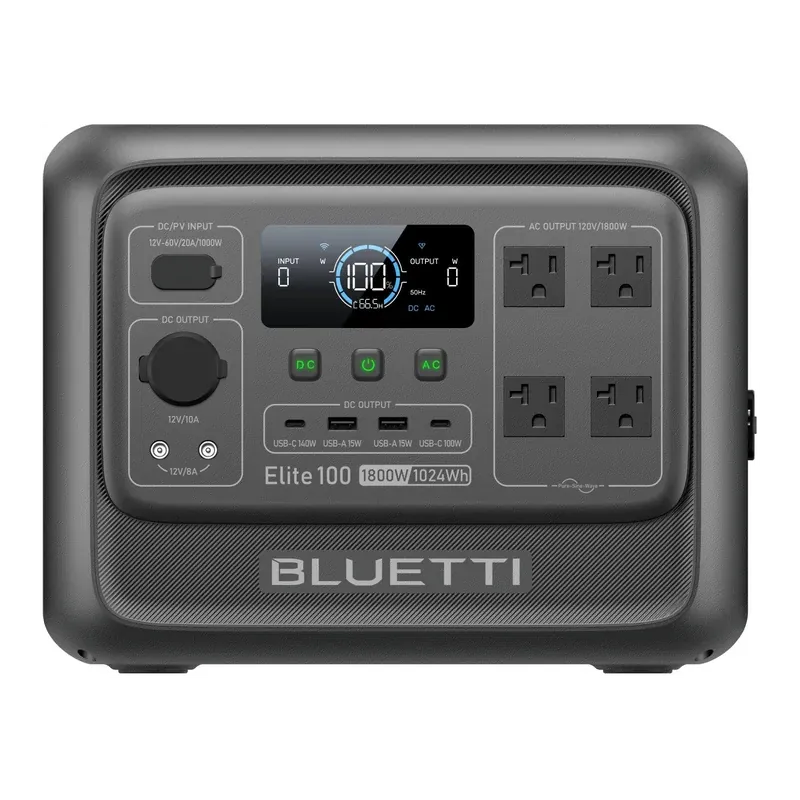
BLUETTI Elite 100 V2
$380–$500 · price checked
- Capacity
- 1,024 Wh
- Output
- 1,800 W (3,600 W surge)
- Battery
- LiFePO4, 4,000 cycles
- Weight
- 25 lb
- Wall charge
- 1 h 10 min
- Solar input
- 1,000 W
Why it won: It comes within a few hours of the Jackery's runtimes, about 67 hours on a 12V cooler, and takes up to 1,000 W of solar, so a few panels can refill it on a sunny day. It weighs 25 lb, has a 12V car-style socket for a cooler and usually costs a bit less.
Skip it if: It cannot add extra batteries, and reaching the full 1,000 W of solar takes several panels, which is a lot to haul for a weekend.
- 1,800 W output runs most kitchen appliances one at a time
- Full recharge from a wall outlet in about 70 minutes
- 25 lb, much lighter than the older AC180
- 4,000-cycle battery rated for about 10 years of use
- Cannot add extra batteries
- 1,024 Wh will run a fridge for roughly a day, not several days
- Reaching the full 1,000 W solar input takes several panels
We may earn a commission if you buy through these links. It doesn’t change your price. How we make money
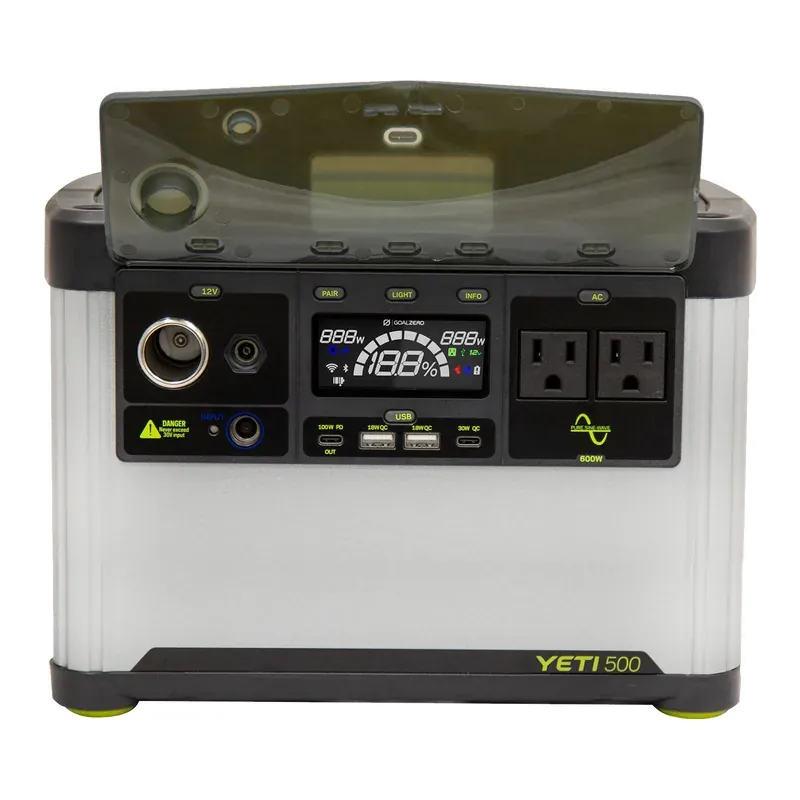
Goal Zero Yeti 500
$340–$500 · price checked
- Capacity
- 499 Wh
- Output
- 500 W (1,000 W surge)
- Battery
- LiFePO4, 4,000 cycles
- Weight
- 16.1 lb
- Wall charge
- 1 h 30 min
- Solar input
- 200 W
Why it won: Goal Zero rates it IPX4 water-resistant and able to work down to -4°F, which helps on shoulder-season trips. The 499 Wh battery runs a 12V cooler for about 33 hours, or a CPAP with the humidifier off for about 60 hours. It weighs 16.1 lb.
Skip it if: Its 500 W output rules out kettles and coffee makers, solar tops out at 200 W, and it often costs about as much as a 1,024 Wh unit.
- Light enough to carry one-handed at 16.1 lb
- Long-life LiFePO4 battery rated for 4,000 cycles
- Full wall recharge in about 90 minutes in High input mode
- Water-resistant (IPX4) and works down to -4°F
- 500 W of AC output, so no microwaves or space heaters
- Solar input tops out at 200 W
- Cannot add extra batteries, and has no rated UPS switch-over time
We may earn a commission if you buy through these links. It doesn’t change your price. How we make money
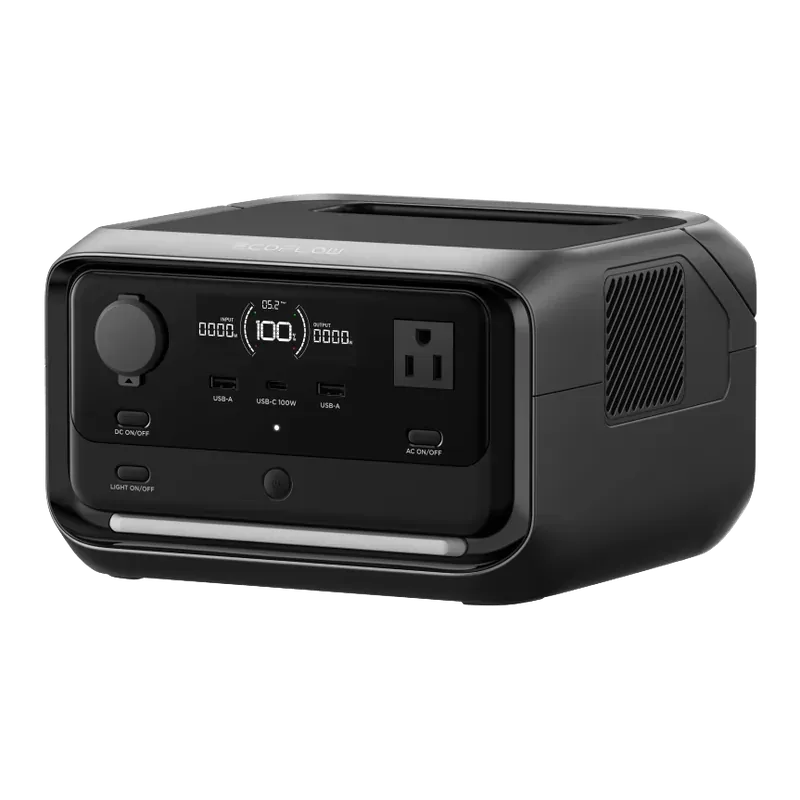
EcoFlow RIVER 3 Plus
$180–$300 · price checked
- Capacity
- 286 Wh
- Output
- 600 W (1,200 W surge)
- Battery
- LiFePO4, 3,000 cycles
- Weight
- 10.4 lb
- Wall charge
- 1 h
- Solar input
- 220 W
Why it won: Usually under $300, it covers the basics for a night. At 10.4 lb, it runs a 12V cooler for about 19 hours or LED string lights for about 24, and it refills from a wall outlet in about an hour before you leave. Add an EB300 or EB600 extra battery and it grows to 858 Wh.
Skip it if: One charge will not keep a cooler, lights and phones going for a full day; it lasts about 14 hours on that load. Plan on solar for longer trips.
- Light enough to carry one-handed at 10.4 lb
- Refills from a wall outlet in about an hour
- 10 ms UPS switch-over keeps a router, modem or CPAP running through a flicker
- Snap on an EB300 or EB600 extra battery to reach 858 Wh
- 286 Wh only runs small loads for a few hours
- 600 W limit rules out most kitchen appliances and space heaters
- Only one USB-C port
We may earn a commission if you buy through these links. It doesn’t change your price. How we make money
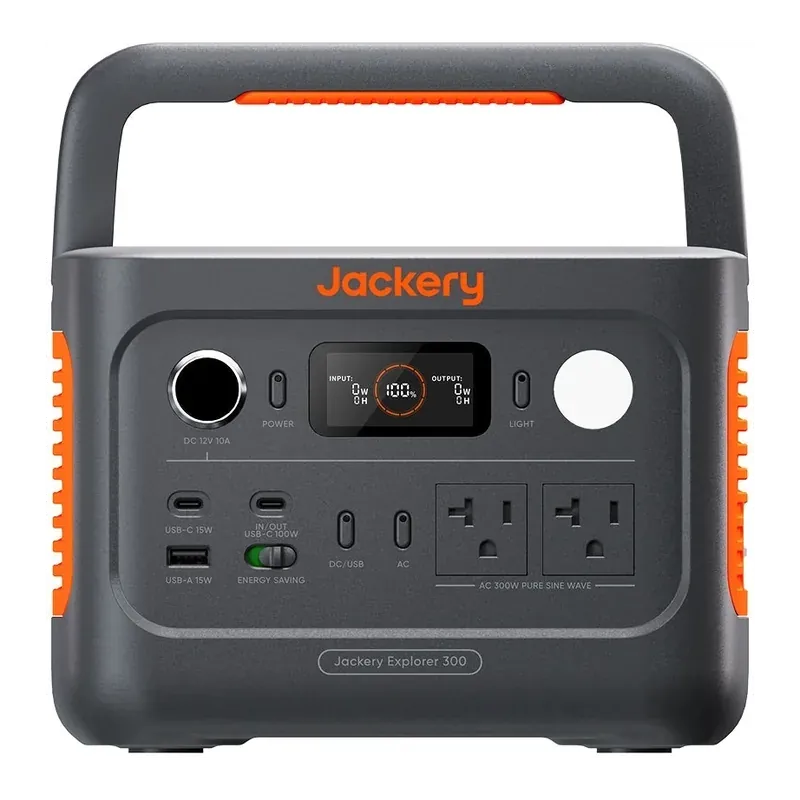
Jackery Explorer 300 v2
$200–$280 · price checked
- Capacity
- 288 Wh
- Output
- 300 W (600 W surge)
- Battery
- LiFePO4, 4,000 cycles (to 70%)
- Weight
- 8.2 lb
- Wall charge
- 1 h 16 min
- Solar input
- 100 W
Why it won: At 8.2 lb, it is the lightest pick, easy to carry from the car to a walk-in site. The 288 Wh battery runs a 12V cooler for about 19 hours, gives about ten full phone charges and has a 100 W USB-C port for a laptop.
Skip it if: Its 300 W output rules out kettles, hair dryers and most heaters. Solar charging only works through the 100 W USB-C input, so it refills slowly from panels.
- Only 8.2 lb with a fold-down handle
- Two AC outlets plus a 100 W USB-C port for laptops
- Full recharge from a wall outlet in about 76 minutes
- LiFePO4 battery rated for 4,000 cycles (to 70% capacity)
- 300 W limit rules out coffee makers, hair dryers and most heaters
- Solar charging only through the 100 W USB-C input, with no DC solar port
- No app control, and it can be hard to find in stock
We may earn a commission if you buy through these links. It doesn’t change your price. How we make money
How long each pick runs
On the Jackery Explorer 1000 v2 (1,070 Wh), runtimes go from about 11 hrs for a box fan (20 in) to about 5 days for a CPAP (no humidifier), each running by itself.
Swipe sideways to see every device →
| Power station | Electric cooler (12V) 52 W running, about 13 W average | LED string lights 10 W average | Smartphone charging 20 W running, about 12 W average | Box fan (20 in) 85 W average | CPAP (no humidifier) 7 W average |
|---|---|---|---|---|---|
| Jackery Explorer 1000 v2 1,070 Wh | 3 days | 4 days | 3 days | 11 hrs | 5 days |
| BLUETTI Elite 100 V2 1,024 Wh | 3 days | 4 days | 3 days | 10 hrs | 5 days |
| Goal Zero Yeti 500 499 Wh | 33 hrs | 42 hrs | 35 hrs | 5 hrs | 3 days |
| EcoFlow RIVER 3 Plus 286 Wh | 19 hrs | 24 hrs | 20 hrs | 3 hrs | 35 hrs |
| Jackery Explorer 300 v2 288 Wh | 19 hrs | 24 hrs | 20 hrs | 3 hrs | 35 hrs |
Estimates: battery Wh × 0.85 ÷ the device’s average draw. Real runtime depends on temperature, battery age and how hard the device works.
Runtime on every station, one device at a time
Specs side by side
Swipe sideways to see every column →
| Spec | Jackery Explorer 1000 v2 | BLUETTI Elite 100 V2 | Goal Zero Yeti 500 | EcoFlow RIVER 3 Plus | Jackery Explorer 300 v2 |
|---|---|---|---|---|---|
| Capacity | 1,070 Wh (better) | 1,024 Wh | 499 Wh | 286 Wh | 288 Wh |
| AC output (continuous) | 1,500 W | 1,800 W (better) | 500 W | 600 W | 300 W |
| Surge | 3,000 W | 3,600 W (better) | 1,000 W | 1,200 W | 600 W |
| Boost mode (heaters, kettles) | None | 2,700 W | None | 1,200 W | None |
| Battery type | LiFePO4 | LiFePO4 | LiFePO4 | LiFePO4 | LiFePO4 |
| Cycle life (rated) | 4,000 (to 70%) | 4,000 (to 80%) | 4,000 (to 80%) | 3,000 (to 80%) | 4,000 (to 70%) |
| Weight | 23.8 lb | 25 lb | 16.1 lb | 10.4 lb | 8.2 lb (better) |
| Wall charge time | 1 h 35 min (0–100%; about 1 h in Emergency Super Charge) | 1 h 10 min (0–100% with TurboBoost; 80% in 45 min) | 1 h 30 min (in High input mode; ships in slower Low mode) | 1 h (0–100% from a wall outlet) (better) | 1 h 16 min (0–100% from a wall outlet) |
| Max solar input | 400 W | 1,000 W (better) | 200 W | 220 W | 100 W |
| AC outlets | 3 | 4 (better) | 2 | 3 | 2 |
| USB-C ports (max) | 2 (100 W) | 2 (140 W) (better) | 3 (100 W) | 1 (100 W) | 2 (100 W) |
| USB-A ports | 1 | 2 | 2 | 2 | 1 |
| 12V / car port | Yes (1 DC ports) | Yes (3 DC ports) | Yes (2 DC ports) | Yes (1 DC ports) | Yes (1 DC ports) |
| Expandable | No | No | No | Yes, up to 858 Wh | No |
| UPS switch-over | 20 ms | 10 ms | No UPS mode | 10 ms | 10 ms |
| App control | Yes | Yes | Yes | Yes | No |
| Size | 12.9 x 8.8 x 9.7 in | 12.6 x 8.5 x 9.8 in | 11.32 x 7.82 x 7.8 in | 9.2 x 9.1 x 5.8 in | 9.1 x 6.0 x 6.6 in |
| Released | 2024 | 2025 | 2024 | 2025 | 2026 |
| Typical price | $430–$560 | $380–$500 | $340–$500 | $180–$300 | $200–$280 |
Related comparisons
Torn between two of these? Each comparison gives a verdict, specs and runtimes side by side.
How much battery does a camping weekend need?
Start with the cooler, because it runs all day. A 12V compressor cooler like the Dometic CFX3 45 averages about 13 W once it is cold, or about 312 Wh a day. Add a 100-count LED string for five hours (about 50 Wh) and charging two phones (about 48 Wh), and you are near 410 Wh a day.
Here is a worked example. For a two-day weekend, that is about 820 Wh at the plugs, or about 965 Wh of battery after inverter losses. A 1,070 Wh station covers it. A 499 Wh station lasts about a day, and a 286 Wh station about 14 hours, so you would need to recharge.
A box fan changes the math. At about 85 W for 8 hours, it adds about 680 Wh a night. With the fan running, the same 1,070 Wh station lasts about 20 hours instead of two days.
What to look for in a camping power station
Weight you will actually carry. Car campers can handle 25 lb. Walk-in sites and longer carries favor the 8.2 lb Jackery 300 v2 or the 10.4 lb RIVER 3 Plus.
A 12V car-style socket. Most compressor coolers run on 12V. Plugging them into the station's car socket skips the inverter, which wastes roughly 10% to 15% of the battery as heat. Every pick here has one, so the cooler runtimes on this page are on the safe side.
Solar input. On trips longer than a weekend, solar is how you keep going. The Elite 100 V2 takes up to 1,000 W, the Jackery 1000 v2 400 W, the RIVER 3 Plus 220 W, the Yeti 500 200 W and the Jackery 300 v2 100 W. Real panels rarely hit their rated watts, especially in shade or cloud.
Battery type and cold. All five picks use LiFePO4 batteries rated for 3,000 to 4,000 cycles. Cold slows charging on lithium batteries, so keep the station in the tent or car on cold nights.
Mistakes to avoid
Running the cooler on AC through its wall adapter. Use the 12V cord instead and you get more hours from the same battery.
Leaving the station in a hot car or in full sun all day. Heat ages lithium batteries. Keep it in the shade, even while it charges from panels.
Expecting to run a space heater. A 1,500 W heater is beyond most picks, and even on the Jackery 1000 v2 it would empty the battery in a little over an hour. A 150 W electric blanket uses about 600 Wh a night and is a much better choice on the bigger units.
Forgetting to charge before you leave. Top it up at home the night before, so you start the trip at 100%.
Safety at camp
Battery stations burn no fuel, so they are safe in a tent or camper, unlike a generator or a gas heater. Keep them off wet ground, out of the rain and with space around the vents. The Yeti 500's IPX4 rating means it handles splashes, not puddles or downpours.
If you use a CPAP while camping, a power station should not be your only backup for therapy you cannot skip. Bring enough battery for an extra night, and talk to your supplier about backup options if you need it every night.
Making a charge last longer
Pre-chill the cooler at home on wall power, and keep it in the shade at camp. A full cooler holds its cold better than a half-empty one, and every lid opening makes the compressor run.
Charge phones and lights from USB ports, and turn off the AC outlets when nothing needs them, since an idle inverter still draws power. Set out solar panels early in the day and turn them toward the sun as it moves.
If you sleep with a CPAP, turn the humidifier off. At about 7 W, even the Jackery 300 v2 runs one for about four nights.
Common questions
- What size power station do I need for camping?
- For a weekend with a 12V cooler, lights and phones, about 1,000 Wh. That load uses about 410 Wh a day, so a 1,070 Wh unit lasts about two days. For one night, or a trip without a cooler, a 300 to 500 Wh unit is enough.
- How long will a power station run a 12V fridge or cooler?
- A compressor cooler like the Dometic CFX3 45 averages about 13 W once cold. A 288 Wh station runs it for about 19 hours, a 499 Wh station for about 33 hours and a 1,070 Wh station for about 70 hours. Hot weather and frequent lid opening cut those numbers.
- Can I run a CPAP while camping on a power station?
- Yes. With the humidifier off, a CPAP uses about 7 W, so a 288 Wh unit lasts about four 8-hour nights. With the heated humidifier and tube on, it uses about 34 W, and a 1,070 Wh unit lasts about three nights.
- Can a camping power station run a fan all night?
- A 20-inch box fan uses about 85 W. A 1,070 Wh unit runs one for about 11 hours, while a 286 Wh unit lasts about 3 hours. A small USB fan uses far less.
- Can I charge a power station with solar panels while camping?
- Yes. Every pick takes solar, from 100 W on the Jackery 300 v2 (through USB-C) up to 1,000 W on the Elite 100 V2. Expect less than the panels' rating in real conditions, especially in shade or clouds.
- Is a power station better than a generator for camping?
- For small loads, yes. It has no engine, needs no fuel and can run inside a tent. A generator is better for big loads like a 10,000 BTU portable air conditioner, which would drain a 1,024 Wh station in a little over an hour.