
EcoFlow DELTA 3 Plus vs Jackery Explorer 1000 v2: which should you buy?
The short verdict
The EcoFlow DELTA 3 Plus is the better buy for most people. It puts out 1,800 W instead of 1,500 W, refills from the wall in about 56 minutes instead of about 95, takes up to 1,000 W of solar and can grow to 5,000 Wh with extra batteries. The trade-off is price and weight. It usually costs roughly $100 to $250 more and weighs 27.6 lb against the Jackery's 23.8 lb.
The Jackery Explorer 1000 v2 is still a solid station. Its 1,070 Wh battery is slightly bigger, so it runs a fridge or CPAP a little longer, and it is easier to carry. If you only need a fridge, a CPAP and some phones through a one-day outage, it does the job for less money.
Pick the Jackery if weight and price matter most. Pick the DELTA 3 Plus if you want to run kitchen appliances, recharge from solar or add capacity later.
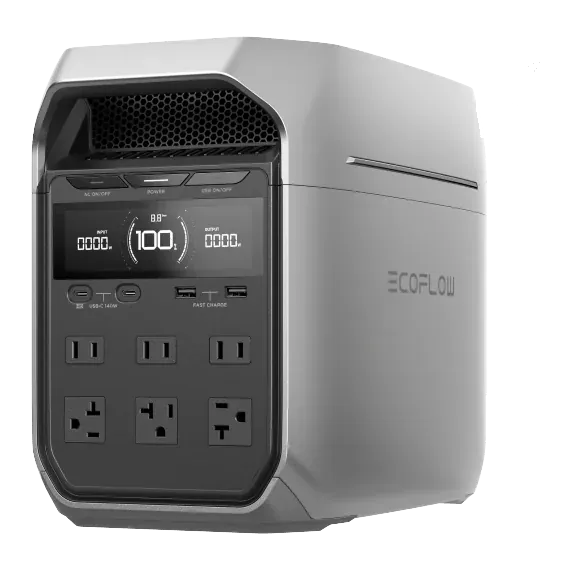
EcoFlow DELTA 3 Plus
1,024 Wh · 1,800 W · $550–$800
We may earn a commission if you buy through these links. It doesn’t change your price. How we make money
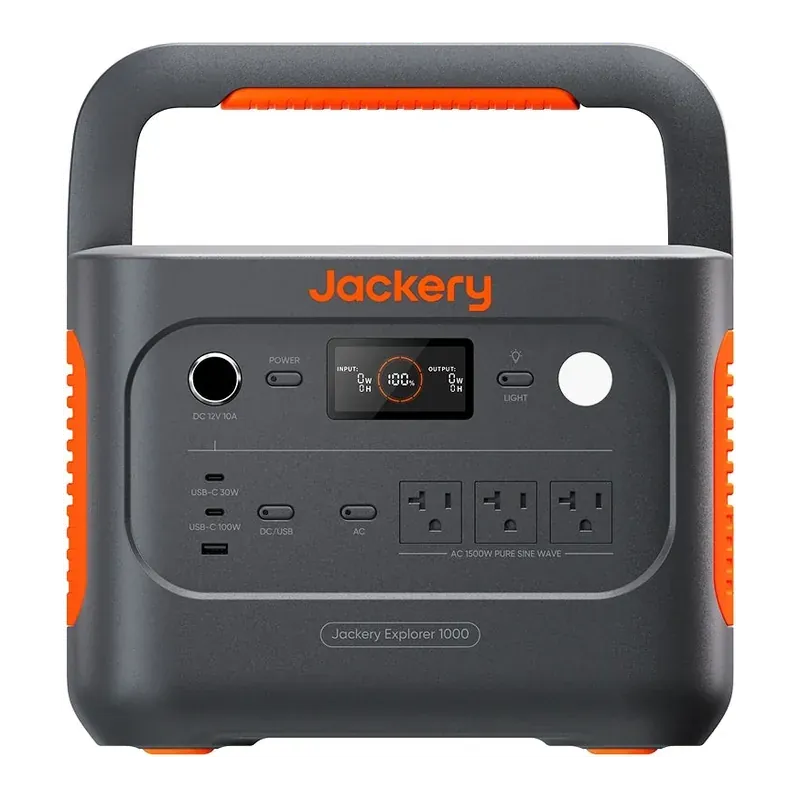
Jackery Explorer 1000 v2
1,070 Wh · 1,500 W · $430–$560
We may earn a commission if you buy through these links. It doesn’t change your price. How we make money
Buy the EcoFlow DELTA 3 Plus if…
You want one station that can handle an air fryer, a single induction burner or a garage door opener as well as the fridge. You own solar panels or plan to, since its two inputs take up to 1,000 W combined. You may want multi-day backup later, because it expands to 5,000 Wh with EcoFlow's DELTA extra batteries.
Buy the Jackery Explorer 1000 v2 if…
You mainly need a fridge, a CPAP, lights and phone charging through a short outage, and you want to spend less. You carry it often, for camping or between rooms, so being 3.8 lb lighter matters. Three AC outlets and 400 W of solar input are enough for how you use it.
Specs side by side
The better number in each row is highlighted.
| Spec | EcoFlow DELTA 3 Plus | Jackery Explorer 1000 v2 |
|---|---|---|
| Capacity | 1,024 Wh | 1,070 Wh (better) |
| AC output (continuous) | 1,800 W (better) | 1,500 W |
| Surge | 3,600 W (better) | 3,000 W |
| Boost mode (heaters, kettles) | 2,200 W | None |
| Battery type | LiFePO4 | LiFePO4 |
| Cycle life (rated) | 4,000 (to 80%) | 4,000 (to 70%) |
| Weight | 27.6 lb | 23.8 lb (better) |
| Wall charge time | 56 min (0–100%; about 80% in 30–40 min) (better) | 1 h 35 min (0–100%; about 1 h in Emergency Super Charge) |
| Max solar input | 1,000 W (better) | 400 W |
| AC outlets | 6 (better) | 3 |
| USB-C ports (max) | 2 (140 W) (better) | 2 (100 W) |
| USB-A ports | 2 | 1 |
| 12V / car port | Yes (3 DC ports) | Yes (1 DC ports) |
| Expandable | Yes, up to 5,000 Wh | No |
| UPS switch-over | 10 ms (better) | 20 ms |
| App control | Yes | Yes |
| Size | 15.7 x 8.0 x 11.2 in | 12.9 x 8.8 x 9.7 in |
| Released | 2024 | 2024 |
| Typical price | $550–$800 | $430–$560 (better) |
Runtime for common devices
On the Jackery Explorer 1000 v2 (1,070 Wh), runtimes go from about 20 hrs for a full-size refrigerator to about 27 hrs for a CPAP with heated humidifier, each running by itself.
Swipe sideways to see every device →
| Power station | Full-size refrigerator 150 W running, about 45 W average | CPAP with heated humidifier 34 W average | Air fryer 1,550 W running, about 930 W average | Induction cooktop (single burner) 1,800 W running, about 1,080 W average | Garage door opener 875 W running, about 8.8 W average |
|---|---|---|---|---|---|
| EcoFlow DELTA 3 Plus 1,024 Wh | 19 hrs | 26 hrs | 55 min | 50 min | 4 days |
| Jackery Explorer 1000 v2 1,070 Wh | 20 hrs | 27 hrs | Can’t run it | Can’t run it | Can’t run it |
Estimates: battery Wh × 0.85 ÷ the device’s average draw. Real runtime depends on temperature, battery age and how hard the device works.
See how every power station on this site handles one device:
Which one runs a fridge or CPAP longer?
On paper the Jackery holds more: 1,070 Wh against 1,024 Wh. That is about 4% more energy. On a full-size fridge it works out to about 20 hours against about 19, and on a CPAP with a heated humidifier it adds about an hour across three nights. You are unlikely to notice it in a typical outage.
The bigger runtime difference shows up after the first day. The DELTA 3 Plus accepts EcoFlow's DELTA extra batteries and grows to 5,000 Wh. At that size it would run the same fridge for about 94 hours, close to four days. The Jackery cannot take extra batteries, so 1,070 Wh is its ceiling unless you recharge.
Both use LiFePO4 batteries rated for 4,000 cycles. Jackery rates that figure to 70% of original capacity and EcoFlow to 80%, so the EcoFlow's rating is the stricter one. At one full cycle a day, 4,000 cycles is more than ten years.
Can either one run an air fryer or microwave?
Continuous output decides which appliances you can plug in at all. The DELTA 3 Plus gives 1,800 W and the Jackery 1,500 W. That 300 W gap matters in the kitchen. A typical air fryer draws about 1,550 W and a single induction burner on high about 1,800 W, so both run on the EcoFlow but overload the Jackery. A 1,000 W microwave pulls about 1,500 W from the outlet, which sits right at the Jackery's limit, so run it with nothing else plugged in.
Surge is the short burst a motor needs to start. The EcoFlow handles 3,600 W and the Jackery 3,000 W. Both start a fridge compressor, which needs about 1,000 W, with room to spare. A 1/2 HP garage door opener can need about 3,200 W to start, which the EcoFlow covers and the Jackery does not. With either unit you can still pull the red release cord and lift the door by hand.
The EcoFlow also has X-Boost, rated to 2,200 W, for heating appliances such as kettles and space heaters. It only helps those heating loads, so treat it as a fallback rather than extra output.
Which recharges faster from the wall and from solar?
From a wall outlet the DELTA 3 Plus refills from empty in about 56 minutes, with about 80% in 30 to 40 minutes. The Jackery takes about 95 minutes normally, or about an hour in Emergency Super Charge mode. Between storms either is fine. During rolling outages, where power comes back for an hour at a time, the EcoFlow's quicker top-up is a real advantage.
Solar is the larger gap. The EcoFlow has two solar inputs that take up to 1,000 W combined. The Jackery takes up to 400 W. In ideal sun with enough panels, that is roughly one hour for a full refill against roughly 2.7 hours. Real panels rarely reach their rated output, so both take longer in practice, but the EcoFlow can pull in about two and a half times as much power per sunny hour.
Size, ports and UPS
The Jackery weighs 23.8 lb and measures 12.9 x 8.8 x 9.7 in. The EcoFlow weighs 27.6 lb in a larger 15.7 x 8.0 x 11.2 in case. For car camping or moving it between rooms, the Jackery is the easier carry.
The EcoFlow has six AC outlets against three, and its two USB-C ports each give up to 140 W, enough for a 16-inch laptop at full speed. The Jackery's main USB-C port tops out at 100 W and its second at 30 W. The EcoFlow also has three 12V DC outputs against one.
Both can sit between the wall and your gear as a basic UPS. The EcoFlow switches to battery in 10 ms and the Jackery in 20 ms. Routers and CPAP machines usually ride through either, but a desktop computer is safer on the faster 10 ms switch.
Common questions
- Which runs a refrigerator longer, the DELTA 3 Plus or the Jackery 1000 v2?
- The Jackery, by a little. A typical full-size fridge averages about 45 W, so the Jackery's 1,070 Wh lasts about 20 hours and the EcoFlow's 1,024 Wh about 19 hours. Add extra batteries to the EcoFlow and it pulls far ahead, to about four days at 5,000 Wh.
- Can the Jackery Explorer 1000 v2 run an air fryer?
- Usually not. A typical air fryer draws about 1,550 W, above the Jackery's 1,500 W continuous limit. The DELTA 3 Plus has 1,800 W of output and gives roughly 55 minutes of air fryer time on a full charge.
- How many CPAP nights do I get from each?
- With a heated humidifier and heated tube, at about 34 W, roughly three 8-hour nights on either. Without the humidifier, at about 7 W, about 15 to 16 nights on either.
- Is the DELTA 3 Plus worth the extra money?
- Yes if you will use solar, run 1,500 W to 1,800 W kitchen appliances or add a battery later. If you just need a fridge and a CPAP for a day, the Jackery covers it for less, usually roughly $100 to $250 below the EcoFlow.
Full specs and buying guides
More comparisons
- EcoFlow DELTA 3 Plus vs Anker SOLIX C1000 Gen 2: which should you buy?
- Anker SOLIX C1000 Gen 2 vs Jackery Explorer 1000 v2: which should you buy?
- EcoFlow DELTA 3 vs EcoFlow DELTA 3 Plus: which should you buy?
- BLUETTI Elite 100 V2 vs EcoFlow DELTA 3 Plus: which should you buy?
- DJI Power 1000 V2 vs EcoFlow DELTA 3 Plus: which should you buy?
- Goal Zero Yeti 1000 (6th Gen) vs EcoFlow DELTA 3 Plus: which should you buy?