
Best lightweight power station in 2026
As an Amazon Associate, BlackoutWise earns from qualifying purchases. We may also earn a commission when you buy through brand store links. This never changes the price you pay or which products we recommend. How we make money
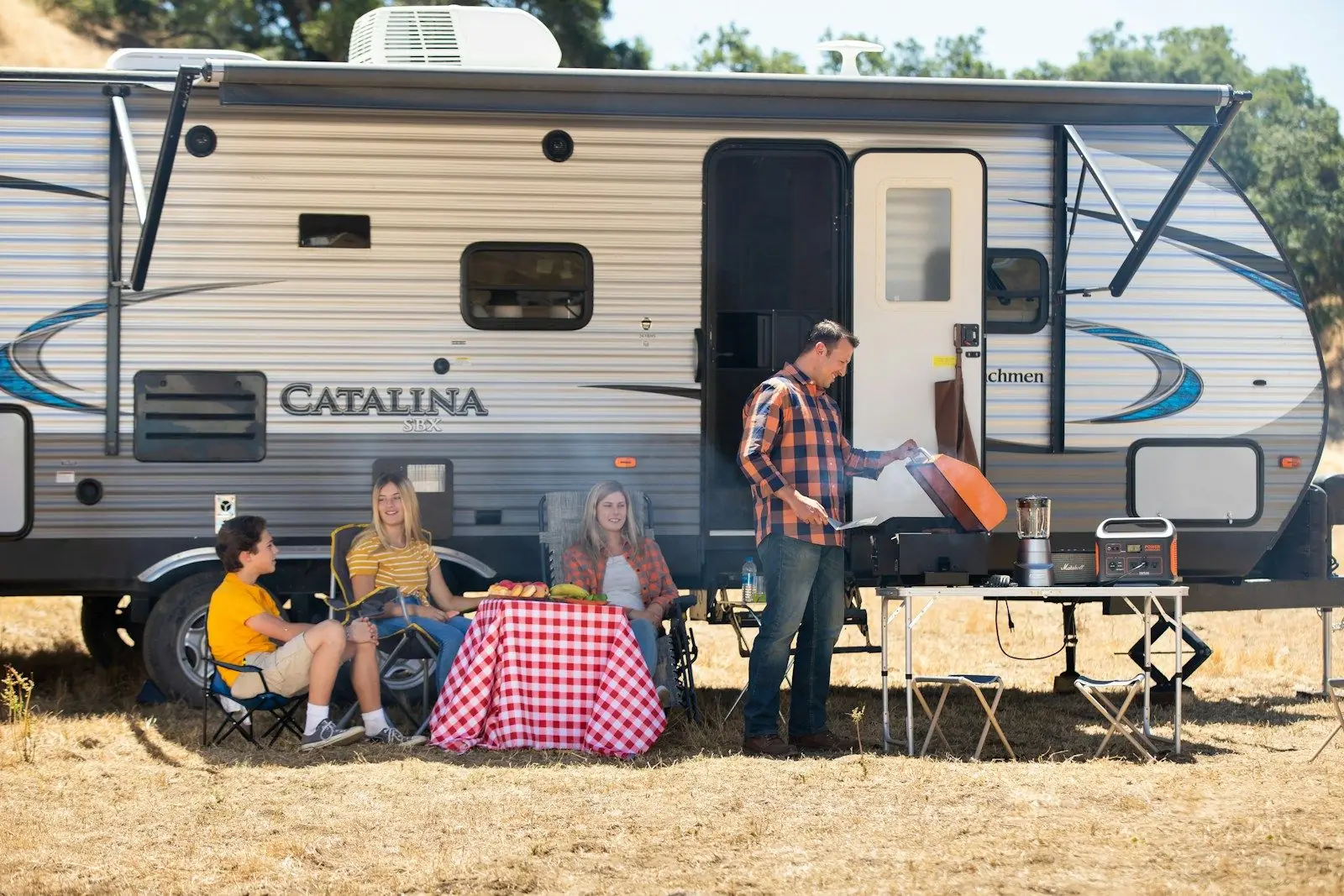
The Anker SOLIX C1000 Gen 2 is our top lightweight pick. At 24.9 lb it carries 1,024 Wh and 2,000 W, enough to run a CPAP with the heated humidifier for about three nights or a mini fridge for about 29 hours, and it refills from the wall in about 49 minutes.
Weight is the price you pay for capacity. Every pick here is under 30 lb, but the gap between an 8 lb unit and a 25 lb unit is the gap between charging phones for a weekend and running a CPAP for several nights. The most useful number is watt-hours per pound: the Jackery Explorer 1000 v2 leads at about 45, and the small units sit around 28 to 35.
We do not test units ourselves. We chose these from the official spec sheets and manuals, the watt-hour math on this site, and prices we check by hand. Runtimes below include about 15% lost in the inverter. See how we pick.
Quick picks
- 1. Best overall: Anker SOLIX C1000 Gen 21,024 Wh · 2,000 W · $400–$600
- 2. Most battery per pound: Jackery Explorer 1000 v21,070 Wh · 1,500 W · $430–$560
- 3. Best middle weight: Goal Zero Yeti 500499 Wh · 500 W · $340–$500
- 4. Best small pick: EcoFlow RIVER 3 Plus286 Wh · 600 W · $180–$300
- 5. Lightest: Jackery Explorer 300 v2288 Wh · 300 W · $200–$280
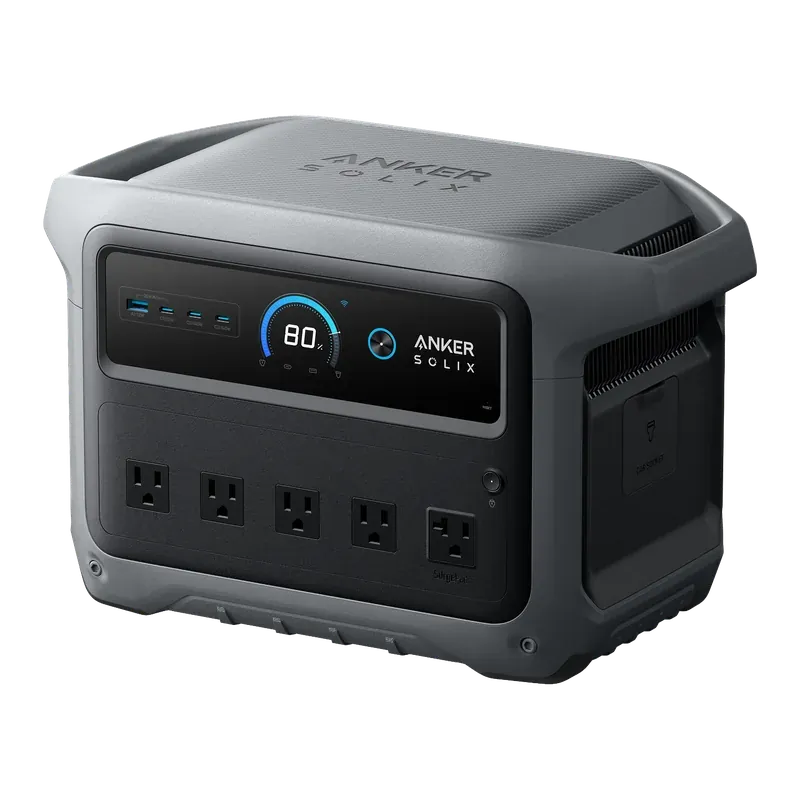
Anker SOLIX C1000 Gen 2
$400–$600 · price checked
- Capacity
- 1,024 Wh
- Output
- 2,000 W (3,000 W surge)
- Battery
- LiFePO4, 4,000 cycles
- Weight
- 24.9 lb
- Wall charge
- 49 min
- Solar input
- 600 W
Why it won: It packs 1,024 Wh and a 2,000 W inverter into 24.9 lb, so it handles a CPAP with the heated humidifier for about three nights, a mini fridge for about 29 hours or a drip coffee maker. The 49-minute wall recharge, with UltraFast turned on in the app, makes a quick top-up before you leave easy. Its 10 ms UPS also makes it useful at home between trips.
Skip it if: Skip it if you want to add batteries later, since its capacity is fixed. The fastest charge also needs the app and a battery above 68°F.
- 2,000 W output runs a fridge, microwave or space heater
- Refills from empty in under an hour from a wall outlet
- 10 ms UPS switch-over protects a CPAP or computer
- 4,000-cycle LiFePO4 battery in a compact 24.9 lb body
- Capacity cannot be expanded, unlike the older C1000
- Only one USB-A port
- The 49-minute charge needs the app and a battery above 68°F
We may earn a commission if you buy through these links. It doesn’t change your price. How we make money
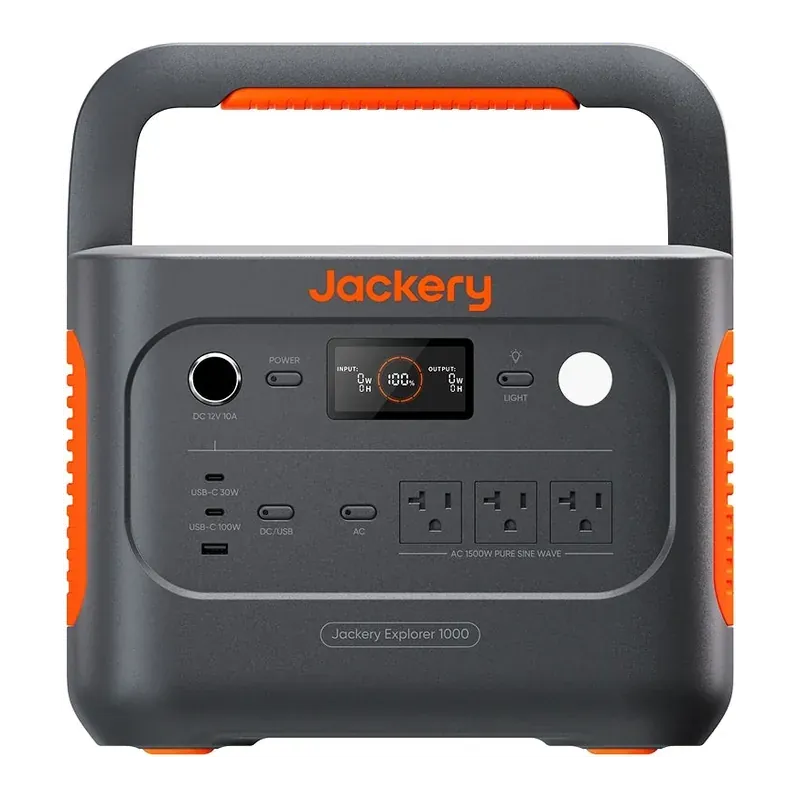
Jackery Explorer 1000 v2
$430–$560 · price checked
- Capacity
- 1,070 Wh
- Output
- 1,500 W (3,000 W surge)
- Battery
- LiFePO4, 4,000 cycles (to 70%)
- Weight
- 23.8 lb
- Wall charge
- 1 h 35 min
- Solar input
- 400 W
Why it won: At 23.8 lb for 1,070 Wh, it carries about 45 Wh per pound, the most on this list. That works out to about 3.3 nights of CPAP with the heated humidifier, or more than 30 hours on a mini fridge. The folding handle makes the walk from the car to the campsite easier.
Skip it if: Skip it if you want to run an 1,800 W induction burner or a hair dryer, since its 1,500 W output rules those out. Its second USB-C port is only 30 W.
- 1,500 W output runs a fridge, microwave or coffee maker one at a time
- Light for its size at 23.8 lb, with a folding handle
- Full recharge in about 95 minutes, or about 1 hour in emergency mode
- App control plus a 20 ms UPS switch-over for routers and computers
- Cannot add extra batteries
- Only one USB-A port, and the second USB-C is 30 W
- Jackery rates cycle life to 70% capacity, not 80%
We may earn a commission if you buy through these links. It doesn’t change your price. How we make money
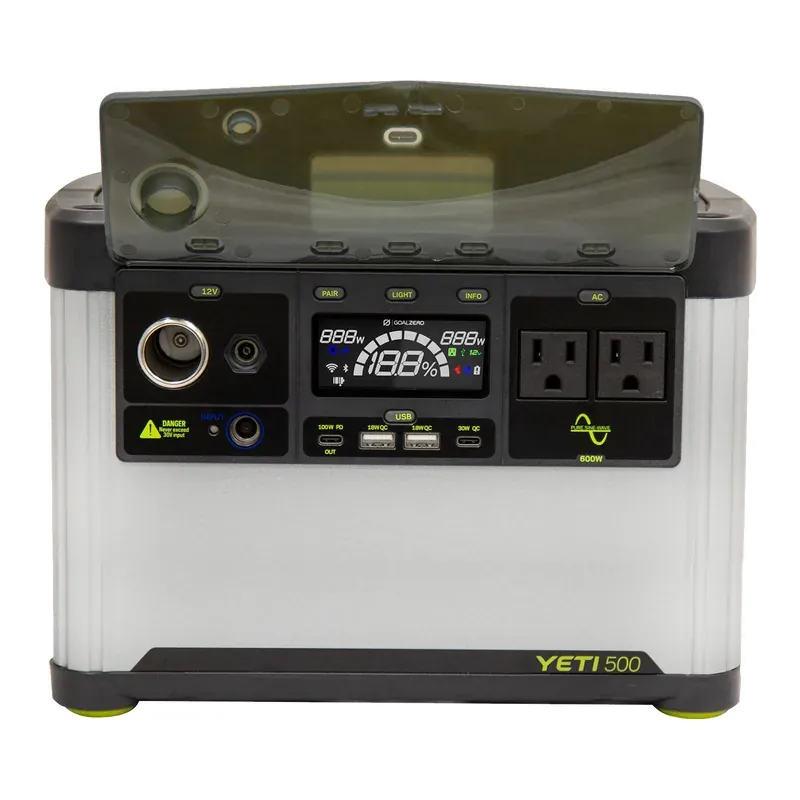
Goal Zero Yeti 500
$340–$500 · price checked
- Capacity
- 499 Wh
- Output
- 500 W (1,000 W surge)
- Battery
- LiFePO4, 4,000 cycles
- Weight
- 16.1 lb
- Wall charge
- 1 h 30 min
- Solar input
- 200 W
Why it won: At 16.1 lb it holds 499 Wh, about one and a half CPAP nights with the heated humidifier, or more than seven nights without it. It is rated IPX4 for water resistance and works down to -4°F, which suits camping better than most small units. Its LiFePO4 battery is rated for 4,000 cycles.
Skip it if: Skip it if you also want a home backup for a router or computer, because it has no rated UPS switch-over time. Its 500 W limit also rules out microwaves and space heaters.
- Light enough to carry one-handed at 16.1 lb
- Long-life LiFePO4 battery rated for 4,000 cycles
- Full wall recharge in about 90 minutes in High input mode
- Water-resistant (IPX4) and works down to -4°F
- 500 W of AC output, so no microwaves or space heaters
- Solar input tops out at 200 W
- Cannot add extra batteries, and has no rated UPS switch-over time
We may earn a commission if you buy through these links. It doesn’t change your price. How we make money
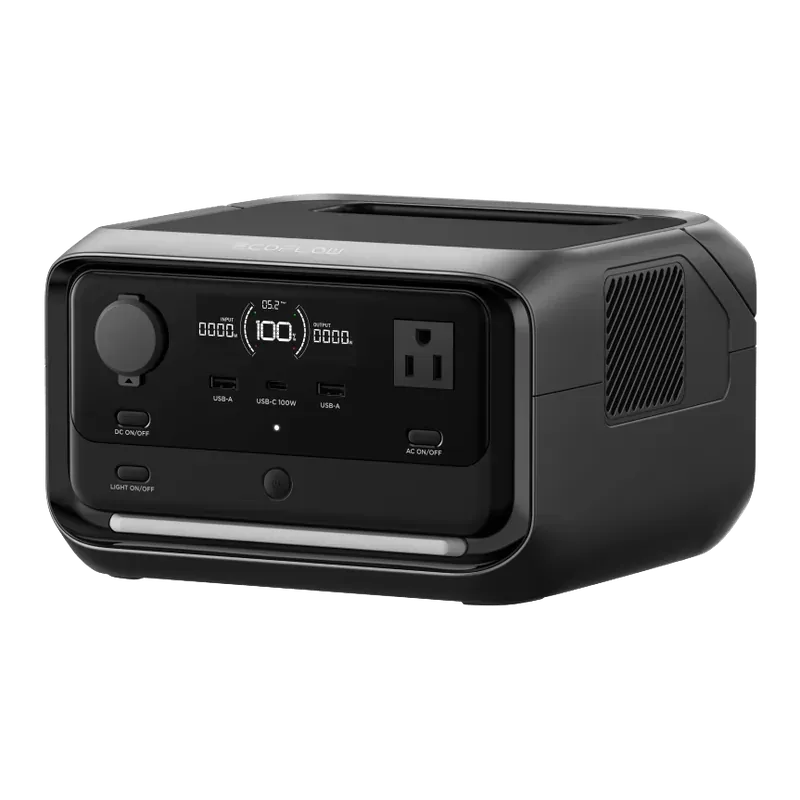
EcoFlow RIVER 3 Plus
$180–$300 · price checked
- Capacity
- 286 Wh
- Output
- 600 W (1,200 W surge)
- Battery
- LiFePO4, 3,000 cycles
- Weight
- 10.4 lb
- Wall charge
- 1 h
- Solar input
- 220 W
Why it won: At 10.4 lb and usually $300 or less, it runs a Wi-Fi router for about 10 hours or a CPAP without the humidifier for about four nights. It refills from the wall in about an hour. When you need more, an EB300 or EB600 extra battery takes it to 858 Wh, and you can leave the extra battery home when you do not.
Skip it if: Skip it if you use a heated humidifier every night. At about 7 hours per charge, 286 Wh falls just short of one 8-hour night unless you add a battery.
- Light enough to carry one-handed at 10.4 lb
- Refills from a wall outlet in about an hour
- 10 ms UPS switch-over keeps a router, modem or CPAP running through a flicker
- Snap on an EB300 or EB600 extra battery to reach 858 Wh
- 286 Wh only runs small loads for a few hours
- 600 W limit rules out most kitchen appliances and space heaters
- Only one USB-C port
We may earn a commission if you buy through these links. It doesn’t change your price. How we make money
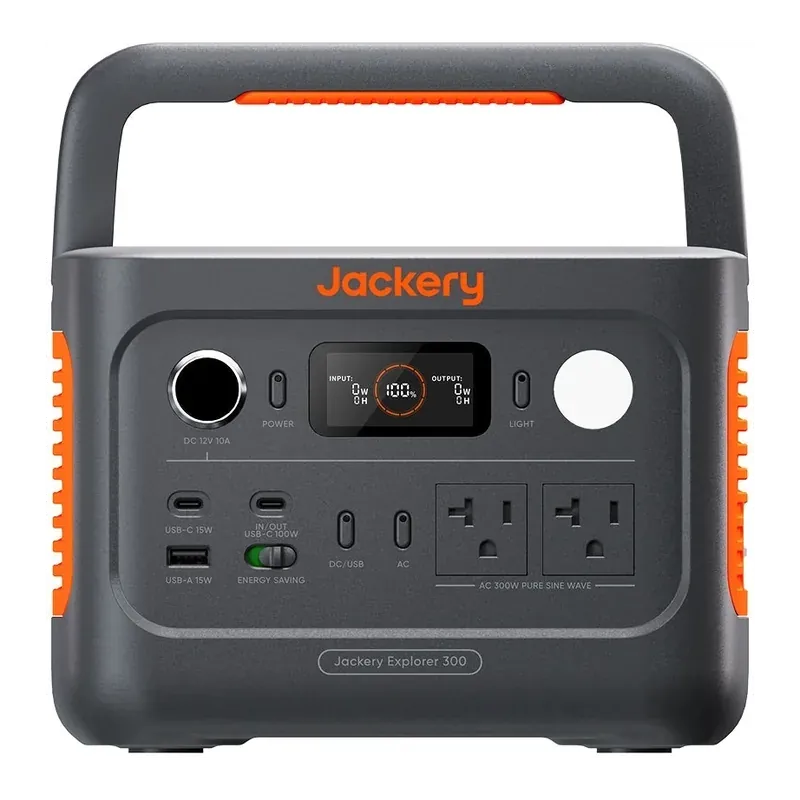
Jackery Explorer 300 v2
$200–$280 · price checked
- Capacity
- 288 Wh
- Output
- 300 W (600 W surge)
- Battery
- LiFePO4, 4,000 cycles (to 70%)
- Weight
- 8.2 lb
- Wall charge
- 1 h 16 min
- Solar input
- 100 W
Why it won: At 8.2 lb it is the lightest pick, and it still holds 288 Wh, enough for two to three full laptop charges, a mini fridge for about 8 hours or a CPAP without the humidifier for about four nights. Its 600 W surge rating is just enough to start a compact fridge.
Skip it if: Skip it if you need more than 300 W at once. That rules out coffee makers, hair dryers and most heaters, and solar charging only comes in through the 100 W USB-C port.
- Only 8.2 lb with a fold-down handle
- Two AC outlets plus a 100 W USB-C port for laptops
- Full recharge from a wall outlet in about 76 minutes
- LiFePO4 battery rated for 4,000 cycles (to 70% capacity)
- 300 W limit rules out coffee makers, hair dryers and most heaters
- Solar charging only through the 100 W USB-C input, with no DC solar port
- No app control, and it can be hard to find in stock
We may earn a commission if you buy through these links. It doesn’t change your price. How we make money
How long each pick runs
On the Jackery Explorer 1000 v2 (1,070 Wh), runtimes go from about 11 hrs for a box fan (20 in) to about 36 hrs for a Wi-Fi router + cable modem, each running by itself.
Swipe sideways to see every device →
| Power station | CPAP with heated humidifier 34 W average | Laptop (13-16 in) 65 W running, about 39 W average | Mini fridge 100 W running, about 30 W average | Wi-Fi router + cable modem 25 W average | Box fan (20 in) 85 W average |
|---|---|---|---|---|---|
| Anker SOLIX C1000 Gen 2 1,024 Wh | 26 hrs | 22 hrs | 29 hrs | 35 hrs | 10 hrs |
| Jackery Explorer 1000 v2 1,070 Wh | 27 hrs | 23 hrs | 30 hrs | 36 hrs | 11 hrs |
| Goal Zero Yeti 500 499 Wh | 12 hrs | 11 hrs | 14 hrs | 17 hrs | 5 hrs |
| EcoFlow RIVER 3 Plus 286 Wh | 7 hrs | 6 hrs | 8 hrs | 9.5 hrs | 3 hrs |
| Jackery Explorer 300 v2 288 Wh | 7 hrs | 6.5 hrs | 8 hrs | 10 hrs | 3 hrs |
Estimates: battery Wh × 0.85 ÷ the device’s average draw. Real runtime depends on temperature, battery age and how hard the device works.
Runtime on every station, one device at a time
Specs side by side
Swipe sideways to see every column →
| Spec | Anker SOLIX C1000 Gen 2 | Jackery Explorer 1000 v2 | Goal Zero Yeti 500 | EcoFlow RIVER 3 Plus | Jackery Explorer 300 v2 |
|---|---|---|---|---|---|
| Capacity | 1,024 Wh | 1,070 Wh (better) | 499 Wh | 286 Wh | 288 Wh |
| AC output (continuous) | 2,000 W (better) | 1,500 W | 500 W | 600 W | 300 W |
| Surge | 3,000 W | 3,000 W | 1,000 W | 1,200 W | 600 W |
| Boost mode (heaters, kettles) | None | None | None | 1,200 W | None |
| Battery type | LiFePO4 | LiFePO4 | LiFePO4 | LiFePO4 | LiFePO4 |
| Cycle life (rated) | 4,000 (to 80%) | 4,000 (to 70%) | 4,000 (to 80%) | 3,000 (to 80%) | 4,000 (to 70%) |
| Weight | 24.9 lb | 23.8 lb | 16.1 lb | 10.4 lb | 8.2 lb (better) |
| Wall charge time | 49 min (with UltraFast mode turned on in the app) (better) | 1 h 35 min (0–100%; about 1 h in Emergency Super Charge) | 1 h 30 min (in High input mode; ships in slower Low mode) | 1 h (0–100% from a wall outlet) | 1 h 16 min (0–100% from a wall outlet) |
| Max solar input | 600 W (better) | 400 W | 200 W | 220 W | 100 W |
| AC outlets | 5 (better) | 3 | 2 | 3 | 2 |
| USB-C ports (max) | 3 (140 W) (better) | 2 (100 W) | 3 (100 W) | 1 (100 W) | 2 (100 W) |
| USB-A ports | 1 | 1 | 2 | 2 | 1 |
| 12V / car port | Yes (1 DC ports) | Yes (1 DC ports) | Yes (2 DC ports) | Yes (1 DC ports) | Yes (1 DC ports) |
| Expandable | No | No | No | Yes, up to 858 Wh | No |
| UPS switch-over | 10 ms | 20 ms | No UPS mode | 10 ms | 10 ms |
| App control | Yes | Yes | Yes | Yes | No |
| Size | 15.1 x 8.2 x 9.6 in | 12.9 x 8.8 x 9.7 in | 11.32 x 7.82 x 7.8 in | 9.2 x 9.1 x 5.8 in | 9.1 x 6.0 x 6.6 in |
| Released | 2025 | 2024 | 2024 | 2025 | 2026 |
| Typical price | $400–$600 | $430–$560 | $340–$500 | $180–$300 | $200–$280 |
Related comparisons
Torn between two of these? Each comparison gives a verdict, specs and runtimes side by side.
How much battery do you need, and how much can you carry?
Start with a simple camping day. Two phones charging for about two hours each use about 48 Wh. LED string lights for five hours use about 50 Wh. Two hours of laptop charging adds about 78 Wh. That is about 176 Wh a day, or about 207 Wh of battery once you allow for inverter losses.
So a 288 Wh unit covers that day with a little to spare, and a two-night weekend needs about 415 Wh, which points to the 499 Wh Yeti 500. Add a CPAP with the heated humidifier at about 272 Wh a night, and each day needs about 530 Wh of battery. That is where the 1,000 Wh class, at about 24 to 25 lb, earns its weight.
A fair rule: if you only charge small gadgets, carry the 8 to 10 lb units. If you sleep with a CPAP or want to run a cooler or mini fridge, the extra 15 lb of a 1,000 Wh unit is worth it.
What to look for in a light unit
Compare watt-hours per pound, not just weight. The Jackery Explorer 1000 v2 carries about 45 Wh per pound and the Anker C1000 Gen 2 about 41. The Jackery Explorer 300 v2 is about 35, the Yeti 500 about 31 and the RIVER 3 Plus about 28.
All five picks use LiFePO4 cells rated for 3,000 to 4,000 cycles. NMC packs can be a bit lighter for the same capacity, but they are usually rated for far fewer cycles. For a unit you will drain and refill on every trip, LiFePO4 is the better long-term buy.
Check surge if you want to run anything with a motor. A compact fridge needs about 500 W for a second at start-up, which the 600 W surge of the Explorer 300 v2 can handle. A full-size fridge needs about 1,000 W, which rules out the 300 v2 but not the 1,000 Wh picks.
Recharge speed matters when you are between campsites. The C1000 Gen 2 refills in about 49 minutes with UltraFast on, the RIVER 3 Plus in about an hour, the Explorer 300 v2 in about 76 minutes, the Yeti 500 in about 90 minutes in High input mode and the Explorer 1000 v2 in about 95 minutes.
Mistakes to avoid
Buying the smallest unit and then adding a CPAP is the most common mistake. A 288 Wh unit runs a CPAP with the heated humidifier for about 7 hours, just short of a full night.
Expecting a small unit to run kitchen gear is another. A drip coffee maker pulls about 1,000 W, so it needs a station with at least that much continuous output. The 300 W Explorer 300 v2 and 500 W Yeti 500 cannot run one.
Finally, remember that expansion batteries add weight. The RIVER 3 Plus is 10.4 lb on its own, but carrying an extra battery means carrying two boxes.
Safety
Keep the station dry and give it room to breathe. IPX4 on the Yeti 500 means it handles splashes, not being left in the rain or set in a puddle. Do not leave any of these in a hot car, since heat shortens battery life.
If you rely on a CPAP or oxygen, a small power station should never be your only backup for life-support equipment. Carry a second plan, and ask your doctor or equipment supplier what they recommend.
Making it last longer
Turning off the CPAP's heated humidifier and tube is the biggest saving on this page: draw drops from about 34 W to about 7 W, so a 288 Wh unit goes from about 7 hours to about four nights.
Charge phones and laptops from USB-C instead of the AC outlet, which skips inverter losses. Between trips, store the station partly charged in a cool, dry place and top it up every few months.
Common questions
- What is the lightest power station that can run a CPAP?
- The Jackery Explorer 300 v2 at 8.2 lb runs a CPAP without the humidifier for about four nights (about 35 hours). With the heated humidifier and tube on, it lasts about 7 hours, just short of a full night. For that, step up to the 16.1 lb Yeti 500, which lasts about 12 hours.
- How heavy is a 1,000 Wh power station?
- Most current 1,000 Wh class units weigh about 24 to 28 lb. The Jackery Explorer 1000 v2 is 23.8 lb, the Anker SOLIX C1000 Gen 2 24.9 lb, the BLUETTI Elite 100 V2 25 lb and the EcoFlow DELTA 3 Plus 27.6 lb. The older BLUETTI AC180 is heavier at 35.3 lb.
- Can a small power station run a mini fridge?
- Yes, if its surge rating is at least about 500 W. The Jackery Explorer 300 v2, with a 600 W surge rating, runs a compact fridge for about 8 hours, and the Yeti 500 for about 14 hours. A full-size fridge needs about 1,000 W of surge, which rules out the 300 v2.
- Is a 300 Wh power station enough for camping?
- For phones, lights and a laptop, yes. A typical camp day of two phone charges, string lights for five hours and two hours of laptop charging uses about 176 Wh, so 288 Wh lasts nearly a day and a half. Add a CPAP with a humidifier or a fan and you need a bigger unit.
- Are lighter power stations less durable?
- Not on this list. All five picks use LiFePO4 batteries rated for 3,000 to 4,000 cycles. Jackery rates its cycle life to 70% capacity rather than 80%, so compare those numbers carefully.