
EcoFlow RIVER 3 Plus vs Jackery Explorer 300 v2: which should you buy?
The short verdict
The EcoFlow RIVER 3 Plus is the better pick for most people. It holds almost the same energy, 286 Wh against the Jackery’s 288 Wh, but it puts out 600 W instead of 300 W and handles a 1,200 W start-up surge instead of 600 W. That is the difference between running a fridge for about 5.5 hours in an outage and not running it at all.
The Jackery Explorer 300 v2 wins on weight and cycle rating. It is 8.2 lb against 10.4 lb, and Jackery rates it for 4,000 charge cycles against 3,000 for the EcoFlow, though Jackery counts to 70% capacity rather than 80%. If all you power is phones, laptops, a CPAP or a router, both last about the same time and the lighter box may suit you better.
The RIVER 3 Plus can also grow. Add an EcoFlow extra battery and it reaches 858 Wh. The Explorer 300 v2 cannot take extra batteries.
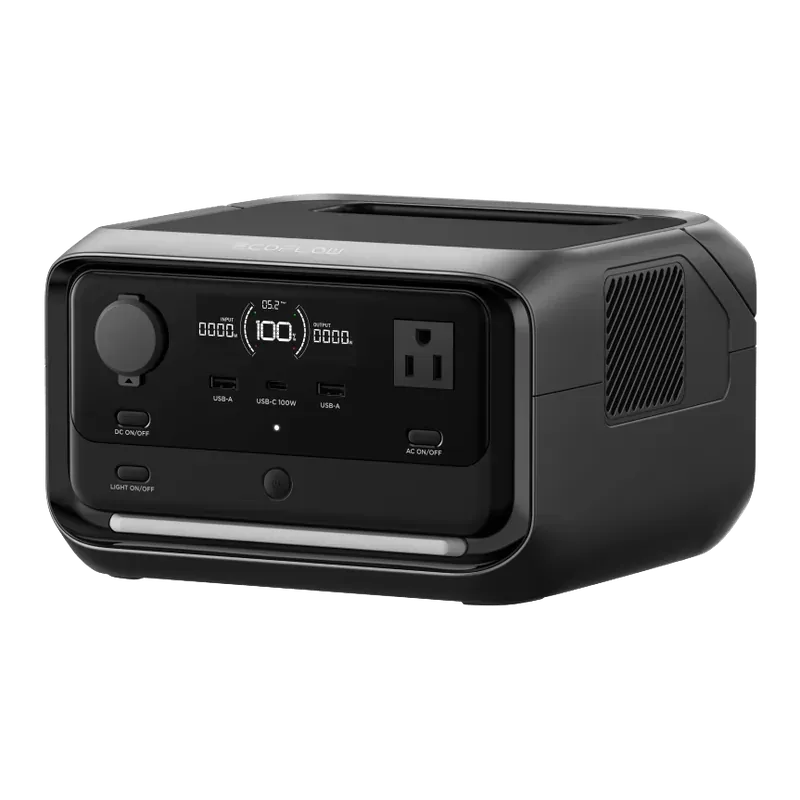
EcoFlow RIVER 3 Plus
286 Wh · 600 W · $180–$300
We may earn a commission if you buy through these links. It doesn’t change your price. How we make money
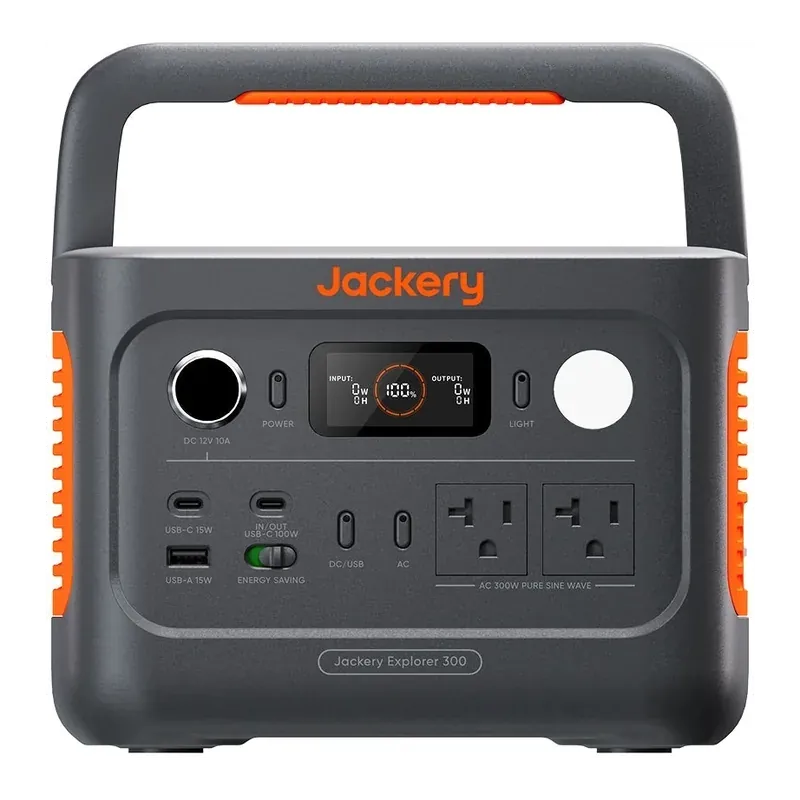
Jackery Explorer 300 v2
288 Wh · 300 W · $200–$280
We may earn a commission if you buy through these links. It doesn’t change your price. How we make money
Buy the EcoFlow RIVER 3 Plus if…
You want one small unit that can keep a fridge or chest freezer cold for a few hours during an outage, or run a desktop PC long enough to save your work. It also makes sense if you may want more capacity later, since an extra battery takes it to 858 Wh, or if you plan to charge it from a solar panel bigger than 100 W.
Buy the Jackery Explorer 300 v2 if…
You mostly charge phones, laptops, cameras and lights, and every pound matters, such as on a hike-in campsite or a day at the beach. It also suits a renter who just wants a router and a CPAP covered through a short outage and does not need an app.
Specs side by side
The better number in each row is highlighted.
| Spec | EcoFlow RIVER 3 Plus | Jackery Explorer 300 v2 |
|---|---|---|
| Capacity | 286 Wh | 288 Wh (better) |
| AC output (continuous) | 600 W (better) | 300 W |
| Surge | 1,200 W (better) | 600 W |
| Boost mode (heaters, kettles) | 1,200 W | None |
| Battery type | LiFePO4 | LiFePO4 |
| Cycle life (rated) | 3,000 (to 80%) | 4,000 (to 70%) |
| Weight | 10.4 lb | 8.2 lb (better) |
| Wall charge time | 1 h (0–100% from a wall outlet) (better) | 1 h 16 min (0–100% from a wall outlet) |
| Max solar input | 220 W (better) | 100 W |
| AC outlets | 3 (better) | 2 |
| USB-C ports (max) | 1 (100 W) | 2 (100 W) |
| USB-A ports | 2 | 1 |
| 12V / car port | Yes (1 DC ports) | Yes (1 DC ports) |
| Expandable | Yes, up to 858 Wh | No |
| UPS switch-over | 10 ms | 10 ms |
| App control | Yes | No |
| Size | 9.2 x 9.1 x 5.8 in | 9.1 x 6.0 x 6.6 in |
| Released | 2025 | 2026 |
| Typical price | $180–$300 | $200–$280 |
Runtime for common devices
On the Jackery Explorer 300 v2 (288 Wh), runtimes go from about 6.5 hrs for a laptop (13-16 in) to about 10 hrs for a Wi-Fi router + cable modem, each running by itself.
Swipe sideways to see every device →
| Power station | Full-size refrigerator 150 W running, about 45 W average | Chest freezer (7 cu ft) 80 W running, about 26 W average | CPAP with heated humidifier 34 W average | Wi-Fi router + cable modem 25 W average | Laptop (13-16 in) 65 W running, about 39 W average |
|---|---|---|---|---|---|
| EcoFlow RIVER 3 Plus 286 Wh | 5.5 hrs | 9 hrs | 7 hrs | 9.5 hrs | 6 hrs |
| Jackery Explorer 300 v2 288 Wh | Can’t run it | Can’t run it | 7 hrs | 10 hrs | 6.5 hrs |
Estimates: battery Wh × 0.85 ÷ the device’s average draw. Real runtime depends on temperature, battery age and how hard the device works.
See how every power station on this site handles one device:
Same battery, very different output
On paper the batteries are almost twins: 286 Wh against 288 Wh. For small, steady loads they last the same time. A CPAP with a heated humidifier runs for about 7 hours on either one, a cable modem and router for about 10 hours, and a laptop for about 6 hours of normal use.
The gap is in output. The RIVER 3 Plus delivers 600 W continuously and 1,200 W for a moment at start-up. The Explorer 300 v2 stops at 300 W and 600 W. A fridge compressor needs about 1,000 W for a second when it kicks on, and a chest freezer about 700 W. Both are above the Jackery’s surge limit, so it cannot start them. The RIVER 3 Plus can, and it keeps a full-size fridge going for about 5.5 hours or a chest freezer for about 9.
Neither unit runs a coffee maker, microwave, kettle or space heater. The RIVER 3 Plus has an X-Boost mode rated up to 1,200 W for simple heating devices, but its 286 Wh battery would drain fast even then. Think of both as electronics stations, with the EcoFlow able to stretch to small appliances.
Which one recharges faster from solar?
Both refill fast from a wall outlet. EcoFlow lists a full charge in about 60 minutes and Jackery about 76 minutes, so either one is ready again within the time it takes to make dinner.
Solar is where they split. The RIVER 3 Plus takes up to 220 W of solar, so in strong sun a matching panel could refill it in roughly an hour and a half. The Explorer 300 v2 only charges from solar through its 100 W USB-C port, which means a smaller panel and roughly 3 hours or more of good sun for a full charge. If you camp off-grid for several days, the EcoFlow keeps up more easily.
Size, ports and backup features
The Jackery is the easier carry at 8.2 lb, about 2 lb lighter than the 10.4 lb EcoFlow. Both are small enough for a car floor or a shelf. The RIVER 3 Plus has three AC outlets and two USB-A ports. The Explorer 300 v2 has two AC outlets but two USB-C ports, one of them 100 W, which is handy if your family runs on USB-C phones and laptops.
Both list a 10 ms UPS switch-over, so a router, modem or CPAP plugged in through either should keep running when the power blinks. Only the EcoFlow has app control, and only the EcoFlow can add an extra battery. With one fitted it reaches 858 Wh, which would run a full-size fridge for about 16 hours or a heated-humidifier CPAP for about 21 hours.
Value
Prices overlap. Both usually sell for roughly $200 to $300, and the RIVER 3 Plus often dips lower on sale. For about the same money, the EcoFlow gives you twice the output, more solar input and a path to more capacity.
The Jackery’s value is in its simplicity and lighter weight. If you will never plug in anything bigger than a laptop, you give up nothing you would use, and you get a slightly lighter box and a higher cycle rating.
Common questions
- Can the Jackery Explorer 300 v2 run a refrigerator?
- No. A typical fridge needs about 1,000 W for a second to start its compressor, and the Explorer 300 v2 tops out at a 600 W surge. The RIVER 3 Plus has a 1,200 W surge and runs a full-size fridge for about 5.5 hours.
- Which lasts longer on a CPAP?
- They are effectively tied. With a heated humidifier and tube, a CPAP draws about 34 W, so either unit lasts about 7 hours, a little short of a full 8-hour night. Turn the humidifier off and either one lasts about 35 hours, a little over four 8-hour nights.
- Which one is lighter?
- The Jackery Explorer 300 v2 weighs 8.2 lb. The EcoFlow RIVER 3 Plus weighs 10.4 lb, about 2 lb more.
- Can I add a battery to either one?
- Only the RIVER 3 Plus. With an EcoFlow extra battery it reaches 858 Wh, about three times its built-in capacity. The Explorer 300 v2 cannot be expanded.