
Jackery Explorer 2000 v2 vs Anker SOLIX C2000 Gen 2: which should you buy?
The short verdict
The Anker SOLIX C2000 Gen 2 is the better buy for most people. It matches the Jackery’s battery almost exactly, then adds 200 W more output, twice the solar input, five AC outlets instead of three and the option to double its capacity with one extra battery. It usually costs about the same or less.
The Jackery Explorer 2000 v2 is the more compact box. It is 2.2 lb lighter and much shorter end to end, which helps in a small closet or a car trunk. It also has a slightly higher start-up surge rating, 4,400 W against 4,000 W, though no common household device we list falls in that gap.
For runtime, call it a draw. Both run a full-size fridge for about 39 hours, so the choice comes down to features and fit.
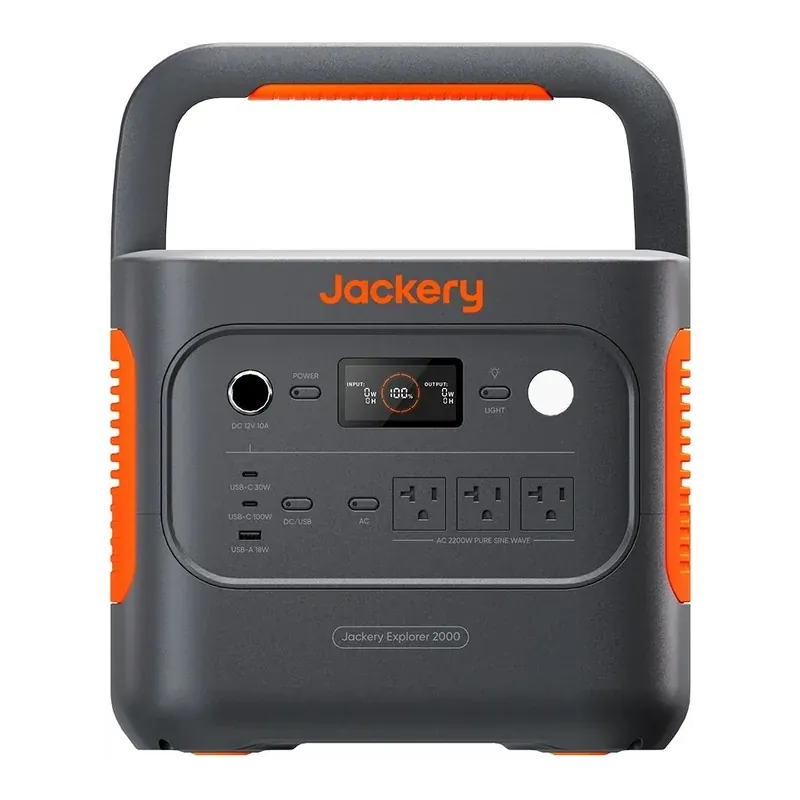
Jackery Explorer 2000 v2
2,042 Wh · 2,200 W · $700–$1,000
We may earn a commission if you buy through these links. It doesn’t change your price. How we make money
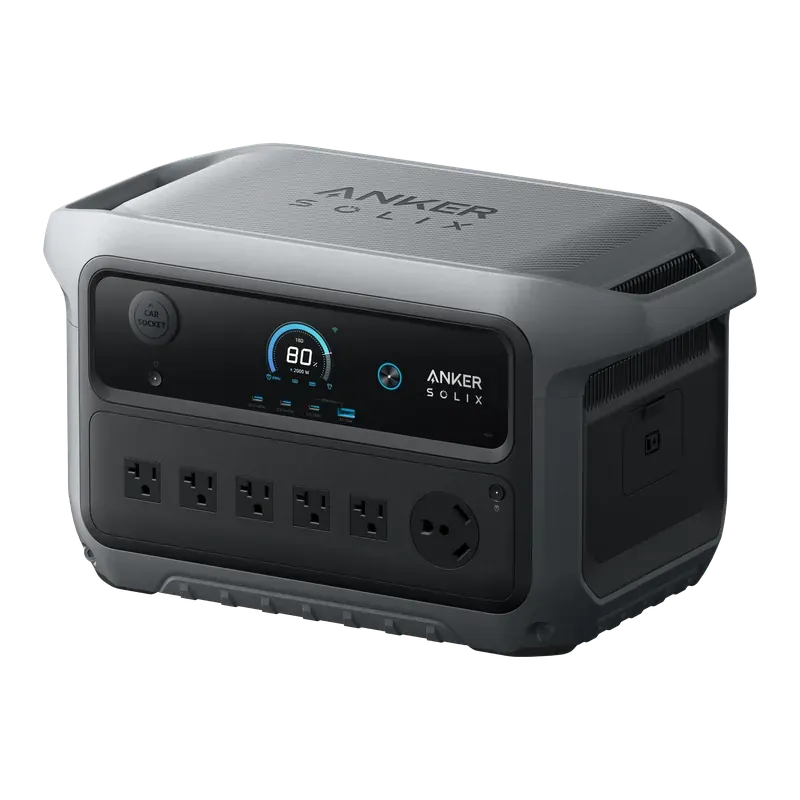
Anker SOLIX C2000 Gen 2
2,048 Wh · 2,400 W · $700–$900
We may earn a commission if you buy through these links. It doesn’t change your price. How we make money
Buy the Jackery Explorer 2000 v2 if…
You want a 2,000 Wh unit that fits a tight storage spot or a car trunk, and you will mostly charge it from the wall. It also makes sense if you find it on a better sale than the Anker, since its runtimes are nearly the same.
Buy the Anker SOLIX C2000 Gen 2 if…
You want room to grow, faster solar charging or more plugs. The TT-30 outlet plugs straight into a camper, the extra battery takes it to 4,096 Wh for multi-day outages, and the 10 ms UPS suits a home office computer.
Specs side by side
The better number in each row is highlighted.
| Spec | Jackery Explorer 2000 v2 | Anker SOLIX C2000 Gen 2 |
|---|---|---|
| Capacity | 2,042 Wh | 2,048 Wh (better) |
| AC output (continuous) | 2,200 W | 2,400 W (better) |
| Surge | 4,400 W (better) | 4,000 W |
| Boost mode (heaters, kettles) | None | None |
| Battery type | LiFePO4 | LiFePO4 |
| Cycle life (rated) | 4,000 (to 70%) | 4,000 (to 80%) |
| Weight | 39.5 lb (better) | 41.7 lb |
| Wall charge time | 1 h 45 min (0–100%; about 1.3 h in emergency charge mode) | 1 h 28 min (0–100% from a wall outlet alone) (better) |
| Max solar input | 400 W | 800 W (better) |
| AC outlets | 3 | 5 (better) |
| USB-C ports (max) | 2 (100 W) | 3 (140 W) (better) |
| USB-A ports | 1 | 1 |
| 12V / car port | Yes (1 DC ports) | Yes (1 DC ports) |
| Expandable | No | Yes, up to 4,096 Wh |
| UPS switch-over | 20 ms | 10 ms (better) |
| App control | Yes | Yes |
| Size | 13.2 x 10.4 x 11.5 in | 18.1 x 9.8 x 10.1 in |
| Released | 2024 | 2025 |
| Typical price | $700–$1,000 | $700–$900 (better) |
Runtime for common devices
On the Anker SOLIX C2000 Gen 2 (2,048 Wh), runtimes go from about 1 hr for a microwave (1000 W) to about 2 days for a CPAP with heated humidifier, each running by itself.
Swipe sideways to see every device →
| Power station | Full-size refrigerator 150 W running, about 45 W average | CPAP with heated humidifier 34 W average | Window AC 8,000 BTU 735 W running, about 368 W average | Well pump (1/2 HP) 1,000 W running, about 50 W average | Microwave (1000 W) 1,500 W average |
|---|---|---|---|---|---|
| Jackery Explorer 2000 v2 2,042 Wh | 39 hrs | 2 days | 4.5 hrs | 35 hrs | 1 hr |
| Anker SOLIX C2000 Gen 2 2,048 Wh | 39 hrs | 2 days | 4.5 hrs | 35 hrs | 1 hr |
Estimates: battery Wh × 0.85 ÷ the device’s average draw. Real runtime depends on temperature, battery age and how hard the device works.
See how every power station on this site handles one device:
How long does each one run a fridge or CPAP?
The Jackery holds 2,042 Wh and the Anker 2,048 Wh. That is a difference of six watt-hours, which you will never notice. A full-size fridge runs for about 39 hours on either one. A CPAP with a heated humidifier runs for about 51 hours, or about six 8-hour nights. A cable modem and router would run for close to three days.
The real difference shows up over a long outage. The Explorer 2000 v2 cannot take extra batteries, so 2,042 Wh is all you will ever have. The C2000 Gen 2 can add one BP2000 Gen 2 battery to reach 4,096 Wh. That would keep the same fridge going for about three days instead of a day and a half.
Output and what each can start
Both have plenty of power for a normal kitchen. The Anker delivers 2,400 W continuously and the Jackery 2,200 W, so either can run a 1,500 W microwave, a toaster or an induction cooktop one at a time. The extra 200 W on the Anker helps when you stack loads, for example a microwave while a window AC is already running. That pair needs about 2,235 W, just over the Jackery’s limit.
For start-up surge the Jackery rates 4,400 W and the Anker 4,000 W. Both clear an 8,000 BTU window AC (about 2,200 W to start) and a 120V 1/2 hp well pump (about 3,000 W to start). The well pump would run for about 35 hours on either, based on its usual on-and-off pattern. Many well pumps are wired for 230V, though, and neither unit supplies that.
Outlets differ more than watts. The Jackery has three AC outlets, two USB-C ports (100 W and 30 W), one USB-A and a car port. The Anker has five AC outlets including a TT-30 RV outlet, three USB-C ports up to 140 W, one USB-A and a car port.
Charging, weight and UPS
From the wall, the Anker refills in about 88 minutes and the Jackery in about 105, with a faster emergency mode of about 1.3 hours. Either is full again within two hours. Solar is a bigger gap. The Anker accepts 800 W and the Jackery 400 W. In ideal sun that is roughly 2.5 hours for the Anker and about 5 hours for the Jackery, and real-world panels usually take longer.
The Jackery weighs 39.5 lb and the Anker 41.7 lb. Both need two hands. The Jackery is shaped more like a cube at 13.2 inches long, while the Anker stretches to 18.1 inches, so measure your storage spot if space is tight.
Both work as a UPS. The Anker lists a 10 ms switch-over and the Jackery 20 ms. Routers and most computers handle either, but the faster switch gives more margin for sensitive desktop power supplies.
Value
Both usually sell for roughly $700 to $900, and the Jackery’s price can run higher. At the same price, the Anker gives you more outlets, more solar input, a faster UPS and an upgrade path. Anker’s list price is well above its usual street price, so wait for a sale.
Jackery rates its 4,000-cycle battery life to 70% capacity. Anker also lists 4,000 cycles. Either will outlast years of outages and weekend trips.
Common questions
- How long will each run a refrigerator?
- About 39 hours for a typical full-size fridge on either unit. With the Anker’s extra battery, that rises to about 77 hours, a little over three days.
- Can either one run a window air conditioner?
- Yes. Both can start and run an 8,000 BTU window AC, which needs about 735 W running and 2,200 W to start. Expect roughly 4.5 to 5 hours on either, based on the compressor cycling on and off.
- Which charges faster from solar?
- The Anker. It accepts up to 800 W of solar, twice the Jackery’s 400 W. With enough panels in full sun, it can refill in about 2.5 hours, against about 5 hours for the Jackery.
- Can I plug an RV into either one?
- The Anker C2000 Gen 2 has a built-in TT-30 outlet that plugs straight into an RV. The Jackery Explorer 2000 v2 does not have a 30A RV outlet.