Skip to content

Popular searches
Not sure what to search? Try the runtime calculator
Will it run my…

Can a power station run a washing machine (front load)?

Updated
Short answer

Yes, on 16 of 20 units, if the station puts out at least 1,000 W and handles a 2,000 W start-up. A 1,000 Wh power station runs about one cold-water load, and a 2,000 Wh unit about three.

Calculate your runtime
Running
1,000 W
300–1200 W range
Start-up
2,000 W
Runs
50%
of the time, about 500 W average

A front-load washer does not pull its peak power all cycle. An LG model is rated at 120 V and 10 amps, which is up to about 1,200 W, and the peak comes when the motor is working hardest. We plan on 1,000 W while it runs and about 500 W averaged over a cycle. Your own washer's rating plate lists its amps, and amps times 120 gives the peak watts.

The hurdle is the start-up. The motor needs about 2,000 W for a moment, twice its running draw, so the station needs at least 1,000 W of continuous output and a 2,000 W surge. That rules out the four units of 499 Wh or less: the RIVER 3 Plus and Elite 30 V2 stop at 600 W, the Explorer 300 v2 at 300 W and the Yeti 500 at 500 W. The other 16 can run it. A one-hour cold-water cycle uses about 500 Wh at the average draw. A 1,000 Wh unit runs the washer about 1.5 to 2 hours, enough for one load. A 2,000 Wh unit runs it about 3.5 hours, or three loads, and the HomePower 3000 about 5 hours, or five.

Hot water and the dryer are the limits. Hot cycles can push the draw past our numbers, so stick to cold and check your model's label. An electric dryer is a 240 V appliance that is not in our data, so we say no to it and give no watts. Dry clothes on a rack or a line instead. If your washer is hard-wired rather than plugged in, it needs an electrician and a transfer switch or inlet, never a cord into the station.

How long does each power station run a washing machine (front load)?

At about 500 W on average, a washing machine (front load) runs for about 1.5 hrs to 2 hrs on a 1,000 Wh-class unit (998–1,070 Wh) and about 7 hrs on the 4,096 Wh EcoFlow DELTA Pro 3. 4 units here can’t run it.

Swipe sideways for battery size, output and price →

Hours a washing machine (front load) runs on each power station, from a full charge with nothing else plugged in (15% inverter loss). Sorted by battery size.
Power stationRuntimeBatteryOutput / surgePrice range
EcoFlow RIVER 3 PlusCan’t run it286 Wh600 / 1,200 W$180–$300
BLUETTI Elite 30 V2Can’t run it288 Wh600 / 1,500 W$180–$280
Jackery Explorer 300 v2Can’t run it288 Wh300 / 600 W$200–$280
Goal Zero Yeti 500Can’t run it499 Wh500 / 1,000 W$340–$500
Goal Zero Yeti 1000 (6th Gen)1.5 hrs998 Wh2,000 / 3,600 Wlist price about $1,200
Anker SOLIX C1000 Gen 21.5 hrs1,024 Wh2,000 / 3,000 W$400–$600
BLUETTI Elite 100 V21.5 hrs1,024 Wh1,800 / 3,600 W$380–$500
DJI Power 1000 V21.5 hrs1,024 Wh2,600 / 2,600 W$340–$450
EcoFlow DELTA 31.5 hrs1,024 Wh1,800 / 3,600 W$500–$700
EcoFlow DELTA 3 Plus1.5 hrs1,024 Wh1,800 / 3,600 W$550–$800
Jackery Explorer 1000 v22 hrs1,070 Wh1,500 / 3,000 W$430–$560
BLUETTI AC1802 hrs1,152 Wh1,800 / 2,700 W$400–$500
Jackery Explorer 2000 v23.5 hrs2,042 Wh2,200 / 4,400 W$700–$1,000
Anker SOLIX C2000 Gen 23.5 hrs2,048 Wh2,400 / 4,000 W$700–$900
DJI Power 20003.5 hrs2,048 Wh3,000 / 3,600 W$700–$1,300
BLUETTI Elite 200 V23.5 hrs2,074 Wh2,600 / 3,900 W$700–$900
BLUETTI Apex 3004.5 hrs2,765 Wh3,840 / 7,680 W$1,200–$1,600
Jackery HomePower 30005 hrs3,072 Wh3,600 / 7,200 W$900–$1,500
Anker SOLIX F3800 Plus6.5 hrs3,840 Wh6,000 / 9,000 W$2,090–$2,700
EcoFlow DELTA Pro 37 hrs4,096 Wh4,000 / 8,000 W$2,400–$3,700

Estimate: battery Wh × 0.85 ÷ 500 W average (1000 W × 0.5 duty). Your model may draw more or less; check its label. Prices are typical ranges we checked by hand on October 9, 2026, not live prices.

Where these numbers come from

An LG front loader is rated 120 V and 10 amps, and the motor needs about twice its running watts to start. ENERGY STAR lists the same machine at 105 kWh a year, so a cold-water load usually uses under 500 Wh.

Sources

  1. energystar.gov · energystar.gov · PDF
  2. townappliance.com · townappliance.com
  3. DTE Energy appliance usage guide (GenerLink worksheet) · dteenergy.com · PDF
  4. Home Depot product document · images.homedepot-static.com · PDF

We do not test units ourselves. Picks come from the official spec sheets and manuals, the watt-hour math on this site, and prices we check by hand. How we pick

Good fits for a washing machine (front load)

#1
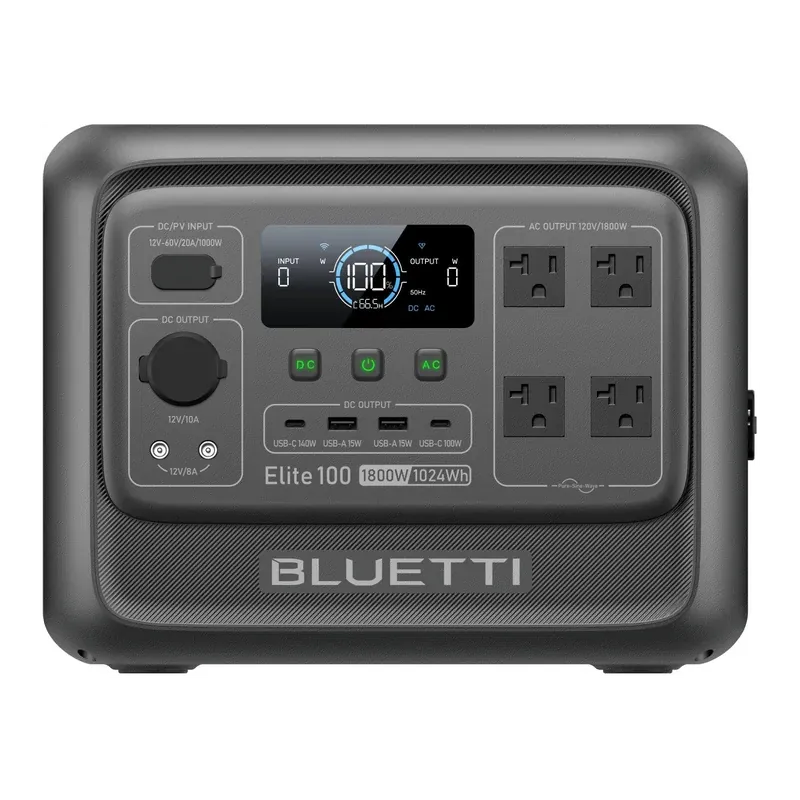
BLUETTI Elite 100 V2 portable power station, front view

BLUETTI Elite 100 V2

$380–$500 · price checked

Capacity
1,024 Wh
Output
1,800 W (3,600 W surge)
Battery
LiFePO4, 4,000 cycles
Weight
25 lb
Wall charge
1 h 10 min
Solar input
1,000 W

Why it won: About 1.5 hours of washing, enough for one cold load. Its 1,800 W output and 3,600 W surge clear the 2,000 W start, and it weighs 25 lb.

  • 1,800 W output runs most kitchen appliances one at a time
  • Full recharge from a wall outlet in about 70 minutes
  • 25 lb, much lighter than the older AC180
  • 4,000-cycle battery rated for about 10 years of use
  • Cannot add extra batteries
  • 1,024 Wh will run a fridge for roughly a day, not several days
  • Reaching the full 1,000 W solar input takes several panels
Full specs and runtimes for the BLUETTI Elite 100 V2
#2
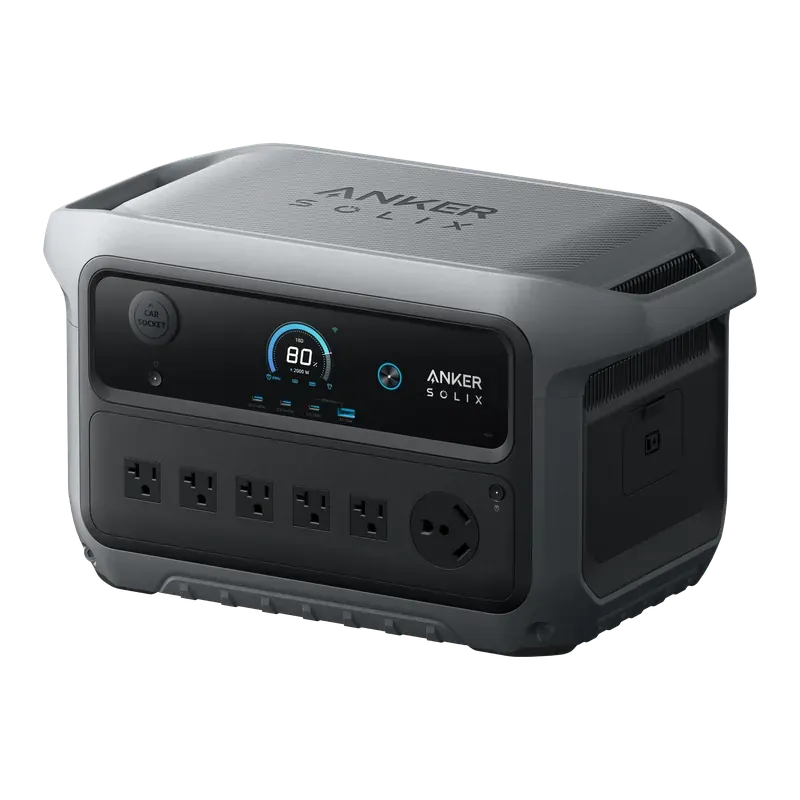
Anker SOLIX C2000 Gen 2 portable power station, front view

Anker SOLIX C2000 Gen 2

$700–$900 · price checked

Capacity
2,048 Wh
Output
2,400 W (4,000 W surge)
Battery
LiFePO4, 4,000 cycles
Weight
41.7 lb
Wall charge
1 h 28 min
Solar input
800 W

Why it won: About 3.5 hours, or about three cold loads, with 2,400 W of output and a 4,000 W surge. At 41.7 lb, it is a two-hand carry.

  • 2,400 W output with 4,000 W peak handles most kitchen appliances
  • Built-in TT-30 outlet plugs straight into an RV
  • Expands to 4,096 Wh with one BP2000 Gen 2 battery
  • 10 ms UPS switch-over protects a router or computer
  • 41.7 lb, a two-hand carry
  • Only one USB-A port
  • List price is much higher than typical sale prices, so wait for a sale
Full specs and runtimes for the Anker SOLIX C2000 Gen 2
#3
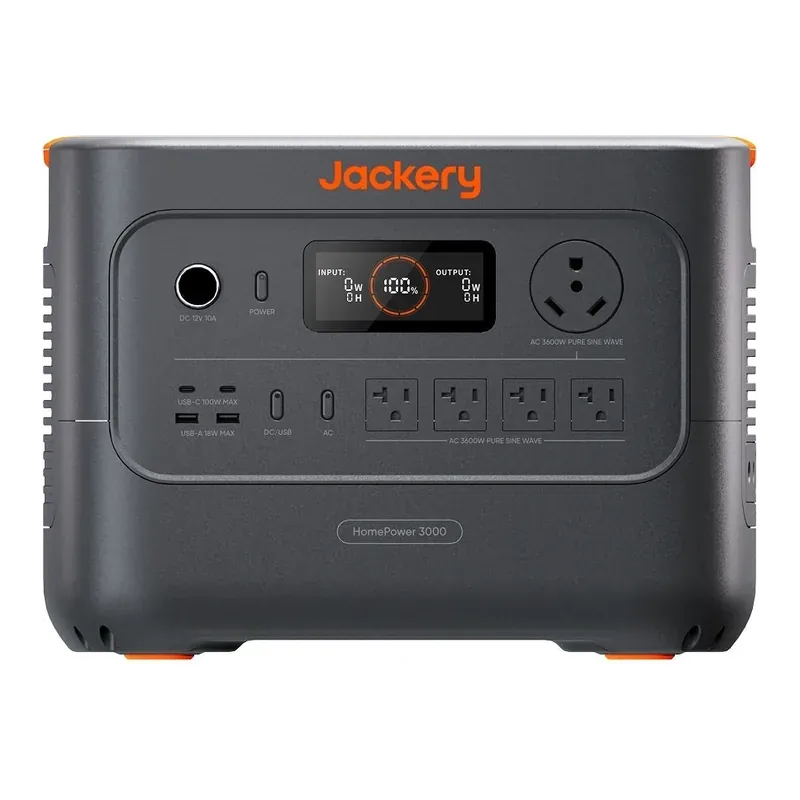
Jackery HomePower 3000 portable power station, front view

Jackery HomePower 3000

$900–$1,500 · price checked

Capacity
3,072 Wh
Output
3,600 W (7,200 W surge)
Battery
LiFePO4, 4,000 cycles (to 70%)
Weight
59.5 lb
Wall charge
2 h 12 min
Solar input
1,000 W

Why it won: About 5 hours, or about five cold loads, from 3,072 Wh. Its 3,600 W output leaves headroom, but at 59.5 lb it has no built-in wheels.

  • 3,600 W output with a 30A outlet can run several appliances at once
  • Can feed up to six home circuits through a manual transfer switch
  • Takes up to 1,000 W of solar for faster off-grid recharging
  • Compact and light for its 3,072 Wh capacity at 59.5 lb
  • Cannot add extra batteries; the 2000 Plus or 5000 Plus can
  • Still heavy to carry up stairs, with no built-in wheels
  • Jackery rates cycle life to 70% capacity, not 80%
Full specs and runtimes for the Jackery HomePower 3000

Make it last longer

  • • Wash on cold. Our math assumes a cold-water cycle, and a hot one adds heater draw on top.
  • • Skip the extra rinse and the heavy-soil option, so the motor runs for fewer minutes.
  • • Wash full loads, so each charge cleans more clothes.
  • • Start the washer first, with nothing else plugged into the station, so the 2,000 W start-up has the full surge limit to itself.
  • • Wash while the station is also charging from solar or the wall, if your unit allows it, so the load takes less from the battery.
  • • Hang clothes to dry instead of looking for a way to power a dryer.

Add the rest of your devices

Yes, but it’s tight, about 1.5 hrs for a washing machine (front load) on the BLUETTI Elite 100 V2.

Step 1

What do you want to run?

  • Washing machine (front load)
    Number of Washing machine (front load): 1
Add more
Step 2

Pick a power station

1,800 W output · 3,600 W surge · full specs

For a washing machine (front load) on the BLUETTI Elite 100 V2:

Yes, but it’s tight
Estimated runtime
1.5 hrs
If everything ran flat out the whole time: about 50 min.
Running load
1,000 W
Average draw
500 W
Biggest surge
2,000 W
  • • The biggest start-up surge (2,000 W) is above the continuous output but within the 3,600 W surge rating, so it should start fine.
  • • Runtime is only about 1.5 hrs. Consider a bigger battery or fewer devices.

Math: battery Wh × 0.85 ÷ average watts. Cold weather, battery age and screen-on time all shorten this.

Power stations that can run this

We may earn a commission if you buy through these links. It doesn't change your price. How we make money
Price ranges checked by hand on October 9, 2026. Prices change often.

About 1.5 hrs
1 device on BLUETTI Elite 100 V2
See result

Common questions

How many loads of laundry can a 1,000 Wh power station run?
About one cold-water load. A 1,024 Wh unit runs the washer for about 1.5 hours, and a one-hour cycle uses about 500 Wh, so a second full cycle falls short.
Can a 300 Wh power station run a washing machine?
No. The washer needs about 1,000 W to run and about 2,000 W to start. The 286 and 288 Wh units put out only 300 to 600 W, and the 499 Wh Yeti 500 stops at 500 W.
Can a power station run a washer and a dryer?
Only the washer. An electric dryer is a 240 V appliance and is not in our data, so we cannot say any station runs it. Use a rack or a line for drying.
Why does my power station shut off when the washer starts?
The motor needs about 2,000 W for a moment, twice what it draws once running. A station with less than 1,000 W of output or a lower surge limit cuts out. Use a unit that handles both numbers and plug nothing else in.
How long will a 2,000 Wh power station run a washing machine?
About 3.5 hours, which is about three cold-water loads. Step up to the HomePower 3000 and it is about 5 hours and five loads.

Related “will it run” questions