
BLUETTI AC180 vs EcoFlow DELTA 3 Plus: which should you buy?
The short verdict
The EcoFlow DELTA 3 Plus is the better pick for most people who want home backup. Both put out 1,800 W, but the DELTA handles a 3,600 W start-up surge against the AC180's 2,700 W. That is enough to start a 1/2 HP well pump or a garage door opener, which the AC180 cannot. It also lists a 10 ms UPS switch-over against 20 ms, and it weighs 27.6 lb instead of 35.3 lb.
The BLUETTI AC180 wins on battery and price. It holds 1,152 Wh against 1,024 Wh, so it runs a full-size fridge for about 22 hours instead of 19 and a CPAP with a heated humidifier for about 29 hours instead of 26. It usually sells for roughly $400 to $500, while the DELTA 3 Plus usually sells for roughly $550 to $800.
The tie-breaker is growth and the motor loads in your home. The DELTA 3 Plus can add EcoFlow extra batteries up to 5,000 Wh and takes 1,000 W of solar against 500 W. The AC180 cannot add batteries. If you only run a fridge, a CPAP, a router and small appliances, the AC180 gives you more hours for less money.
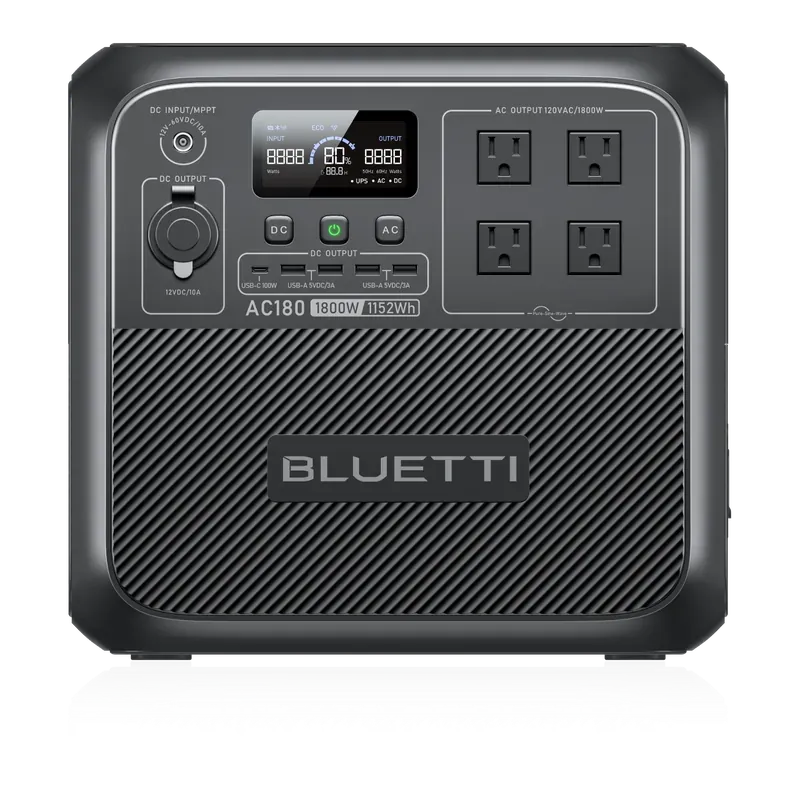
BLUETTI AC180
1,152 Wh · 1,800 W · $400–$500
We may earn a commission if you buy through these links. It doesn’t change your price. How we make money
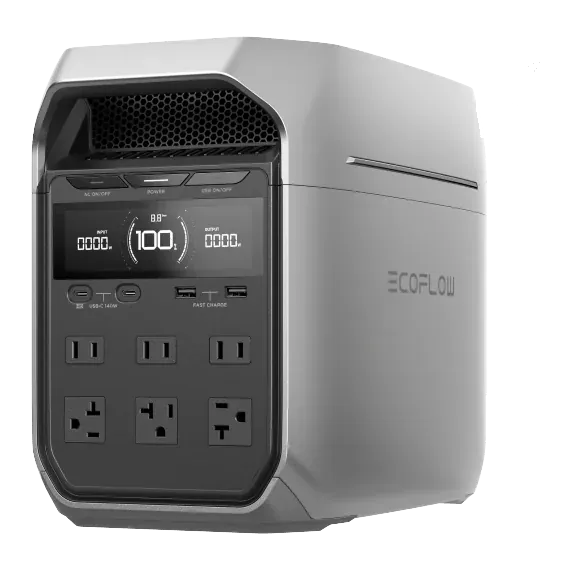
EcoFlow DELTA 3 Plus
1,024 Wh · 1,800 W · $550–$800
We may earn a commission if you buy through these links. It doesn’t change your price. How we make money
Buy the BLUETTI AC180 if…
You want the most runtime per dollar for a fridge, a CPAP or a router through a short outage, and you will not add batteries later. It also suits you if you charge a lot of small gear, since it has four USB-A ports and a wireless phone pad, and you do not mind lifting 35.3 lb.
Buy the EcoFlow DELTA 3 Plus if…
You need to start a motor load such as a 1/2 HP well pump or a garage door opener, or you want a 10 ms UPS switch-over for a computer or network gear. It also fits if you may want more battery later, up to 5,000 Wh, or plan to charge from up to 1,000 W of solar.
Specs side by side
The better number in each row is highlighted.
| Spec | BLUETTI AC180 | EcoFlow DELTA 3 Plus |
|---|---|---|
| Capacity | 1,152 Wh (better) | 1,024 Wh |
| AC output (continuous) | 1,800 W | 1,800 W |
| Surge | 2,700 W | 3,600 W (better) |
| Boost mode (heaters, kettles) | 2,700 W | 2,200 W |
| Battery type | LiFePO4 | LiFePO4 |
| Cycle life (rated) | 3,500 (to 80%) | 4,000 (to 80%) (better) |
| Weight | 35.3 lb | 27.6 lb (better) |
| Wall charge time | 1 h 18 min (Turbo mode; 0–80% in 45 min) | 56 min (0–100%; about 80% in 30–40 min) (better) |
| Max solar input | 500 W | 1,000 W (better) |
| AC outlets | 4 | 6 (better) |
| USB-C ports (max) | 1 (100 W) | 2 (140 W) (better) |
| USB-A ports | 4 | 2 |
| 12V / car port | Yes (1 DC ports) | Yes (3 DC ports) |
| Expandable | No | Yes, up to 5,000 Wh |
| UPS switch-over | 20 ms | 10 ms (better) |
| App control | Yes | Yes |
| Size | 13.4 x 9.7 x 12.5 in | 15.7 x 8.0 x 11.2 in |
| Released | 2023 | 2024 |
| Typical price | $400–$500 (better) | $550–$800 |
Runtime for common devices
On the BLUETTI AC180 (1,152 Wh), runtimes go from about 40 min for a microwave (1000 W) to about 29 hrs for a CPAP with heated humidifier, each running by itself.
Swipe sideways to see every device →
| Power station | Full-size refrigerator 150 W running, about 45 W average | CPAP with heated humidifier 34 W average | Well pump (1/2 HP) 1,000 W running, about 50 W average | Garage door opener 875 W running, about 8.8 W average | Microwave (1000 W) 1,500 W average |
|---|---|---|---|---|---|
| BLUETTI AC180 1,152 Wh | 22 hrs | 29 hrs | Can’t run it | Can’t run it | 40 min |
| EcoFlow DELTA 3 Plus 1,024 Wh | 19 hrs | 26 hrs | 17 hrs | 4 days | 35 min |
Estimates: battery Wh × 0.85 ÷ the device’s average draw. Real runtime depends on temperature, battery age and how hard the device works.
See how every power station on this site handles one device:
More battery against more surge
Both units deliver 1,800 W continuously, so they run the same everyday loads. The AC180 holds 128 Wh more, about 12.5% extra, and that shows in every runtime. A full-size fridge runs about 22 hours on the AC180 and about 19 on the DELTA 3 Plus. A router and cable modem run about 39 hours against 35, and a chest freezer about 37 hours against 33.
The gap that decides some homes is start-up surge. A 1/2 HP well pump needs about 3,000 W for a moment to start, and a garage door opener about 3,200 W. The DELTA 3 Plus allows 3,600 W, so it can start both. The AC180 stops at 2,700 W, so it cannot run either one. On the DELTA, the well pump at its usual light duty lasts about 17 hours.
Boost modes do not change this. The AC180 has a Power Lifting mode rated at 2,700 W and the DELTA has X-Boost rated at 2,200 W. They may run simple heating devices at reduced power, so check the manual, but they do not raise the start-up surge for a pump or motor.
Kitchen and medical loads
A 1,000 W microwave pulls about 1,500 W from the outlet, which both units can supply. The AC180 gives about 40 minutes of total cooking and the DELTA about 35. That is about seven 5-minute reheats on the AC180 and six on the DELTA.
A CPAP with a heated humidifier runs about 29 hours on the AC180 and about 26 on the DELTA 3 Plus. Both cover 3 full nights of 8 hours. The DELTA's 10 ms UPS switch-over is meant to keep it running through a grid drop, against 20 ms on the AC180. Treat either one as a short bridge, never your only backup, and ask your equipment supplier about an outage plan.
Recharging, solar and expansion
The DELTA 3 Plus refills from a wall outlet in about 56 minutes, and EcoFlow lists about 80% in 30 to 40 minutes. The AC180 takes about 1 hour 18 minutes in Turbo mode, or about 45 minutes to 80%. Both are fast enough to top up between rolling outages.
Solar is a bigger gap. The DELTA 3 Plus takes up to 1,000 W through two inputs of 500 W each, and the AC180 takes up to 500 W. The DELTA can also add EcoFlow extra batteries up to 5,000 Wh, almost five times its own battery. The AC180 stays at 1,152 Wh.
Size, ports and value
The DELTA 3 Plus weighs 27.6 lb and the AC180 weighs 35.3 lb, about 7.7 lb more. The DELTA has six AC outlets to the AC180's four, and two 140 W USB-C ports against one 100 W port. The AC180 has four USB-A ports to the DELTA's two, plus a wireless phone pad. Both have a 12V car port.
Both use LiFePO4 cells, rated for 3,500 cycles on the AC180 and 4,000 on the DELTA. The AC180 came out in 2023 and the DELTA 3 Plus in 2024. The AC180's app works over Bluetooth only, with no Wi-Fi.
The AC180 usually sells for under $500 and the DELTA 3 Plus for roughly $550 to $800. For the lower price you get more battery. For the higher one you get more surge, a faster UPS, more solar input, a lighter box and a path to more capacity.
Common questions
- Can the BLUETTI AC180 run a well pump?
- Not a 1/2 HP well pump. It needs about 3,000 W to start, and the AC180's surge limit is 2,700 W. The DELTA 3 Plus has a 3,600 W surge and runs it for about 17 hours. Many well pumps are hard-wired, so have an electrician install an inlet and never backfeed the house.
- Which runs a refrigerator longer, the AC180 or the DELTA 3 Plus?
- The AC180, at about 22 hours on a full-size fridge against about 19 on the DELTA 3 Plus. Its battery is 1,152 Wh against 1,024 Wh.
- Which is lighter?
- The DELTA 3 Plus, at 27.6 lb against 35.3 lb. That is about 7.7 lb less, with about 11% less battery.
- Can I add a battery to either one?
- Only to the DELTA 3 Plus. EcoFlow extra batteries take it up to 5,000 Wh. The AC180 cannot be expanded and stays at 1,152 Wh.
- Can either one run a garage door opener?
- Only the DELTA 3 Plus. An opener needs about 3,200 W for a moment to start, which fits under its 3,600 W surge but not the AC180's 2,700 W. Each open uses very little energy, so the battery is not the limit.
Full specs and buying guides
More comparisons
- EcoFlow DELTA 3 Plus vs Jackery Explorer 1000 v2: which should you buy?
- EcoFlow DELTA 3 Plus vs Anker SOLIX C1000 Gen 2: which should you buy?
- EcoFlow DELTA 3 vs EcoFlow DELTA 3 Plus: which should you buy?
- BLUETTI Elite 100 V2 vs EcoFlow DELTA 3 Plus: which should you buy?
- DJI Power 1000 V2 vs EcoFlow DELTA 3 Plus: which should you buy?
- BLUETTI AC180 vs BLUETTI Elite 100 V2: which should you buy?