
Best power station for a sump pump in 2026
As an Amazon Associate, BlackoutWise earns from qualifying purchases. We may also earn a commission when you buy through brand store links. This never changes the price you pay or which products we recommend. How we make money

The best power station for sump pump backup for most homes is the Anker SOLIX C2000 Gen 2. Its 4,000 W surge starts a 1/3 HP pump with room to spare, and its 2,048 Wh battery covers about 22 hours if the pump runs 10% of the time. It lists a 10 ms UPS switch-over, so it can take over the pump without you plugging anything in.
Fall rain and spring snowmelt fill sump pits fast, and the same storms knock out power. Start-up is the first hurdle. A 1/3 HP pump needs about 2,100 W for a moment each time the float switch kicks in, then about 800 W while it runs. That rules out every 286 to 499 Wh unit in our table, since none puts out more than 600 W. At 10% pump time the pump averages 80 W, or about 1,920 Wh a day, so plan on about 2,260 Wh of battery for each day.
We do not test units ourselves. Our picks come from the official spec sheets and manuals, the watt-hour math on this site, and prices we check by hand. Runtimes are estimates that assume about 15% is lost in the inverter. See how we pick.
Quick picks
- 1. Best overall: Anker SOLIX C2000 Gen 22,048 Wh · 2,400 W · $700–$900
- 2. Most battery in one box: Jackery HomePower 30003,072 Wh · 3,600 W · $900–$1,500
- 3. Most room to grow: DJI Power 20002,048 Wh · 3,000 W · $700–$1,300
- 4. Best value: BLUETTI Elite 100 V21,024 Wh · 1,800 W · $380–$500
- 5. Best for long storms: Anker SOLIX F3800 Plus3,840 Wh · 6,000 W · $2,090–$2,700
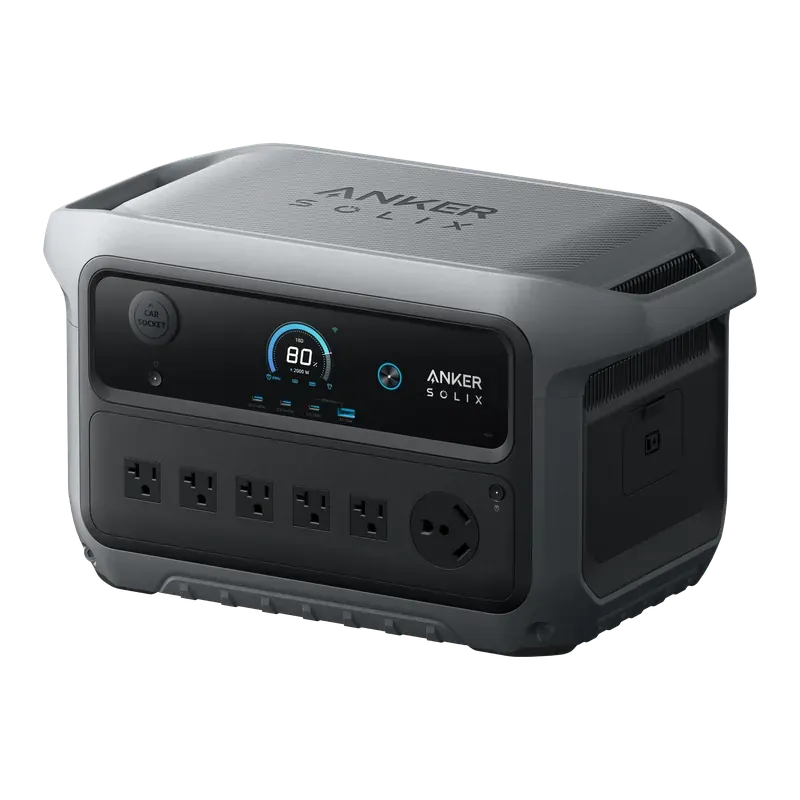
Anker SOLIX C2000 Gen 2
$700–$900 · price checked
- Capacity
- 2,048 Wh
- Output
- 2,400 W (4,000 W surge)
- Battery
- LiFePO4, 4,000 cycles
- Weight
- 41.7 lb
- Wall charge
- 1 h 28 min
- Solar input
- 800 W
Why it won: It has 2,400 W of output and a 4,000 W surge, almost twice the 2,100 W a 1/3 HP pump needs to start. The 2,048 Wh battery backs up the pump for about 22 hours at 10% pump time, or about 14 hours with a router and two LED bulbs on too. One BP2000 Gen 2 battery doubles it to 4,096 Wh, about 44 hours for the pump alone. It lists a 10 ms UPS switch-over and refills from the wall in about 88 minutes.
Skip it if: At 41.7 lb, it is a two-hand carry down the basement stairs. If the pump runs nonstop in a heavy storm, even this battery lasts only about 2 hours.
- 2,400 W output with 4,000 W peak handles most kitchen appliances
- Built-in TT-30 outlet plugs straight into an RV
- Expands to 4,096 Wh with one BP2000 Gen 2 battery
- 10 ms UPS switch-over protects a router or computer
- 41.7 lb, a two-hand carry
- Only one USB-A port
- List price is much higher than typical sale prices, so wait for a sale
We may earn a commission if you buy through these links. It doesn’t change your price. How we make money
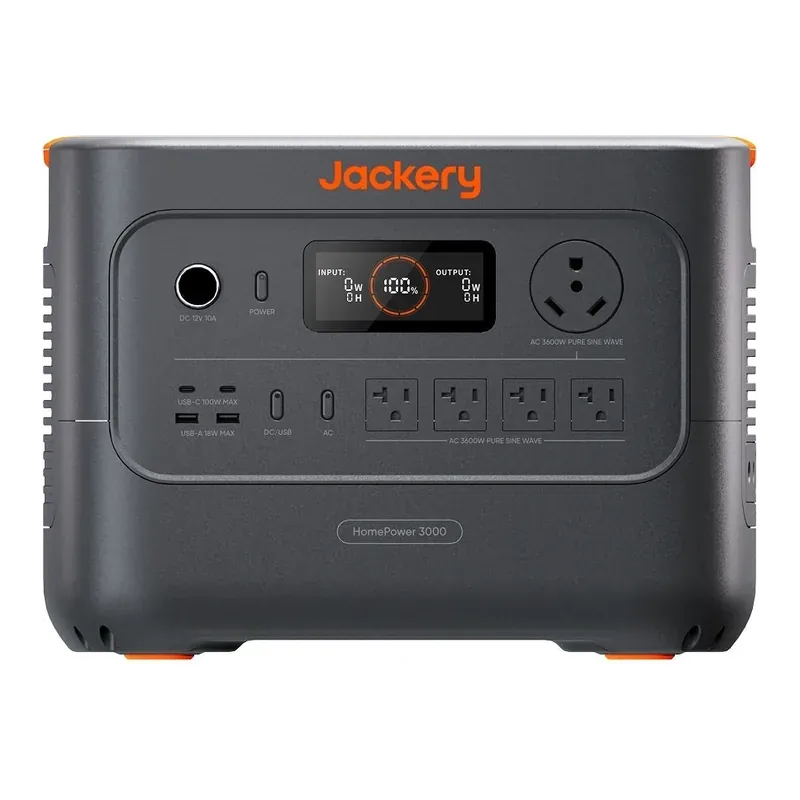
Jackery HomePower 3000
$900–$1,500 · price checked
- Capacity
- 3,072 Wh
- Output
- 3,600 W (7,200 W surge)
- Battery
- LiFePO4, 4,000 cycles (to 70%)
- Weight
- 59.5 lb
- Wall charge
- 2 h 12 min
- Solar input
- 1,000 W
Why it won: With 3,072 Wh, it backs up a 1/3 HP pump for about 33 hours at 10% pump time, or about 21 hours with a router and two LED bulbs. Add a full-size fridge to that and it still lasts about 16 hours. Its 3,600 W output and 7,200 W surge leave plenty of headroom to start the pump while other things run. It also takes up to 1,000 W of solar for refills between storms.
Skip it if: It cannot add batteries, weighs 59.5 lb with no wheels, and lists a 20 ms UPS switch-over, slower than the 10 ms of the Anker and DJI picks. It usually sells for roughly $900 to $1,500.
- 3,600 W output with a 30A outlet can run several appliances at once
- Can feed up to six home circuits through a manual transfer switch
- Takes up to 1,000 W of solar for faster off-grid recharging
- Compact and light for its 3,072 Wh capacity at 59.5 lb
- Cannot add extra batteries; the 2000 Plus or 5000 Plus can
- Still heavy to carry up stairs, with no built-in wheels
- Jackery rates cycle life to 70% capacity, not 80%
We may earn a commission if you buy through these links. It doesn’t change your price. How we make money
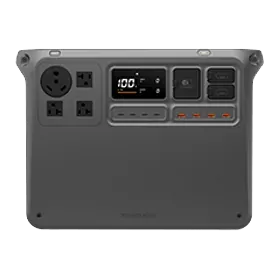
DJI Power 2000
$700–$1,300 · price checked
- Capacity
- 2,048 Wh
- Output
- 3,000 W (3,600 W surge)
- Battery
- LiFePO4, 4,000 cycles
- Weight
- 48.5 lb
- Wall charge
- 55 min to 80%
- Solar input
- 1,800 W
Why it won: Its 3,000 W output and 3,600 W surge start the pump easily, and the 2,048 Wh battery covers about 22 hours at 10% pump time. With expansion batteries it grows to 22,528 Wh, far more than the C2000 Gen 2's 4,096 Wh. It lists a 10 ms UPS switch-over and refills to 80% from the wall in about 55 minutes, which helps when power comes back between storms.
Skip it if: It weighs 48.5 lb with no wheels and has no 12V car socket. Solar charging needs a DJI add-on charger.
- 3,000 W output covers nearly every household appliance
- Expands to 22,528 Wh with up to ten expansion batteries
- Quiet (30 dB or less) and recharges to 80% in under an hour
- Four USB-C (up to 140 W) and four USB-A ports, plus a 10 ms UPS
- Heavy at 48.5 lb with no wheels
- No 12V car socket; DC output relies on DJI SDC accessories
- Solar and car charging need DJI's add-on chargers
We may earn a commission if you buy through these links. It doesn’t change your price. How we make money
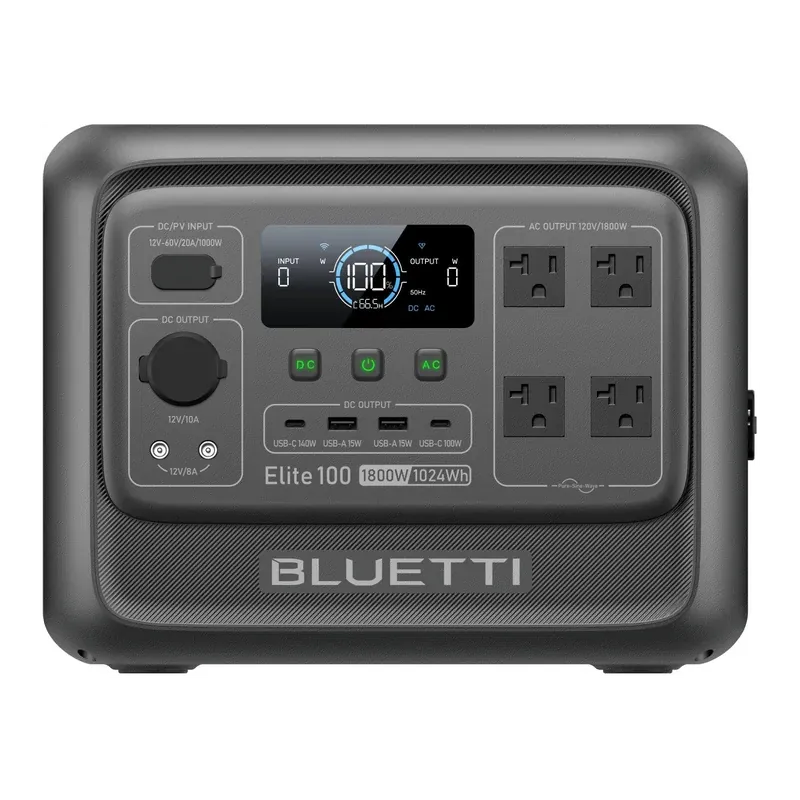
BLUETTI Elite 100 V2
$380–$500 · price checked
- Capacity
- 1,024 Wh
- Output
- 1,800 W (3,600 W surge)
- Battery
- LiFePO4, 4,000 cycles
- Weight
- 25 lb
- Wall charge
- 1 h 10 min
- Solar input
- 1,000 W
Why it won: It is the smallest unit here that still starts a 1/3 HP pump, with 1,800 W of output and a 3,600 W surge. The 1,024 Wh battery covers about 11 hours at 10% pump time, or about 7 hours with a router and two LED bulbs. At 25 lb it is easy to carry downstairs, it lists a 10 ms UPS switch-over and it refills from the wall in about 70 minutes. It usually sells for under $500.
Skip it if: It cannot add batteries, so about 11 hours is the most you get between recharges. If the pump runs nonstop, it lasts only about 1 hour.
- 1,800 W output runs most kitchen appliances one at a time
- Full recharge from a wall outlet in about 70 minutes
- 25 lb, much lighter than the older AC180
- 4,000-cycle battery rated for about 10 years of use
- Cannot add extra batteries
- 1,024 Wh will run a fridge for roughly a day, not several days
- Reaching the full 1,000 W solar input takes several panels
We may earn a commission if you buy through these links. It doesn’t change your price. How we make money
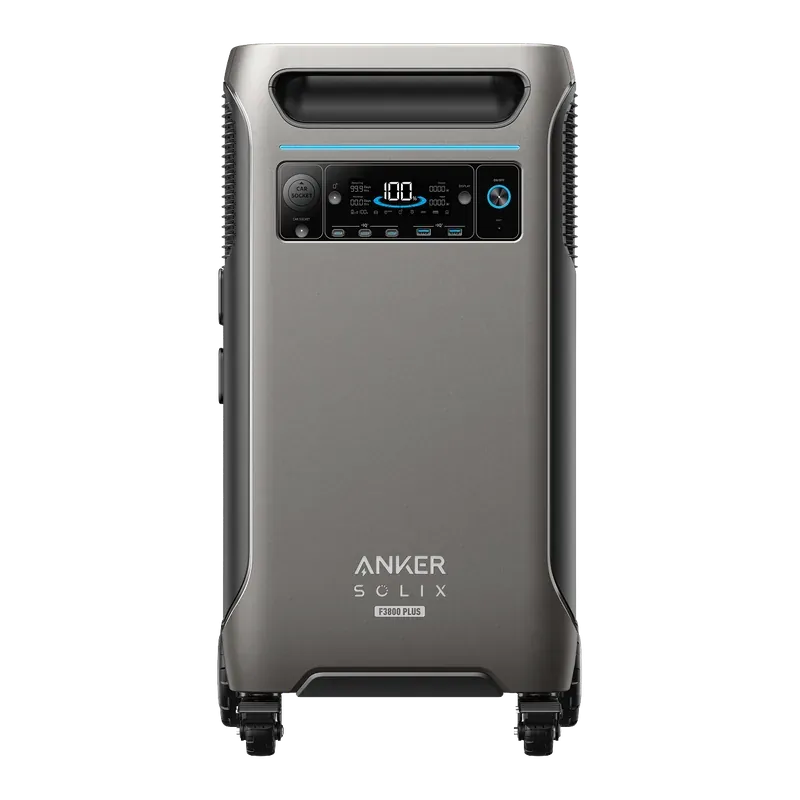
Anker SOLIX F3800 Plus
$2,090–$2,700 · price checked
- Capacity
- 3,840 Wh
- Output
- 6,000 W (9,000 W surge)
- Battery
- LiFePO4, 3,000 cycles
- Weight
- 136.7 lb
- Wall charge
- 3 h
- Solar input
- 3,200 W
Why it won: Its 3,840 Wh battery backs up the pump for about 41 hours at 10% pump time, or about 19 hours alongside a full-size fridge, a router and two LED bulbs. With 6,000 W of output and a 9,000 W surge, it can start the pump while other big loads run. It takes up to 3,200 W of solar, accepts a gas generator for recharging and expands to 26,880 Wh.
Skip it if: At 136.7 lb, it rolls on wheels but does not go down basement stairs easily. It usually sells for roughly $2,090 to $2,700, more than most homes need for a sump pump alone.
- 6,000 W at 120V or 240V runs a well pump, dryer or central AC
- Up to 3,200 W of solar can refill it in about 1.5–2 hours
- Accepts a gas generator and can tie into a Home Power Panel
- Expands to 26,880 Wh with six expansion batteries
- 136.7 lb; it rolls on wheels but is not portable
- 20 ms UPS is slower than the 10 ms of Anker's C-series
- Expensive even before you add an expansion battery
We may earn a commission if you buy through these links. It doesn’t change your price. How we make money
How long each pick runs
On the Anker SOLIX F3800 Plus (3,840 Wh), runtimes go from about 12 hrs for a dehumidifier (50 pint) to about 15 days for an LED light bulb (9 W), each running by itself.
Swipe sideways to see every device →
| Power station | Sump pump (1/3 HP) 800 W running, about 80 W average | Wi-Fi router + cable modem 25 W average | Full-size refrigerator 150 W running, about 45 W average | LED light bulb (9 W) 9 W average | Dehumidifier (50 pint) 545 W running, about 273 W average |
|---|---|---|---|---|---|
| Anker SOLIX C2000 Gen 2 2,048 Wh | 22 hrs | 3 days | 39 hrs | 8 days | 6.5 hrs |
| Jackery HomePower 3000 3,072 Wh | 33 hrs | 4 days | 2 days | 12 days | 9.5 hrs |
| DJI Power 2000 2,048 Wh | 22 hrs | 3 days | 39 hrs | 8 days | 6.5 hrs |
| BLUETTI Elite 100 V2 1,024 Wh | 11 hrs | 35 hrs | 19 hrs | 4 days | 3 hrs |
| Anker SOLIX F3800 Plus 3,840 Wh | 41 hrs | 5 days | 3 days | 15 days | 12 hrs |
Estimates: battery Wh × 0.85 ÷ the device’s average draw. Real runtime depends on temperature, battery age and how hard the device works.
Your fridge may use more
The fridge column assumes a newer ENERGY STAR model at 150 W while the compressor runs, or about 45 W on average. A 10- to 15-year-old or side-by-side fridge often averages 70 to 90 W. At 80 W, these picks last about 11 hrs on the BLUETTI Elite 100 V2 (1,024 Wh) and about 41 hrs on the Anker SOLIX F3800 Plus (3,840 Wh).
To find yours, divide the kWh per year on the yellow EnergyGuide label by 8.76. That gives the average watts. Fridge runtime on every station
Runtime on every station, one device at a time
Specs side by side
Swipe sideways to see every column →
| Spec | Anker SOLIX C2000 Gen 2 | Jackery HomePower 3000 | DJI Power 2000 | BLUETTI Elite 100 V2 | Anker SOLIX F3800 Plus |
|---|---|---|---|---|---|
| Capacity | 2,048 Wh | 3,072 Wh | 2,048 Wh | 1,024 Wh | 3,840 Wh (better) |
| AC output (continuous) | 2,400 W | 3,600 W | 3,000 W | 1,800 W | 6,000 W (better) |
| Surge | 4,000 W | 7,200 W | 3,600 W | 3,600 W | 9,000 W (better) |
| Boost mode (heaters, kettles) | None | None | None | 2,700 W | None |
| Battery type | LiFePO4 | LiFePO4 | LiFePO4 | LiFePO4 | LiFePO4 |
| Cycle life (rated) | 4,000 (to 80%) | 4,000 (to 70%) | 4,000 (to 80%) | 4,000 (to 80%) | 3,000 (to 80%) |
| Weight | 41.7 lb | 59.5 lb | 48.5 lb | 25 lb (better) | 136.7 lb |
| Wall charge time | 1 h 28 min (0–100% from a wall outlet alone) | 2 h 12 min (0–100% from a wall outlet; faster with solar) | 55 min (0–80% only; a full charge takes longer) | 1 h 10 min (0–100% with TurboBoost; 80% in 45 min) | 3 h (estimated, from a standard wall outlet) |
| Max solar input | 800 W | 1,000 W | 1,800 W (needs add-on) | 1,000 W | 3,200 W |
| AC outlets | 5 | 5 | 4 | 4 | 8 (better) |
| USB-C ports (max) | 3 (140 W) | 2 (100 W) | 4 (140 W) | 2 (140 W) | 3 (100 W) |
| USB-A ports | 1 | 2 | 4 | 2 | 2 |
| 12V / car port | Yes (1 DC ports) | Yes (1 DC ports) | No | Yes (3 DC ports) | Yes (1 DC ports) |
| Expandable | Yes, up to 4,096 Wh | No | Yes, up to 22,528 Wh | No | Yes, up to 26,880 Wh |
| UPS switch-over | 10 ms | 20 ms | 10 ms | 10 ms | 20 ms |
| App control | Yes | Yes | Yes | Yes | Yes |
| Size | 18.1 x 9.8 x 10.1 in | 16.4 x 12.8 x 12.0 in | 17.6 x 8.9 x 12.8 in | 12.6 x 8.5 x 9.8 in | 27.6 x 15.3 x 15.6 in |
| Released | 2025 | 2025 | 2025 | 2025 | 2025 |
| Typical price | $700–$900 | $900–$1,500 | $700–$1,300 | $380–$500 (better) | $2,090–$2,700 |
Needs add-on: solar charging on that unit needs a separate charger from the brand, sold separately. The figure shown is the best case with that add-on, so we don’t highlight a winner in that row.
Related comparisons
Torn between two of these? Each comparison gives a verdict, specs and runtimes side by side.
How big a power station do I need for a sump pump?
Check the surge first, then the battery. A 1/3 HP pump needs about 2,100 W to start and about 800 W to run, so look for at least 2,100 W of surge and 800 W of continuous output. Every 1,000 Wh class unit in our table meets both. None of the 286 to 499 Wh units does.
For the hours, guess how often the pump runs. If it runs 10% of the time, about 6 minutes each hour, it averages 80 W. That adds up to about 1,920 Wh a day, or about 2,260 Wh of battery after inverter losses. A 1,024 Wh unit lasts about 11 hours, a 2,048 Wh unit about 22, a 3,072 Wh unit about 33 and a 3,840 Wh unit about 41.
Most homes want a few other things on too. Add a router and two LED bulbs and the average climbs to about 123 W, so a 2,048 Wh unit lasts about 14 hours and a 3,072 Wh unit about 21. Add a full-size fridge as well and it climbs to about 168 W, which is about 10 hours on 2,048 Wh.
What if the pump runs nonstop?
In a heavy storm or a fast snowmelt, the pump may barely shut off. Then it draws its full 800 W and the battery drains fast. A 1,024 Wh unit lasts only about 1 hour, a 2,048 Wh unit about 2 hours, a 3,072 Wh unit about 3.5 hours and a 3,840 Wh unit about 4 hours. That is roughly 1 hour for every 1,000 Wh.
So watch the pit while it rains. Check the battery level every hour or two and unplug everything else. Plan how you will recharge before the battery runs low: a generator running outdoors, solar panels once the sky clears, or the wall as soon as power comes back.
Check your own pump's label
Our numbers are for a 1/3 HP pump at 800 W. Real 1/3 HP pumps run at about 700 to 1,115 W, so yours may use more. Multiply the amps on the label by 120 to get its running watts, and use that number in the math above.
We do not have data for 1/2 HP pumps, so do not assume these numbers carry over. They draw more to run and to start. Work out the running watts from the label amps, then find the start-up rating in the manual or ask the maker. Pick a station whose output and surge are both above those numbers.
Mistakes to avoid
Shopping by watt-hours alone. A station with a big battery but a surge under 2,100 W cannot start a 1/3 HP pump at all. The surge rating decides whether the pump runs, and the battery decides for how long.
Leaving the station off UPS mode. If the pump is not plugged in through UPS or pass-through mode, nothing happens when the grid drops at night. Set it up before storm season, then test it: unplug the station from the wall and pour a bucket of water into the pit.
Using a long, thin extension cord. Pick a heavy-duty cord rated above the pump's amps and keep it short.
Backfeeding the house. If your pump is hard-wired, do not try to power it through a wall outlet with a double-ended cord. Have an electrician install a transfer switch or inlet.
Safety
Keep the station dry. Set it on a shelf or table well above the floor and away from the pit, with space around the vents. Never leave it where floodwater could reach it.
Never run a gas generator indoors, in the basement or in an attached garage. Run it outdoors, far from windows and doors, and use it to refill the station.
Do not stand in water to plug or unplug anything. If the basement is already flooding, stay out and call an electrician or your utility.
How do I get more hours from each charge?
Run the dehumidifier after the storm, not during it. A 50-pint dehumidifier averages about 270 W, more than three times the pump. With both on, a 2,048 Wh unit lasts only about 5 hours instead of about 22.
Turn off lights and gear you do not need while the rain is heavy. The pump needs the battery more than anything else in the house.
Top up the battery whenever you can. A wall outlet, a generator outdoors or solar panels between rain bands all buy more pump time.
Common questions
- How long will a power station run a sump pump?
- About 11 hours on a 1,024 Wh unit, 22 hours on a 2,048 Wh unit and 33 hours on a 3,072 Wh unit, if the pump runs 10% of the time. If it runs nonstop, plan on about 1 hour per 1,000 Wh.
- Can a 500 Wh power station run a sump pump?
- No. A 1/3 HP pump needs about 800 W to run and about 2,100 W to start, and the Goal Zero Yeti 500 stops at 500 W of output and 1,000 W of surge. None of the 286 to 499 Wh units in our table can run it.
- Can a power station run a 1/2 HP sump pump?
- We do not have data for 1/2 HP pumps, so check yours. Multiply the label amps by 120 for running watts, and find the start-up rating in the manual. Choose a station whose output and surge are both higher.
- Will a power station turn my sump pump on by itself in an outage?
- Only if the pump is already plugged into it and the station is in UPS or pass-through mode. All five picks list a UPS switch-over of 10 to 20 ms. Test the setup before storm season.
- Can I run a sump pump and a fridge on the same power station?
- Yes, on any of our picks. A pump, a full-size fridge, a router and two LED bulbs average about 168 W, so a 2,048 Wh unit lasts about 10 hours and a 3,840 Wh unit about 19.