
Best whole-home backup power station in 2026
As an Amazon Associate, BlackoutWise earns from qualifying purchases. We may also earn a commission when you buy through brand store links. This never changes the price you pay or which products we recommend. How we make money

The Anker SOLIX F3800 Plus is our top whole-home pick. It puts out 6,000 W at 120V or 240V, enough for a well pump, dryer or central AC, and grows from 3,840 Wh to 26,880 Wh with six expansion batteries.
Whole-home backup is a different job from keeping a fridge cold. You want 240V for big appliances, an outlet that feeds a transfer switch or home panel so you are not running cords through the house, and a battery that can grow. You also need surge for motor loads: a 1/2 HP well pump needs about 3,000 W for a second as it starts.
We do not test units ourselves. The picks come from the official spec sheets and manuals, the watt-hour math on this site, and prices we check by hand. All of them need some planning, and the panel hookup needs a licensed electrician. See how we pick.
Quick picks
- 1. Best overall: Anker SOLIX F3800 Plus3,840 Wh · 6,000 W · $2,090–$2,700
- 2. Best value: BLUETTI Apex 3002,765 Wh · 3,840 W · $1,200–$1,600
- 3. Fastest recharge: EcoFlow DELTA Pro 34,096 Wh · 4,000 W · $2,400–$3,700
- 4. Best budget pick: Jackery HomePower 30003,072 Wh · 3,600 W · $900–$1,500
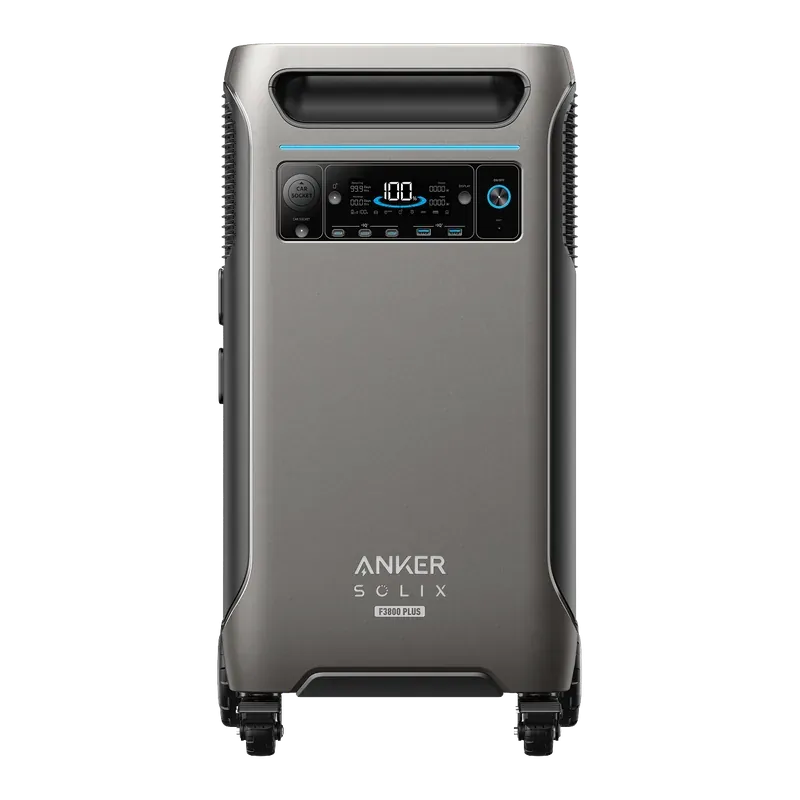
Anker SOLIX F3800 Plus
$2,090–$2,700 · price checked
- Capacity
- 3,840 Wh
- Output
- 6,000 W (9,000 W surge)
- Battery
- LiFePO4, 3,000 cycles
- Weight
- 136.7 lb
- Wall charge
- 3 h
- Solar input
- 3,200 W
Why it won: With 6,000 W continuous and 9,000 W of surge, it can start a well pump while the fridge, freezer and lights keep running. Expanded to 26,880 Wh, it covers about 5 days of fridge, freezer, router, lights and sump pump, or about 4 days with a well pump added. Up to 3,200 W of solar and a gas generator input give you more ways to refill than the wall alone.
Skip it if: Skip it if you need to move it often. At 136.7 lb it rolls on wheels but is not portable, its 20 ms UPS is slower than some, and it usually costs more than $2,000 before batteries.
- 6,000 W at 120V or 240V runs a well pump, dryer or central AC
- Up to 3,200 W of solar can refill it in about 1.5–2 hours
- Accepts a gas generator and can tie into a Home Power Panel
- Expands to 26,880 Wh with six expansion batteries
- 136.7 lb; it rolls on wheels but is not portable
- 20 ms UPS is slower than the 10 ms of Anker's C-series
- Expensive even before you add an expansion battery
We may earn a commission if you buy through these links. It doesn’t change your price. How we make money
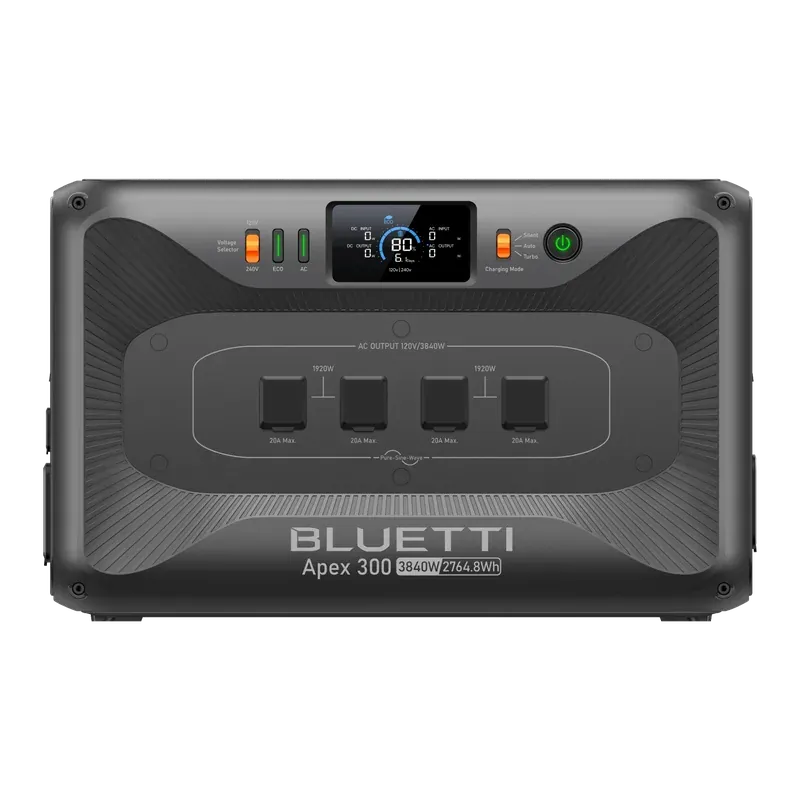
BLUETTI Apex 300
$1,200–$1,600 · price checked
- Capacity
- 2,765 Wh
- Output
- 3,840 W (7,680 W surge)
- Battery
- LiFePO4, 6,000 cycles
- Weight
- 83.8 lb
- Wall charge
- 1 h 50 min
- Solar input
- 2,400 W
Why it won: For roughly $1,200 to $1,600 to start, you get 3,840 W at both 120V and 240V, RV-style TT-30 and 14-50 outlets, and a path to 33,485 Wh, the largest on this list. Each B500K battery adds about 5,120 Wh, and the fully expanded system covers about 6 days of essentials without a well pump. Two outlets switch over with no gap in 240V mode, and the rest in 20 ms.
Skip it if: Skip it if you want USB or 12V ports built in, since those need the optional Hub D1. The base unit alone (2,765 Wh) covers only about 13 hours of essentials, so budget for at least one battery.
- 3,840 W at 120V and 240V at once, with RV-style TT-30 and 14-50 outlets
- Grows to 33,485 Wh with six B500K batteries
- 0 ms UPS switch on two outlets in 240V mode (20 ms on the rest)
- Full recharge in about 65 minutes with an optional 30A or 50A cable
- 83.8 lb; not something you carry around
- No built-in USB or 12V ports; those need the optional Hub D1
- Expensive once you add batteries or the home panel kit
We may earn a commission if you buy through these links. It doesn’t change your price. How we make money
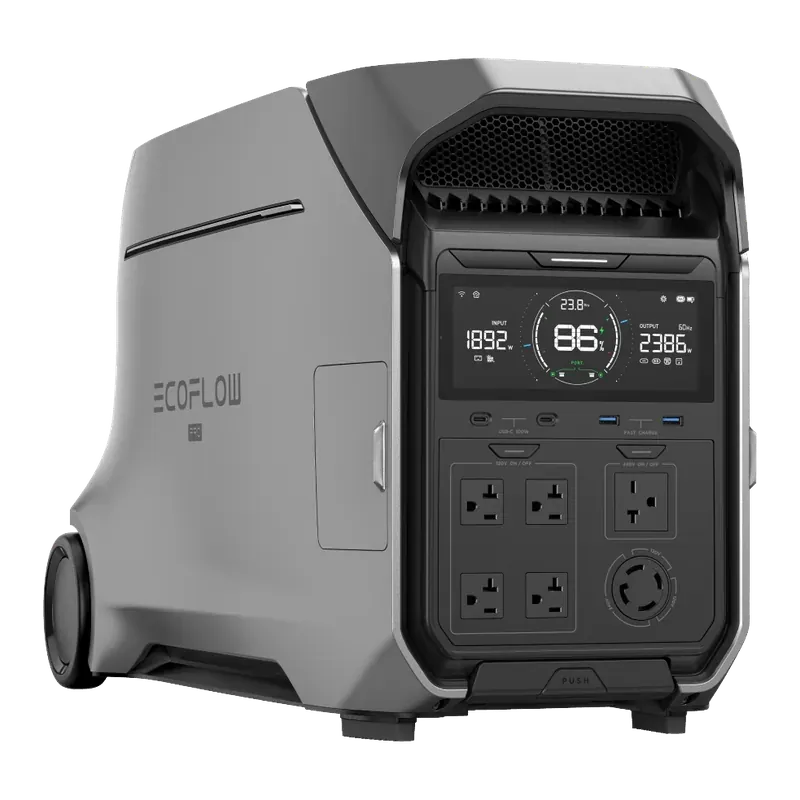
EcoFlow DELTA Pro 3
$2,400–$3,700 · price checked
- Capacity
- 4,096 Wh
- Output
- 4,000 W (8,000 W surge)
- Battery
- LiFePO4, 4,000 cycles
- Weight
- 113.5 lb
- Wall charge
- 50 min to 80%
- Solar input
- 2,600 W
Why it won: It charges to 80% in about 50 minutes from a wall outlet and takes up to 2,600 W of solar, so it bounces back quickly between storms. The 4,096 Wh base battery runs a well pump alone for close to 3 days, or a fridge, freezer, router, lights and sump pump for about 19 hours. Wheels, a handle and a 10 ms UPS switch-over round it out.
Skip it if: Skip it if you want the biggest system. It expands to 12,000 Wh, less than half of the Anker or Bluetti, and prices run from about $2,400 to $3,700.
- 4,000 W at 120V and 240V can run a well pump, dryer or central AC
- Expands to 12,000 Wh with extra batteries
- Up to 2,600 W of solar input for multi-day outages
- Wheels and a handle, plus a 10 ms UPS switch-over
- 113.5 lb; not something you carry up stairs
- No 12V car-style outlet (uses Anderson and DC5521 ports instead)
- Expensive, and no full 0–100% charge time is given
We may earn a commission if you buy through these links. It doesn’t change your price. How we make money
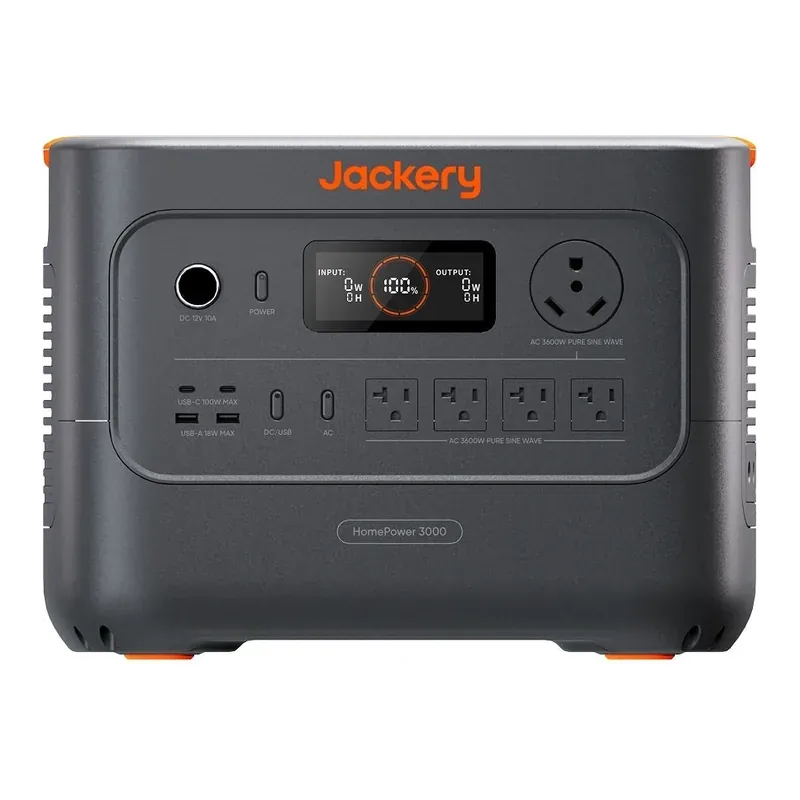
Jackery HomePower 3000
$900–$1,500 · price checked
- Capacity
- 3,072 Wh
- Output
- 3,600 W (7,200 W surge)
- Battery
- LiFePO4, 4,000 cycles (to 70%)
- Weight
- 59.5 lb
- Wall charge
- 2 h 12 min
- Solar input
- 1,000 W
Why it won: It is the cheapest way here to feed house circuits: up to six through a manual transfer switch, with 3,600 W of output and 7,200 W of surge for a well pump start. Its 3,072 Wh battery runs a fridge alone for about 58 hours, or the full essentials list for about 14 hours. At 59.5 lb it is also far lighter than the other picks.
Skip it if: Skip it if you need 240V for a well pump or dryer; choose one of the 240V picks above. It also cannot take extra batteries, so it is a one-to-two-day tool, not a growing system.
- 3,600 W output with a 30A outlet can run several appliances at once
- Can feed up to six home circuits through a manual transfer switch
- Takes up to 1,000 W of solar for faster off-grid recharging
- Compact and light for its 3,072 Wh capacity at 59.5 lb
- Cannot add extra batteries; the 2000 Plus or 5000 Plus can
- Still heavy to carry up stairs, with no built-in wheels
- Jackery rates cycle life to 70% capacity, not 80%
We may earn a commission if you buy through these links. It doesn’t change your price. How we make money
How long each pick runs
On the EcoFlow DELTA Pro 3 (4,096 Wh), runtimes go from about 4.5 hrs for a space heater (1500W) to about 3 days for a full-size refrigerator, each running by itself.
Swipe sideways to see every device →
| Power station | Full-size refrigerator 150 W running, about 45 W average | Well pump (1/2 HP) 1,000 W running, about 50 W average | Sump pump (1/3 HP) 800 W running, about 80 W average | Window AC 8,000 BTU 735 W running, about 368 W average | Space heater (1500W) 1,500 W running, about 750 W average |
|---|---|---|---|---|---|
| Anker SOLIX F3800 Plus 3,840 Wh | 3 days | 3 days | 41 hrs | 9 hrs | 4.5 hrs |
| BLUETTI Apex 300 2,765 Wh | 2 days | 47 hrs | 29 hrs | 6.5 hrs | 3 hrs |
| EcoFlow DELTA Pro 3 4,096 Wh | 3 days | 3 days | 44 hrs | 9.5 hrs | 4.5 hrs |
| Jackery HomePower 3000 3,072 Wh | 2 days | 2 days | 33 hrs | 7 hrs | 3.5 hrs |
Estimates: battery Wh × 0.85 ÷ the device’s average draw. Real runtime depends on temperature, battery age and how hard the device works.
Your fridge may use more
The fridge column assumes a newer ENERGY STAR model at 150 W while the compressor runs, or about 45 W on average. A 10- to 15-year-old or side-by-side fridge often averages 70 to 90 W. At 80 W, these picks last about 29 hrs on the BLUETTI Apex 300 (2,765 Wh) and about 44 hrs on the EcoFlow DELTA Pro 3 (4,096 Wh).
To find yours, divide the kWh per year on the yellow EnergyGuide label by 8.76. That gives the average watts. Fridge runtime on every station
Runtime on every station, one device at a time
Specs side by side
Swipe sideways to see every column →
| Spec | Anker SOLIX F3800 Plus | BLUETTI Apex 300 | EcoFlow DELTA Pro 3 | Jackery HomePower 3000 |
|---|---|---|---|---|
| Capacity | 3,840 Wh | 2,764.8 Wh | 4,096 Wh (better) | 3,072 Wh |
| AC output (continuous) | 6,000 W (better) | 3,840 W | 4,000 W | 3,600 W |
| Surge | 9,000 W (better) | 7,680 W | 8,000 W | 7,200 W |
| Boost mode (heaters, kettles) | None | 7,680 W | 6,000 W | None |
| Battery type | LiFePO4 | LiFePO4 | LiFePO4 | LiFePO4 |
| Cycle life (rated) | 3,000 (to 80%) | 6,000 (to 80%) | 4,000 (to 80%) | 4,000 (to 70%) |
| Weight | 136.7 lb | 83.8 lb | 113.5 lb | 59.5 lb (better) |
| Wall charge time | 3 h (estimated, from a standard wall outlet) | 1 h 50 min (estimated, from a standard wall outlet) | 50 min (0–80% from a wall outlet) | 2 h 12 min (0–100% from a wall outlet; faster with solar) |
| Max solar input | 3,200 W (better) | 2,400 W | 2,600 W | 1,000 W |
| AC outlets | 8 (better) | 6 | 7 | 5 |
| USB-C ports (max) | 3 (100 W) | 0 (0 W) | 2 (100 W) | 2 (100 W) |
| USB-A ports | 2 | 0 | 2 | 2 |
| 12V / car port | Yes (1 DC ports) | No | 2 DC ports | Yes (1 DC ports) |
| Expandable | Yes, up to 26,880 Wh | Yes, up to 33,485 Wh | Yes, up to 12,000 Wh | No |
| UPS switch-over | 20 ms | 20 ms | 10 ms (better) | 20 ms |
| App control | Yes | Yes | Yes | Yes |
| Size | 27.6 x 15.3 x 15.6 in | 20.67 x 12.87 x 12.6 in | 16.2 x 13.4 x 27.3 in | 16.4 x 12.8 x 12.0 in |
| Released | 2025 | 2025 | 2024 | 2025 |
| Typical price | $2,090–$2,700 | $1,200–$1,600 | $2,400–$3,700 | $900–$1,500 (better) |
Related comparisons
Torn between two of these? Each comparison gives a verdict, specs and runtimes side by side.
How much battery does a house need in an outage?
Build the list from the loads that matter. A full-size fridge averages about 45 W, or about 1,080 Wh a day. A 7 cu ft chest freezer adds about 634 Wh. A Wi-Fi router and modem add about 600 Wh. Five LED bulbs for five hours add about 225 Wh. A 1/3 HP sump pump runs only about 10% of the time, but at 800 W that still adds about 1,920 Wh on a wet day. Together that is about 4,460 Wh a day.
Divide by 0.85 for inverter losses and you need about 5,250 Wh of battery per day. That is more than any single base unit here holds. The DELTA Pro 3 covers about 19 hours of it, the F3800 Plus about 18 hours and the Apex 300 about 13 hours.
Add a 1/2 HP well pump, which draws about 1,000 W and runs about 5% of the time for normal household water use, and the day grows to about 5,660 Wh, or about 6,700 Wh of battery. Comfort loads add more: an 8,000 BTU window AC running eight hours uses about 2,940 Wh. This is why whole-home backup almost always means expansion batteries, solar, or both.
240V, transfer switches and home panels
Most well pumps are hard-wired on 230V, and so are dryers and central AC. The F3800 Plus, DELTA Pro 3 and Apex 300 all supply 240V. The HomePower 3000 is best kept to 120V circuits.
A transfer switch or home panel lets the station feed chosen circuits in your breaker panel, so you are not running extension cords to the fridge and furnace room. The F3800 Plus has an L14-30 outlet for a transfer switch and can tie into Anker's Home Power Panel. The DELTA Pro 3 connects to a transfer switch, the Apex 300 works with Bluetti's home panel kit, and the HomePower 3000 feeds up to six circuits through a manual transfer switch.
Pick the circuits before the electrician arrives. Fridge, freezer, well pump, sump pump, internet and a few lighting circuits are the usual list. Leave out the water heater, oven and electric heat, which can drain even an expanded system in hours.
What to look for
Surge decides what will start. A 1/2 HP well pump needs about 3,000 W at start-up, and if the fridge, freezer and lights are already running, the station sees about 3,300 W. Every pick here has at least 7,200 W of surge, so that is covered.
UPS switch-over decides what notices the outage. The Apex 300 switches two outlets with no gap in 240V mode and the rest in 20 ms. The DELTA Pro 3 switches in 10 ms, and the F3800 Plus and HomePower 3000 in 20 ms. Computers and routers ride through all of these.
Solar input decides how long you can last. The F3800 Plus takes up to 3,200 W, the DELTA Pro 3 2,600 W, the Apex 300 2,400 W and the HomePower 3000 1,000 W. All four use LiFePO4 cells, rated from 3,000 cycles on the F3800 Plus to 6,000 on the Apex 300.
Mistakes to avoid
Do not plan on heat. A 1,500 W space heater averages about 750 W as it cycles, so even the 4,096 Wh DELTA Pro 3 runs one for less than 5 hours. Gas heat with an electric blower, or a heated blanket, is a much better use of the battery.
Do not buy only the base unit and expect it to carry a multi-day outage. The base units here hold 2,765 to 4,096 Wh, which covers about half a day to most of a day of essentials. Budget for at least one expansion battery or a solar array at the start.
Do not underestimate the weight. These units weigh 59.5 to 136.7 lb. Choose a spot near the panel, on the ground floor and above any flood line, before it arrives.
Safety
Never connect a power station to the house by plugging it into a wall outlet. That backfeeds the wiring, can send power onto the grid and can injure line workers. Use a transfer switch or home panel installed by a licensed electrician.
Keep the station dry and ventilated, with its vents clear. A basement that floods is the wrong place for it. If anyone in the house depends on oxygen or other life-support equipment, the whole-home system should not be their only backup. Ask the doctor or equipment supplier for a dedicated plan.
Common questions
- Can a power station power a whole house?
- It can power the circuits that matter, not everything at once. A typical essentials list of fridge, chest freezer, router, lights and a sump pump uses about 4,460 Wh a day, so a 4,096 Wh unit lasts about 19 hours. Central AC, electric heat and water heaters will drain even an expanded system fast.
- What size power station do I need to run a well pump?
- A 1/2 HP well pump needs about 1,000 W running and about 3,000 W to start, and most are wired for 230V. Look for at least 3,000 W of surge and 240V output. With normal household water use, the EcoFlow DELTA Pro 3 runs one alone for about 70 hours, and the Anker F3800 Plus for about 65 hours.
- Do I need a transfer switch for a power station?
- Yes, if you want to run hard-wired loads like a well pump or feed circuits in your panel. A licensed electrician installs it, and it keeps the station's power off the grid. The Jackery HomePower 3000 can feed up to six circuits through a manual transfer switch, and the Anker F3800 Plus has an L14-30 outlet for one.
- How many days can a whole-home power station last?
- It depends on what you run. Fridge, freezer, router, lights and a sump pump use about 4,460 Wh a day. The Bluetti Apex 300 expanded to 33,485 Wh covers about 6 days of that, the Anker F3800 Plus at 26,880 Wh about 5 days, and the EcoFlow DELTA Pro 3 at 12,000 Wh a little over 2 days.
- Can a power station run an air conditioner?
- The biggest ones can, but not for long. An 8,000 BTU window AC uses about 2,940 Wh over 8 hours, so a 4,096 Wh DELTA Pro 3 runs one for about 9.5 hours and the F3800 Plus for about 9 hours. Both have 240V output for central AC, but central AC will drain the battery much faster.