
EcoFlow DELTA Pro 3 vs Anker SOLIX F3800 Plus: which should you buy?
The short verdict
For most whole-home backup buyers, the Anker SOLIX F3800 Plus is the better choice. It delivers 6,000 W against the DELTA Pro 3’s 4,000 W, takes more solar, expands much further and usually costs less.
The EcoFlow DELTA Pro 3 wins on battery and charging. It holds a bit more energy (4,096 Wh vs 3,840 Wh), refills from the wall far faster, switches over in 10 ms instead of 20 ms, and is rated for 4,000 cycles instead of 3,000. It is also 23 lb lighter.
Pick the F3800 Plus if you want to run several big loads at once or grow toward a full house. Pick the DELTA Pro 3 if your loads fit under 4,000 W and you value fast recharges and longer battery life.
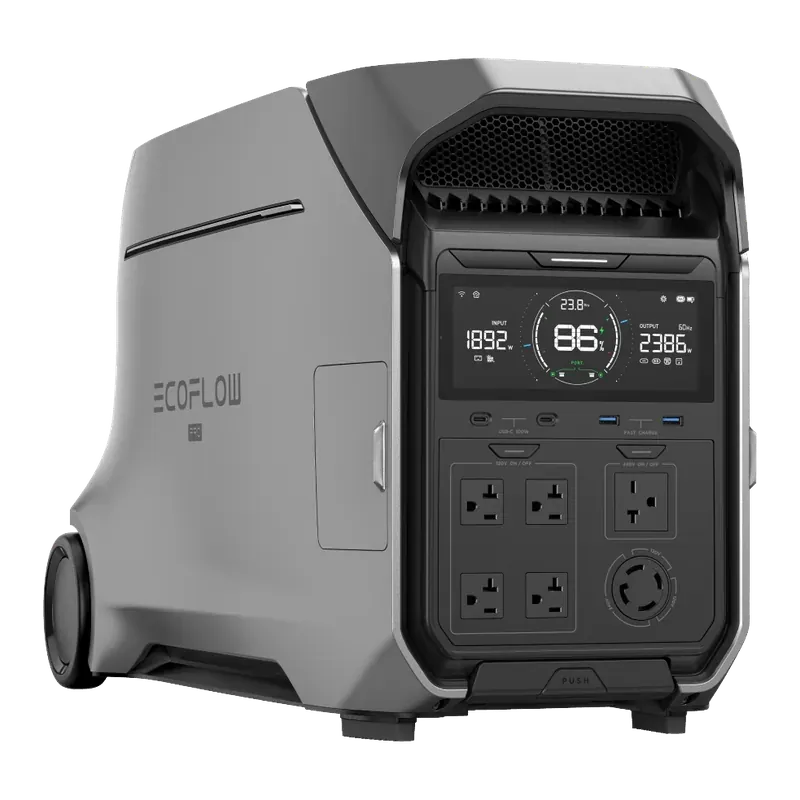
EcoFlow DELTA Pro 3
4,096 Wh · 4,000 W · $2,400–$3,700
We may earn a commission if you buy through these links. It doesn’t change your price. How we make money
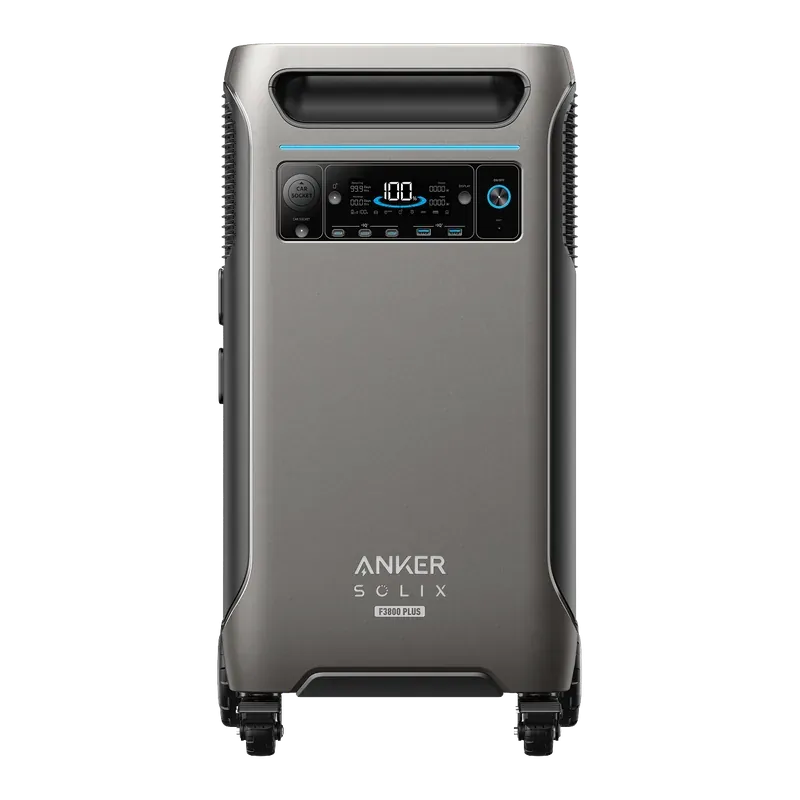
Anker SOLIX F3800 Plus
3,840 Wh · 6,000 W · $2,090–$2,700
We may earn a commission if you buy through these links. It doesn’t change your price. How we make money
Buy the EcoFlow DELTA Pro 3 if…
You rely on wall charging between outages and want it full fast, since it charges to 80% in about 50 minutes. It also suits a home office or medical setup that benefits from a 10 ms UPS, and anyone who wants more battery out of the box without buying an expansion pack.
Buy the Anker SOLIX F3800 Plus if…
You want to run several big loads at the same time, such as a portable AC, a microwave and a space heater, or plan to build up to days of whole-home backup. Its 3,200 W solar input and generator input make it the stronger base for a long-outage setup, and it usually costs less to start.
Specs side by side
The better number in each row is highlighted.
| Spec | EcoFlow DELTA Pro 3 | Anker SOLIX F3800 Plus |
|---|---|---|
| Capacity | 4,096 Wh (better) | 3,840 Wh |
| AC output (continuous) | 4,000 W | 6,000 W (better) |
| Surge | 8,000 W | 9,000 W (better) |
| Boost mode (heaters, kettles) | 6,000 W | None |
| Battery type | LiFePO4 | LiFePO4 |
| Cycle life (rated) | 4,000 (to 80%) (better) | 3,000 (to 80%) |
| Weight | 113.5 lb (better) | 136.7 lb |
| Wall charge time | 50 min (0–80% from a wall outlet) | 3 h (estimated, from a standard wall outlet) |
| Max solar input | 2,600 W | 3,200 W (better) |
| AC outlets | 7 | 8 (better) |
| USB-C ports (max) | 2 (100 W) | 3 (100 W) |
| USB-A ports | 2 | 2 |
| 12V / car port | 2 DC ports | Yes (1 DC ports) |
| Expandable | Yes, up to 12,000 Wh | Yes, up to 26,880 Wh |
| UPS switch-over | 10 ms (better) | 20 ms |
| App control | Yes | Yes |
| Size | 16.2 x 13.4 x 27.3 in | 27.6 x 15.3 x 15.6 in |
| Released | 2024 | 2025 |
| Typical price | $2,400–$3,700 | $2,090–$2,700 (better) |
Runtime for common devices
On the EcoFlow DELTA Pro 3 (4,096 Wh), runtimes go from about 2.5 hrs for level 1 EV charging (120V) to about 3 days for a full-size refrigerator, each running by itself.
Swipe sideways to see every device →
| Power station | Well pump (1/2 HP) 1,000 W running, about 50 W average | Portable AC 10,000 BTU 1,100 W running, about 660 W average | Full-size refrigerator 150 W running, about 45 W average | Sump pump (1/3 HP) 800 W running, about 80 W average | Level 1 EV charging (120V) 1,400 W average |
|---|---|---|---|---|---|
| EcoFlow DELTA Pro 3 4,096 Wh | 3 days | 5.5 hrs | 3 days | 44 hrs | 2.5 hrs |
| Anker SOLIX F3800 Plus 3,840 Wh | 3 days | 5 hrs | 3 days | 41 hrs | 2.5 hrs |
Estimates: battery Wh × 0.85 ÷ the device’s average draw. Real runtime depends on temperature, battery age and how hard the device works.
See how every power station on this site handles one device:
Capacity and runtime
The DELTA Pro 3 holds 4,096 Wh and the F3800 Plus 3,840 Wh, so the EcoFlow runs everything about 7% longer. In practice that is a few extra hours. A full-size fridge runs for about 77 hours on the DELTA Pro 3 and about 72 on the F3800 Plus, so both cover three days on the fridge alone. A 1/3 hp sump pump runs for about 44 and 41 hours, and a 1/2 hp well pump for about 70 and 65 hours.
Expansion changes the picture. The DELTA Pro 3 grows to 12,000 Wh with extra batteries. The F3800 Plus grows to 26,880 Wh with six expansion batteries. On a fridge alone that is roughly 9 days against about 3 weeks. Most homes will run far more than a fridge, but the point holds: the Anker has more than twice the ceiling.
How much can each one run at the same time?
Every single device on our list fits on both units. Both supply 120V and 240V, so both can handle large appliances that need 240V. The difference is how much you can run together. The DELTA Pro 3 has 4,000 W continuous and 8,000 W surge. The F3800 Plus has 6,000 W and 9,000 W.
Here is what that means. A 10,000 BTU portable AC (about 1,100 W), a microwave (about 1,500 W) and a space heater (about 1,500 W) add up to roughly 4,100 W. That is over the DELTA Pro 3’s 4,000 W limit but well within the F3800 Plus. If your plan is to back up a few circuits through a transfer switch, the extra 2,000 W gives you real room.
Charging, weight and UPS
The DELTA Pro 3 is much faster from the wall. It reaches 80% in about 50 minutes. The F3800 Plus takes an estimated 3 hours from a standard outlet. That matters if you top up during brief power returns or from a generator.
Solar flips it. The F3800 Plus takes up to 3,200 W of solar and the DELTA Pro 3 up to 2,600 W. With enough panels in full sun, both could refill in under 2 hours, the Anker a little sooner. The F3800 Plus also accepts a gas generator directly and can tie into Anker’s Home Power Panel.
Neither is portable. Both roll on wheels, but the DELTA Pro 3 weighs 113.5 lb and the F3800 Plus 136.7 lb. The EcoFlow lists a 10 ms UPS switch-over and the Anker 20 ms. Both are fine for routers and most electronics, and the faster switch is safer for desktop computers. The Anker has a 12V car outlet. The EcoFlow uses Anderson and DC5521 ports instead.
Value
The F3800 Plus usually sells for roughly $2,100 to $2,700. The DELTA Pro 3 ranges from about $2,400 up to $3,700. At typical prices, the Anker gives more output and more expansion for less money.
The EcoFlow earns some of its premium back through battery life. It is rated for 4,000 cycles against 3,000 for the Anker. If you will cycle it daily with solar, that adds years. For occasional outage use, both batteries will last a long time.
Common questions
- Can both run a well pump?
- Yes. A 1/2 hp well pump needs about 1,000 W running and 3,000 W to start, well within both. Expect about 70 hours on the DELTA Pro 3 and about 65 hours on the F3800 Plus, based on the pump cycling on and off with normal water use.
- Which one has more power output?
- The Anker F3800 Plus, with 6,000 W continuous and 9,000 W surge. The DELTA Pro 3 has 4,000 W continuous, 8,000 W surge and an X-Boost mode up to 6,000 W for simple heating loads.
- How far can each one expand?
- The DELTA Pro 3 expands to 12,000 Wh. The F3800 Plus expands to 26,880 Wh with six expansion batteries, a little more than twice as much.
- Which charges faster from a wall outlet?
- The DELTA Pro 3, by a wide margin. It reaches 80% in about 50 minutes. The F3800 Plus needs roughly 3 hours from a standard outlet.
- How many nights would each run a CPAP?
- With a heated humidifier and tube, about 12 to 13 nights of 8 hours on either unit. That assumes nothing else is plugged in.