
DJI Power 2000 vs Jackery Explorer 2000 v2: which should you buy?
The short verdict
For home backup, the DJI Power 2000 is the better pick. It puts out 3,000 W against the Jackery's 2,200 W, grows to 22,528 Wh with expansion batteries, and takes up to 1,800 W of solar through DJI's add-on charger. The batteries are nearly the same size, 2,048 Wh against 2,042 Wh, so both run a full-size fridge for about 39 hours.
The Jackery Explorer 2000 v2 wins on carrying and motor starts. It weighs 39.5 lb against 48.5 lb, about 9 lb less. Its 4,400 W start-up surge beats the DJI's 3,600 W, so it can start a circular saw that needs about 3,700 W, and the DJI cannot. It also has a 12V car port, which the DJI lacks.
The tie-breaker is growth. The Explorer 2000 v2 cannot take extra batteries and stops at 400 W of solar, so what you buy is what you keep. If you think you will want more than one day of backup later, the DJI is the one that can grow with you.
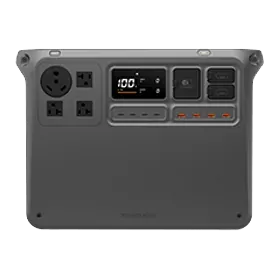
DJI Power 2000
2,048 Wh · 3,000 W · $700–$1,300
We may earn a commission if you buy through these links. It doesn’t change your price. How we make money
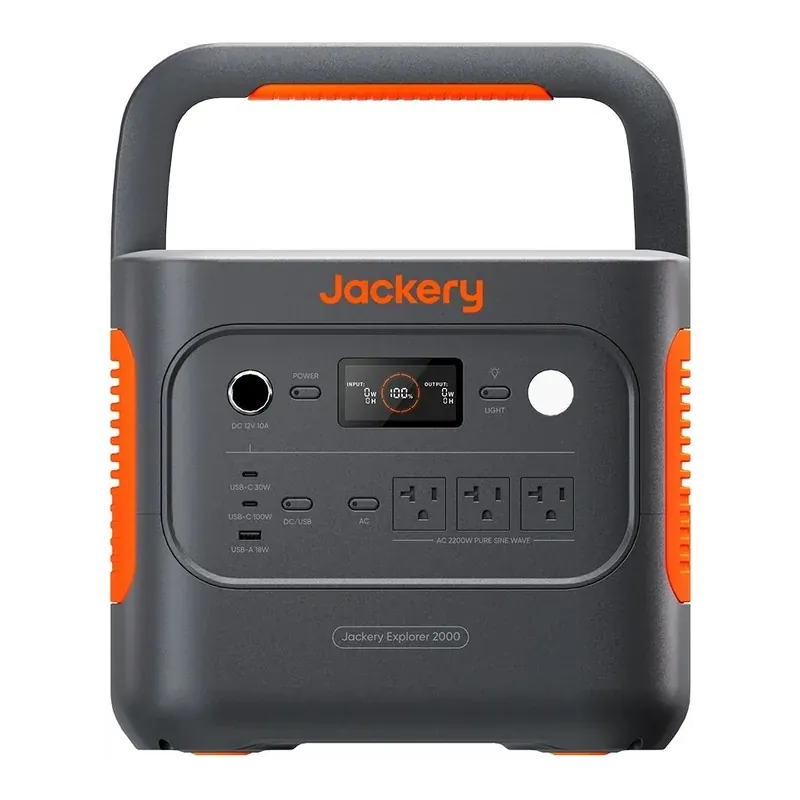
Jackery Explorer 2000 v2
2,042 Wh · 2,200 W · $700–$1,000
We may earn a commission if you buy through these links. It doesn’t change your price. How we make money
Buy the DJI Power 2000 if…
You want a home-backup base you can add to over time, up to 22,528 Wh, or a big solar array to refill it. It also fits a home office where a 10 ms UPS switch-over, four USB-C ports up to 140 W and enough output to run a microwave and a kettle at once matter more than weight.
Buy the Jackery Explorer 2000 v2 if…
You plan to move the station around, to a job site, a campsite or a van, and 9 fewer pounds make that easier. It also suits you if you run corded power tools like a circular saw, or want to charge it or run 12V gear from a car port.
Specs side by side
The better number in each row is highlighted.
| Spec | DJI Power 2000 | Jackery Explorer 2000 v2 |
|---|---|---|
| Capacity | 2,048 Wh (better) | 2,042 Wh |
| AC output (continuous) | 3,000 W (better) | 2,200 W |
| Surge | 3,600 W | 4,400 W (better) |
| Boost mode (heaters, kettles) | None | None |
| Battery type | LiFePO4 | LiFePO4 |
| Cycle life (rated) | 4,000 (to 80%) | 4,000 (to 70%) |
| Weight | 48.5 lb | 39.5 lb (better) |
| Wall charge time | 55 min (0–80% only; a full charge takes longer) | 1 h 45 min (0–100%; about 1.3 h in emergency charge mode) |
| Max solar input | 1,800 W (needs add-on) | 400 W |
| AC outlets | 4 (better) | 3 |
| USB-C ports (max) | 4 (140 W) (better) | 2 (100 W) |
| USB-A ports | 4 | 1 |
| 12V / car port | No | Yes (1 DC ports) |
| Expandable | Yes, up to 22,528 Wh | No |
| UPS switch-over | 10 ms (better) | 20 ms |
| App control | Yes | Yes |
| Size | 17.6 x 8.9 x 12.8 in | 13.2 x 10.4 x 11.5 in |
| Released | 2025 | 2024 |
| Typical price | $700–$1,300 | $700–$1,000 (better) |
Needs add-on: solar charging on that unit needs a separate charger from the brand, sold separately. The figure shown is the best case with that add-on, so we don’t highlight a winner in that row.
Runtime for common devices
On the DJI Power 2000 (2,048 Wh), runtimes go from about 4.5 hrs for a window AC 8,000 BTU to about 2 days for a CPAP with heated humidifier, each running by itself.
Swipe sideways to see every device →
| Power station | Full-size refrigerator 150 W running, about 45 W average | CPAP with heated humidifier 34 W average | Circular saw 1,400 W running, about 420 W average | Well pump (1/2 HP) 1,000 W running, about 50 W average | Window AC 8,000 BTU 735 W running, about 368 W average |
|---|---|---|---|---|---|
| DJI Power 2000 2,048 Wh | 39 hrs | 2 days | Can’t run it | 35 hrs | 4.5 hrs |
| Jackery Explorer 2000 v2 2,042 Wh | 39 hrs | 2 days | 4 hrs | 35 hrs | 4.5 hrs |
Estimates: battery Wh × 0.85 ÷ the device’s average draw. Real runtime depends on temperature, battery age and how hard the device works.
See how every power station on this site handles one device:
Same battery, different limits
For steady loads the two last the same time. A full-size fridge runs for about 39 hours on either one. A fridge, a router and modem, four LED bulbs and three phone charges add up to about 1,930 Wh a day, and either unit covers that for about 22 hours. A CPAP with a heated humidifier gets about 6 nights, and an 8,000 BTU window AC about 4.5 hours.
The limits differ. The DJI delivers 3,000 W continuously, so it can run two 1,500 W appliances at the same time, such as a microwave and a kettle. That uses all of its output and drains the battery in about 35 minutes, but it works. The Jackery stops at 2,200 W, so one 1,500 W appliance at a time.
Start-up is the other way around. A circular saw needs about 3,700 W for a moment when the motor spins up. The Jackery handles 4,400 W of surge and runs the saw for about 4 hours of on-and-off cutting. The DJI tops out at 3,600 W, just short, so it cannot start that saw. Neither unit has a boost mode, so these limits are firm.
Expansion and solar
The DJI Power 2000 takes up to ten expansion batteries and reaches 22,528 Wh. Fully built out, the math gives a full-size fridge alone about 18 days. You can start with the base unit and add batteries later. The Explorer 2000 v2 cannot be expanded at all.
Solar is a similar story, with a catch. The DJI accepts up to 1,800 W of solar, more than four times the Jackery's 400 W, but only through DJI's Super Fast Charger add-on. With DJI's MPPT module instead, it takes 400 W, the same as the Jackery. The Jackery plugs panels in directly with no extra box.
From a wall outlet, the DJI reaches 80% in about 55 minutes, and a full charge takes longer. The Jackery takes about 1 hour 45 minutes to full, or about 1.3 hours in its emergency charge mode.
Size, ports and backup features
The Jackery is the easier carry at 39.5 lb and 13.2 x 10.4 x 11.5 in. The DJI is 48.5 lb, 17.6 x 8.9 x 12.8 in and has no wheels. DJI lists it as quiet, at 30 dB or less.
The DJI has more outlets: four AC, four USB-C up to 140 W and four USB-A. The Jackery has three AC, two USB-C (100 W and 30 W), one USB-A and a 12V car port. The DJI has no car socket, and its DC output relies on DJI accessories.
Both work as a UPS. The DJI lists a 10 ms switch-over and the Jackery 20 ms, A shorter gap is easier on gear like a desktop PC. Test your own setup by unplugging the station from the wall while it runs. Both use LiFePO4 cells rated for 4,000 cycles, though Jackery counts its cycles to 70% capacity.
Value and safety
The DJI usually sells for roughly $700 to $1,300, and the Jackery for roughly $700 to $1,000. At the low end of both ranges, the DJI gives you more output, more ports and a path to more battery for the same money. The Jackery's top price is lower, $1,000 against $1,300.
Either one can run a 1/2 HP well pump for about 35 hours, but many well pumps are hard-wired on 230 V. Those need an electrician to install an inlet or transfer switch. Never backfeed a house through a wall outlet.
For a CPAP, both are a short bridge through an outage, never your only backup. Talk to your equipment supplier about outage plans and register with your utility's medical-needs program.
Common questions
- Can the DJI Power 2000 run a circular saw?
- No. A 7-1/4 inch circular saw needs about 3,700 W to start, and the DJI's surge limit is 3,600 W. The Jackery Explorer 2000 v2 handles 4,400 W and runs the saw for about 4 hours of normal cutting.
- Which is lighter, the DJI Power 2000 or the Jackery Explorer 2000 v2?
- The Jackery, at 39.5 lb against 48.5 lb for the DJI. That is about 9 lb less, with almost the same battery size.
- Can I add a battery to either one?
- Only the DJI Power 2000. With up to ten expansion batteries it reaches 22,528 Wh. The Explorer 2000 v2 cannot be expanded.
- How long will either one run a refrigerator?
- About 39 hours for a full-size fridge on either unit. Add a router, four LED bulbs and phone charging, and it is closer to 22 hours.
- Can either one run a window air conditioner?
- Yes. Both start an 8,000 BTU window AC and run it for about 4.5 hours. Neither can run it and a 1,500 W space heater together.