
Best power station for winter outages in 2026
As an Amazon Associate, BlackoutWise earns from qualifying purchases. We may also earn a commission when you buy through brand store links. This never changes the price you pay or which products we recommend. How we make money
Our top pick for a winter power outage is the Anker SOLIX C2000 Gen 2. Its 2,048 Wh battery keeps a queen electric blanket warm for about 2 nights, or runs a blanket, a fridge and your Wi-Fi together for about 12 hours. One extra battery doubles it to 4,096 Wh, and it lists a 10 ms UPS switch-over.
The rule for staying warm on battery is to heat people, not rooms. A 1,500 W space heater empties a 1,024 Wh station in about 35 minutes on high, or about an hour with its thermostat cycling. An electric blanket averages about 75 W, so an 8-hour night uses about 600 Wh, or roughly 700 Wh of battery after inverter losses. That is why every pick here starts at 1,024 Wh and is judged on blanket nights.
We do not test units ourselves. The picks come from official spec sheets and manuals, the watt-hour math on this site and prices we check by hand. Every runtime is an estimate that allows about 15% for inverter loss, and your own blanket or fridge may draw more or less. See how we pick.
Quick picks
- 1. Best overall: Anker SOLIX C2000 Gen 22,048 Wh · 2,400 W · $700–$900
- 2. Most battery in one box: Jackery HomePower 30003,072 Wh · 3,600 W · $900–$1,500
- 3. Most charge cycles: BLUETTI Elite 200 V22,074 Wh · 2,600 W · $700–$900
- 4. Best 1,000 Wh unit that can grow: EcoFlow DELTA 3 Plus1,024 Wh · 1,800 W · $550–$800
- 5. Best value: BLUETTI Elite 100 V21,024 Wh · 1,800 W · $380–$500
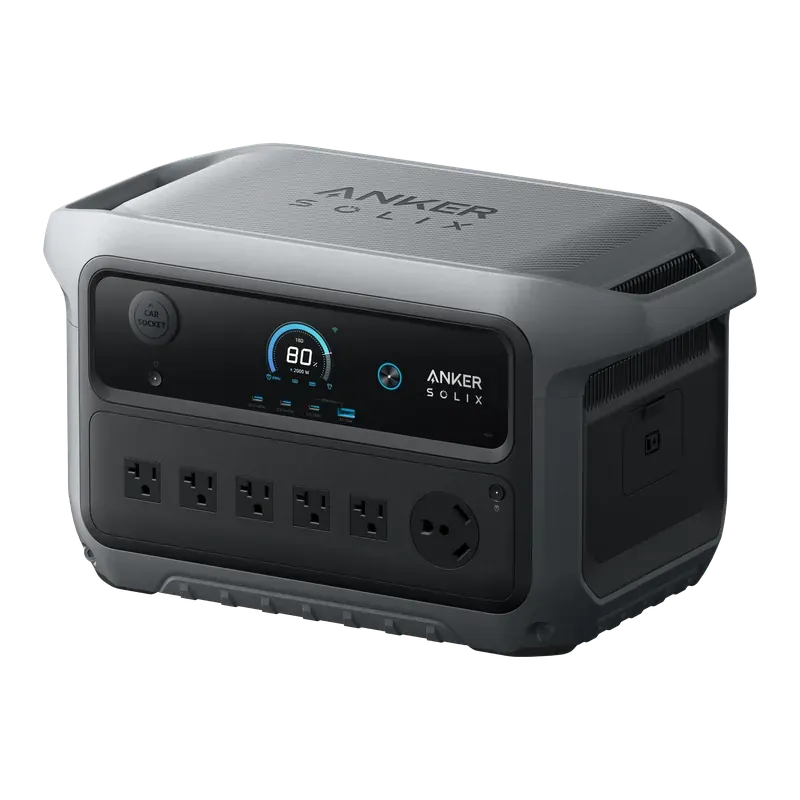
Anker SOLIX C2000 Gen 2
$700–$900 · price checked
- Capacity
- 2,048 Wh
- Output
- 2,400 W (4,000 W surge)
- Battery
- LiFePO4, 4,000 cycles
- Weight
- 41.7 lb
- Wall charge
- 1 h 28 min
- Solar input
- 800 W
Why it won: It balances battery, output and weight better than anything else here. The 2,048 Wh battery runs a queen electric blanket for about 23 hours, which is 2 full nights, or a blanket, fridge and router running together for about 12 hours. Add one BP2000 Gen 2 battery and the blanket alone lasts about 5 nights. It puts out 2,400 W with a 4,000 W surge, takes up to 800 W of solar and refills from the wall in about 1 hour 28 minutes.
Skip it if: At 41.7 lb it is a two-hand carry, which matters if you move it to the bedroom every night. It has only one USB-A port, so plan on USB-C cables for phones.
- 2,400 W output with 4,000 W peak handles most kitchen appliances
- Built-in TT-30 outlet plugs straight into an RV
- Expands to 4,096 Wh with one BP2000 Gen 2 battery
- 10 ms UPS switch-over protects a router or computer
- 41.7 lb, a two-hand carry
- Only one USB-A port
- List price is much higher than typical sale prices, so wait for a sale
We may earn a commission if you buy through these links. It doesn’t change your price. How we make money
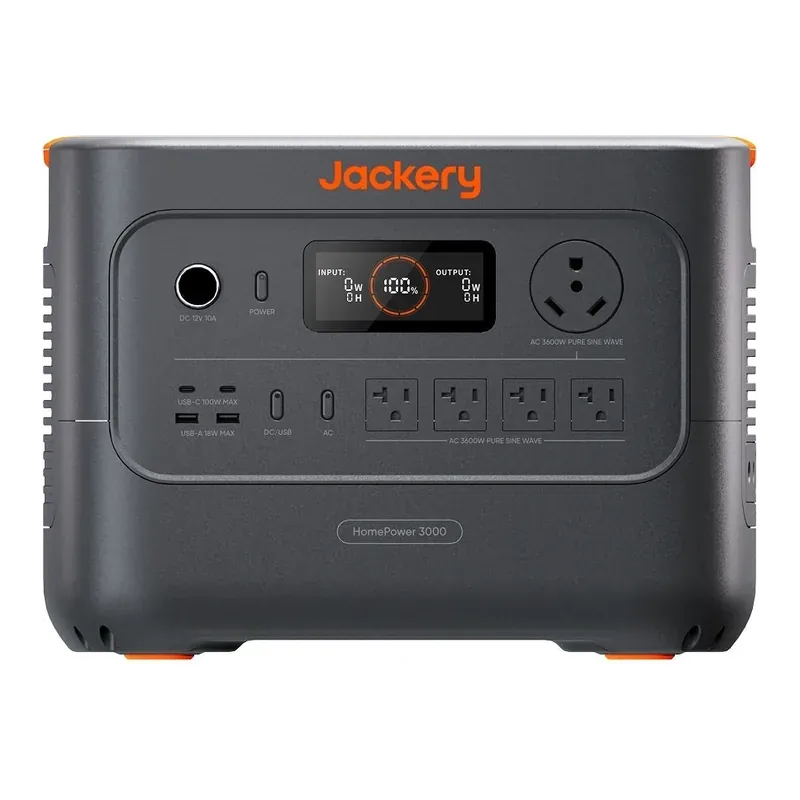
Jackery HomePower 3000
$900–$1,500 · price checked
- Capacity
- 3,072 Wh
- Output
- 3,600 W (7,200 W surge)
- Battery
- LiFePO4, 4,000 cycles (to 70%)
- Weight
- 59.5 lb
- Wall charge
- 2 h 12 min
- Solar input
- 1,000 W
Why it won: With 3,072 Wh, it keeps an electric blanket on for about 35 hours, or 4 nights. A blanket, fridge and router running together last about 18 hours. Its 3,600 W output leaves plenty of room for daytime loads, and it can feed up to six home circuits through a manual transfer switch that an electrician installs. It also takes up to 1,000 W of solar.
Skip it if: It weighs 59.5 lb, has no wheels and cannot add batteries. It usually sells for roughly $900 to $1,500, the widest price swing of these picks, so wait for the low end.
- 3,600 W output with a 30A outlet can run several appliances at once
- Can feed up to six home circuits through a manual transfer switch
- Takes up to 1,000 W of solar for faster off-grid recharging
- Compact and light for its 3,072 Wh capacity at 59.5 lb
- Cannot add extra batteries; the 2000 Plus or 5000 Plus can
- Still heavy to carry up stairs, with no built-in wheels
- Jackery rates cycle life to 70% capacity, not 80%
We may earn a commission if you buy through these links. It doesn’t change your price. How we make money
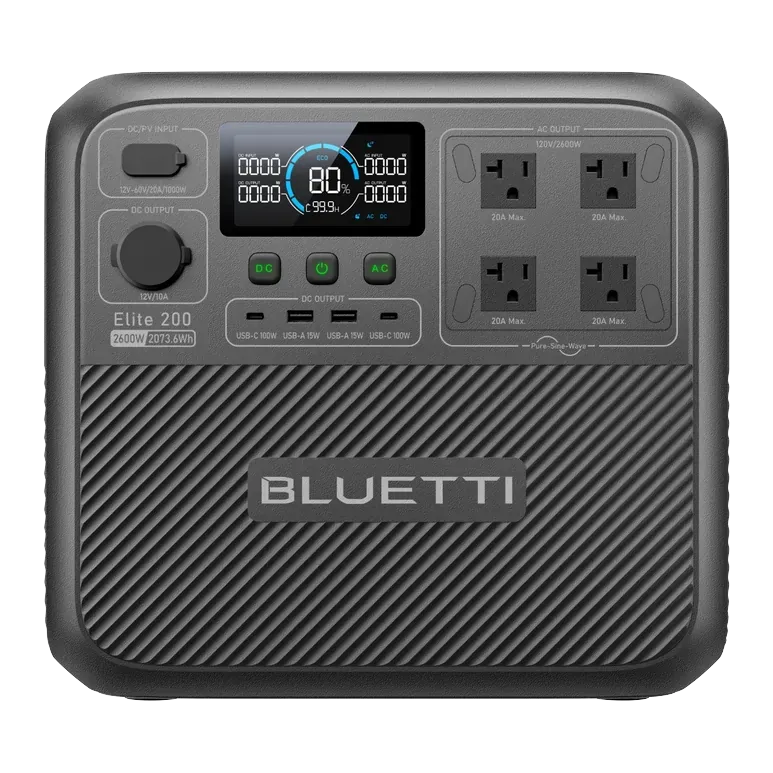
BLUETTI Elite 200 V2
$700–$900 · price checked
- Capacity
- 2,074 Wh
- Output
- 2,600 W (3,900 W surge)
- Battery
- LiFePO4, 6,000 cycles
- Weight
- 53.4 lb
- Wall charge
- 1 h 24 min
- Solar input
- 1,000 W
Why it won: Its 2,074 Wh battery runs an electric blanket for about 24 hours, 2 nights, and a blanket, fridge and router together for about 12 hours. BLUETTI rates it for 6,000 cycles, the most of these picks, which suits a home that loses power several times each winter. It refills from the wall in about 1 hour 24 minutes, so a short break in the outage is enough to top it up. It has 2,600 W of output and a 15 ms UPS switch-over.
Skip it if: It weighs 53.4 lb and cannot add batteries, so 2 blanket nights is its limit without solar or the grid. It also has just one 12V car port.
- 2,600 W output handles space heaters, microwaves and most power tools
- 6,000-cycle battery, about 16 years of daily use
- Full recharge from a wall outlet in about 1.4 hours
- Four wall outlets plus Wi-Fi and Bluetooth app control
- 53.4 lb, a two-hand lift
- Cannot add extra batteries
- Only one 12V car port and no DC barrel jacks
We may earn a commission if you buy through these links. It doesn’t change your price. How we make money
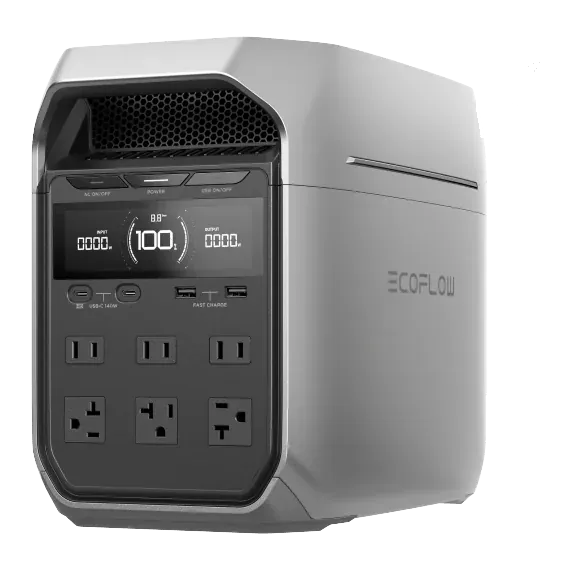
EcoFlow DELTA 3 Plus
$550–$800 · price checked
- Capacity
- 1,024 Wh
- Output
- 1,800 W (3,600 W surge)
- Battery
- LiFePO4, 4,000 cycles
- Weight
- 27.6 lb
- Wall charge
- 56 min
- Solar input
- 1,000 W
Why it won: Out of the box, its 1,024 Wh battery runs an electric blanket for about 12 hours, 1 full night, or a blanket, fridge and router together for about 6 hours. EcoFlow extra batteries take it to 5,000 Wh, which stretches the blanket alone to about 7 nights. It refills from the wall in 56 minutes, takes up to 1,000 W of solar across two inputs and lists a 10 ms UPS switch-over.
Skip it if: On its own it covers one blanket night, not a long weekend. It usually sells for roughly $550 to $800, more than the Elite 100 V2 with the same 1,024 Wh battery.
- Two solar inputs take up to 1,000 W total (500 W each) for fast off-grid refills
- 140 W USB-C ports charge big laptops at full speed
- 10 ms UPS switch-over suits NAS drives, routers and medical devices
- Full recharge from a wall outlet in 56 minutes
- Same 1,024 Wh capacity as the cheaper DELTA 3
- 27.6 lb and roughly the size of a carry-on bag
- The extra cost over the DELTA 3 buys ports and solar, not capacity
We may earn a commission if you buy through these links. It doesn’t change your price. How we make money
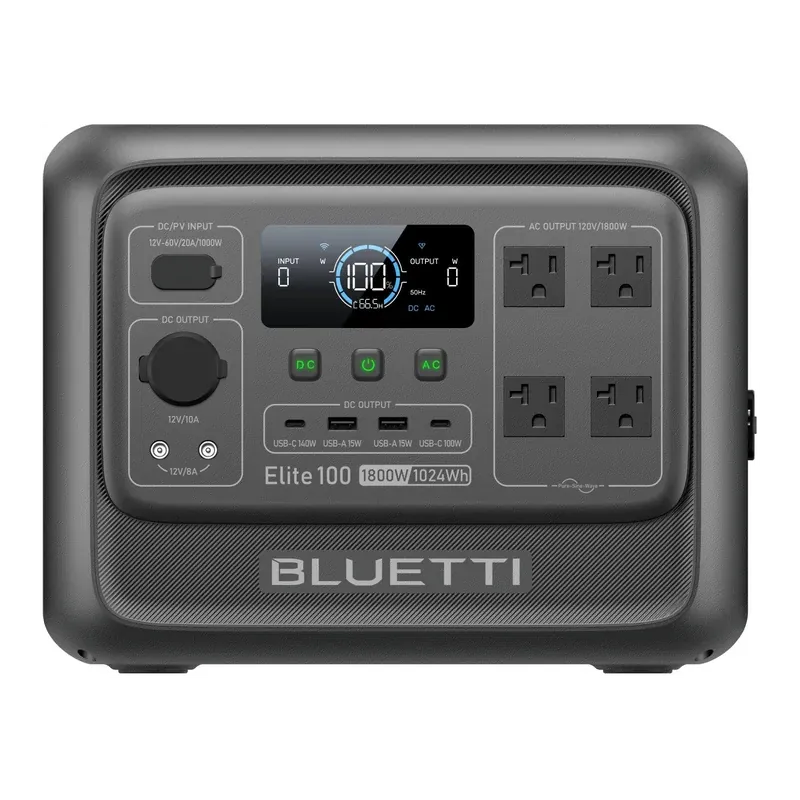
BLUETTI Elite 100 V2
$380–$500 · price checked
- Capacity
- 1,024 Wh
- Output
- 1,800 W (3,600 W surge)
- Battery
- LiFePO4, 4,000 cycles
- Weight
- 25 lb
- Wall charge
- 1 h 10 min
- Solar input
- 1,000 W
Why it won: It gives the same night of blanket heat as the DELTA 3 Plus, about 12 hours, and usually sells for roughly $380 to $500. At 25 lb it is the lightest pick here, easy to carry to a bedroom at night and back to the kitchen in the morning. It has 1,800 W of output, a 10 ms UPS switch-over and a full wall recharge in about 70 minutes.
Skip it if: It cannot add batteries, so it tops out at one blanket night, or about 6 hours of blanket, fridge and router together. If winter outages where you live often last more than a day, choose a 2,000 Wh unit.
- 1,800 W output runs most kitchen appliances one at a time
- Full recharge from a wall outlet in about 70 minutes
- 25 lb, much lighter than the older AC180
- 4,000-cycle battery rated for about 10 years of use
- Cannot add extra batteries
- 1,024 Wh will run a fridge for roughly a day, not several days
- Reaching the full 1,000 W solar input takes several panels
We may earn a commission if you buy through these links. It doesn’t change your price. How we make money
How many nights each pick lasts
At about 75 W on average, an electric blanket runs for about 1 night on the EcoFlow DELTA 3 Plus (1,024 Wh) and about 4 nights on the Jackery HomePower 3000 (3,072 Wh).
| Power station | Electric blanket 150 W running, about 75 W average |
|---|---|
| Anker SOLIX C2000 Gen 2 2,048 Wh | 2 nights (23 hrs) |
| Jackery HomePower 3000 3,072 Wh | 4 nights (35 hrs) |
| BLUETTI Elite 200 V2 2,074 Wh | 2 nights (24 hrs) |
| EcoFlow DELTA 3 Plus 1,024 Wh | 1 night (12 hrs) |
| BLUETTI Elite 100 V2 1,024 Wh | 1 night (12 hrs) |
Estimates: battery Wh × 0.85 ÷ the device’s average draw, with 8 hours of use a night. Real runtime depends on temperature, battery age and how hard the device works.
Other things you might plug in, in hours
On the Jackery HomePower 3000 (3,072 Wh), runtimes go from about 3.5 hrs for a space heater (1500W) to about 12 days for an LED light bulb (9 W), each running by itself.
Swipe sideways to see every device →
| Power station | Full-size refrigerator 150 W running, about 45 W average | Wi-Fi router + cable modem 25 W average | LED light bulb (9 W) 9 W average | Space heater (1500W) 1,500 W running, about 750 W average |
|---|---|---|---|---|
| Anker SOLIX C2000 Gen 2 2,048 Wh | 39 hrs | 3 days | 8 days | 2.5 hrs |
| Jackery HomePower 3000 3,072 Wh | 2 days | 4 days | 12 days | 3.5 hrs |
| BLUETTI Elite 200 V2 2,074 Wh | 39 hrs | 3 days | 8 days | 2.5 hrs |
| EcoFlow DELTA 3 Plus 1,024 Wh | 19 hrs | 35 hrs | 4 days | 1 hr |
| BLUETTI Elite 100 V2 1,024 Wh | 19 hrs | 35 hrs | 4 days | 1 hr |
Estimates: battery Wh × 0.85 ÷ the device’s average draw. Real runtime depends on temperature, battery age and how hard the device works.
Your fridge may use more
The fridge column assumes a newer ENERGY STAR model at 150 W while the compressor runs, or about 45 W on average. A 10- to 15-year-old or side-by-side fridge often averages 70 to 90 W. At 80 W, these picks last about 11 hrs on the EcoFlow DELTA 3 Plus (1,024 Wh) and about 33 hrs on the Jackery HomePower 3000 (3,072 Wh).
To find yours, divide the kWh per year on the yellow EnergyGuide label by 8.76. That gives the average watts. Fridge runtime on every station
Runtime on every station, one device at a time
Specs side by side
Swipe sideways to see every column →
| Spec | Anker SOLIX C2000 Gen 2 | Jackery HomePower 3000 | BLUETTI Elite 200 V2 | EcoFlow DELTA 3 Plus | BLUETTI Elite 100 V2 |
|---|---|---|---|---|---|
| Capacity | 2,048 Wh | 3,072 Wh (better) | 2,073.6 Wh | 1,024 Wh | 1,024 Wh |
| AC output (continuous) | 2,400 W | 3,600 W (better) | 2,600 W | 1,800 W | 1,800 W |
| Surge | 4,000 W | 7,200 W (better) | 3,900 W | 3,600 W | 3,600 W |
| Boost mode (heaters, kettles) | None | None | 3,900 W | 2,200 W | 2,700 W |
| Battery type | LiFePO4 | LiFePO4 | LiFePO4 | LiFePO4 | LiFePO4 |
| Cycle life (rated) | 4,000 (to 80%) | 4,000 (to 70%) | 6,000 (to 80%) | 4,000 (to 80%) | 4,000 (to 80%) |
| Weight | 41.7 lb | 59.5 lb | 53.4 lb | 27.6 lb | 25 lb (better) |
| Wall charge time | 1 h 28 min (0–100% from a wall outlet alone) | 2 h 12 min (0–100% from a wall outlet; faster with solar) | 1 h 24 min (0–100%; 0–80% in about 1.1 h) | 56 min (0–100%; about 80% in 30–40 min) (better) | 1 h 10 min (0–100% with TurboBoost; 80% in 45 min) |
| Max solar input | 800 W | 1,000 W | 1,000 W | 1,000 W | 1,000 W |
| AC outlets | 5 | 5 | 4 | 6 (better) | 4 |
| USB-C ports (max) | 3 (140 W) | 2 (100 W) | 2 (100 W) | 2 (140 W) | 2 (140 W) |
| USB-A ports | 1 | 2 | 2 | 2 | 2 |
| 12V / car port | Yes (1 DC ports) | Yes (1 DC ports) | Yes (1 DC ports) | Yes (3 DC ports) | Yes (3 DC ports) |
| Expandable | Yes, up to 4,096 Wh | No | No | Yes, up to 5,000 Wh | No |
| UPS switch-over | 10 ms | 20 ms | 15 ms | 10 ms | 10 ms |
| App control | Yes | Yes | Yes | Yes | Yes |
| Size | 18.1 x 9.8 x 10.1 in | 16.4 x 12.8 x 12.0 in | 13.78 x 9.84 x 12.74 in | 15.7 x 8.0 x 11.2 in | 12.6 x 8.5 x 9.8 in |
| Released | 2025 | 2025 | 2024 | 2024 | 2025 |
| Typical price | $700–$900 | $900–$1,500 | $700–$900 | $550–$800 | $380–$500 (better) |
Related comparisons
Torn between two of these? Each comparison gives a verdict, specs and runtimes side by side.
How big a power station do I need for a winter outage?
Plan a full day, not one device. One queen electric blanket for an 8-hour night uses about 600 Wh. A full-size fridge averages about 45 W, or about 1,080 Wh a day. A router and modem use about 600 Wh a day, and four LED bulbs for five hours add about 180 Wh.
That is about 2,460 Wh a day at the plugs, or roughly 2,900 Wh of battery after inverter losses. A 1,024 Wh unit covers about 8.5 hours of that day, a 2,048 Wh unit about 17 hours and a 3,072 Wh unit about a full day.
Two sleepers double the blanket share. Two queen blankets average about 150 W, about 1,200 Wh a night. A 2,048 Wh unit runs both for about 12 hours, 1 night, and a 3,072 Wh unit for about 17 hours, 2 nights. If the outage runs longer than that, you need solar panels or a few hours of grid power to refill.
Why not just run a space heater?
A 1,500 W space heater averages about 750 W even with its thermostat cycling, ten times an electric blanket. On high, a 1,024 Wh unit lasts about 35 minutes, a 2,048 Wh unit about 1 hour and a 3,072 Wh unit about 1.5 hours. With the thermostat cycling it half the time, those become about 1, 2.5 and 3.5 hours.
Small stations cannot start one at all. The EcoFlow RIVER 3 Plus and BLUETTI Elite 30 V2 stop at 600 W, the Goal Zero Yeti 500 at 500 W and the Jackery Explorer 300 v2 at 300 W. Boost modes such as EcoFlow X-Boost may run a heater at reduced power, so check the manual, but count it as a no.
A heater on battery makes sense for one thing: a short burst to take the chill off a small room before bed. For the rest of the night, the blanket does the job on a tenth of the power.
Can a power station run my furnace?
We do not have data for gas furnaces or pellet stoves, so we give no wattage for them. Check the label on the unit or its manual for the electrical draw.
Either way, a furnace blower is usually hard-wired, not plugged in. Powering it from a station needs an electrician and a transfer switch or power inlet. Never backfeed the house through a wall outlet with a double-ended cord. It can start a fire and injure line workers.
The Jackery HomePower 3000 is the one pick here built to feed home circuits, up to six through a manual transfer switch. Even then, the electrician decides which circuits it can safely carry.
Cold-weather care for the station
Keep the station inside the warm part of the house, not in a garage or car. Batteries give less in the cold, and most have a lowest safe charging temperature. We do not list those limits, so check the manual before you charge a unit that has been sitting in the cold, and let it warm up indoors first.
Do not wrap the station in blankets to keep it warm. It needs open space around its vents, and it should stay dry, away from melting snow on boots and coats.
Expect less from solar in winter. The sun is lower and the days are shorter, so panels deliver well under their rated input. Brush snow off them and point them toward the low midday sun.
Safety
Never run a gas generator, grill, camp stove or charcoal heater indoors or in a garage for heat. They make carbon monoxide, which you cannot see or smell. Run a generator outdoors, far from windows and doors, and keep a battery-powered carbon monoxide alarm near where people sleep.
Follow your electric blanket's own instructions. Do not fold or bunch it while it is on, and plug it straight into the station rather than through a long extension cord.
How do I stay warmer on less battery?
Pick one room, ideally a small one, and close it off. Hang a blanket over the doorway, close the curtains at night and gather everyone there to sleep.
Warm the bed for a few minutes, then drop the blanket to a low setting. The lower the setting, the more often the controller cycles off. A comforter on top holds the heat in.
Keep the fridge door shut and take out a day of food in one go. In a cold house the compressor should run less, which leaves more battery for the blanket at night.
Common questions
- How long will a power station run an electric blanket in a power outage?
- About 12 hours, 1 night, on a 1,024 Wh unit, about 23 hours, 2 nights, on a 2,048 Wh unit, and about 35 hours, 4 nights, on a 3,072 Wh unit. That assumes a 150 W queen blanket cycling half the time.
- Can a power station heat a room during a winter outage?
- Only briefly. A 1,500 W space heater runs about 35 minutes on high from a 1,024 Wh unit and about 1.5 hours from a 3,072 Wh unit. An electric blanket keeps you warm all night on the same battery.
- Can a power station run a gas furnace?
- We have no wattage data for gas furnaces, so check the furnace label or manual. The blower is usually hard-wired, which means an electrician must install a transfer switch or inlet. Never backfeed through a wall outlet.
- Can I charge a power station in the cold?
- Check the manual first. Most batteries have a lowest safe charging temperature, and we do not list those limits. Bring the unit into a warm room and let it warm up before you plug it in.
- Can one power station run two electric blankets overnight?
- Yes, on a 2,000 Wh unit. Two queen blankets average about 150 W, so a 2,048 Wh station runs both for about 12 hours, 1 night. A 1,024 Wh unit lasts about 6 hours, short of a full night.